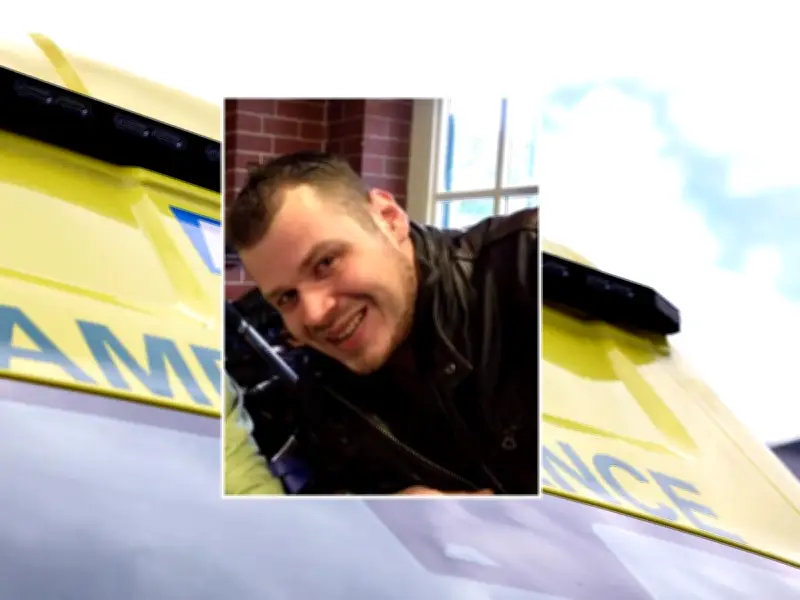
A paramedic who raised concerns over the death of Andrew Watson has told an inquest people "should not be dying of these things in this day and age." Andrew, who died on October 10, 2019, had quinsy, a rare complication of tonsillitis which caused a "tennis ball-sized" swelling in his throat that blocked his airway.
An inquest at Crook Coroners’ Court has previously heard how a "key issue" was that the ambulance response to Andrew’s Langley Moor supported accommodation was "too slow." He first dialed 999 at 5.38pm, but an ambulance did not arrive until around 6.45pm. If an ambulance had reached Andrew within 18 minutes - the target average time for category two ambulance responses - he could have been in hospital quick enough to receive life-saving care.
On Wednesday, Catherine Wilson, a former North East Ambulance Service paramedic who was called to the scene with colleague William Perry, gave evidence. The inquest was told that upon arrival, Andrew was found lying in the front hallway and was "purple in the face."

Ms Wilson said that a support worker told her that Andrew had said he "did not want to go to hospital." Asked if she was sure about that, the witness said "as far as I can recollect" as she took a handwritten note later on. She said at the time of the call-out there was "a lot of organised chaos" but a "huge swelling" was clearly visible and no clothing was obstructing Andrew's throat. She told the inquest that following the call-out, she and Mr Perry spoke about their concerns over delays on the way back to the station, with Mr Perry saying he would "raise it."
Coroner Crispin Oliver asked if the concerns of the paramedics "unsettled" them. Ms Wilson said: "Yes, it's something that is so easily preventable." The coroner asked: "Professionally this didn't sit well with you?" Ms Wilson replied: "No it didn't." The coroner asked if Andrew's death was "preventable." The witness replied: "With antibiotics, tonsillitis should be easily treatable...he should have gone to hospital. In this day and age, people shouldn't be dying of these things."
Around nine days after the death of Andrew, a meeting with the paramedics and senior NEAS staff was held. Ms Wilson - who left NEAS in 2024 - said the meeting was "heated" and explained how she and Mr Perry believed the call-out should have been categorised as "severe harm." She said: "To us this was the most severe harm that could have happened. [We] felt nobody was listening. We were saying 'you can't get more harm than this'...it had the worst possible outcome for the patient."
Andrew’s case is one of several to have been implicated in the alleged "covering-up" of safety investigations by North East Ambulance Service personnel, as disclosed by whistleblowers in 2022. It is only after media coverage of this, which saw NEAS’ then chief executive Helen Ray accept there had been "historical failings," that Andrew’s family became aware of any safety investigation in his case. The inquest continues.