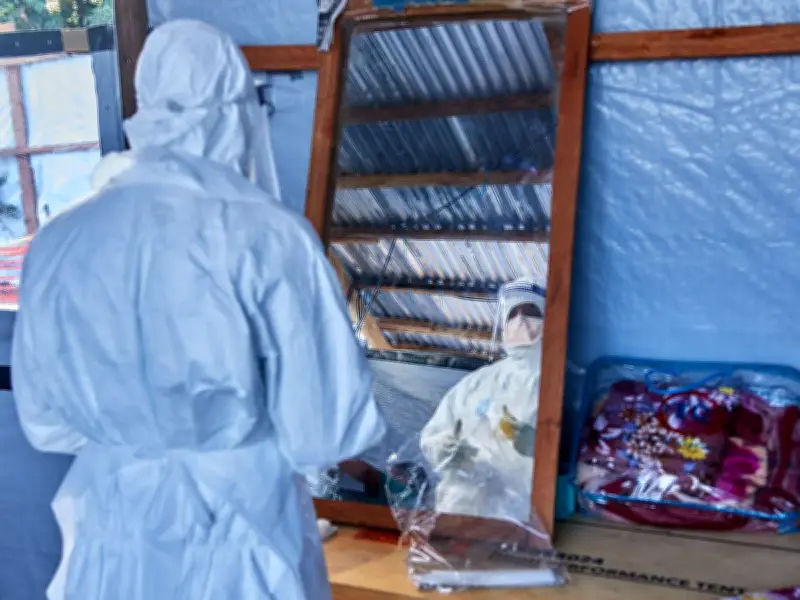
The current Ebola outbreak in Eastern Congo has become the fastest-growing in history, with more than 2,000 confirmed cases and over 750 deaths. The World Health Organization reported that 80% of new cases are linked to unknown chains of transmission, making it significantly harder to isolate cases and slow the spread of the virus.
Strikes by unpaid health workers worsen crisis
Efforts to contain the outbreak have been dealt a blow as unpaid health workers went on strike at two health centres at the heart of the outbreak. Workers at a treatment centre in Ituri province, the epicentre, closed the facility and blocked access on Monday after weeks of dangerous work with little or no pay from the Congolese government. The striking staff included epidemiologists, case investigators, drivers and gravediggers. They later agreed to return on the condition they were paid within 72 hours.
A second strike began at Bunia General Hospital on Wednesday, where workers barricaded the entrance. Any wider walkout across the overstretched and poorly equipped health system could deal another serious blow to containment efforts. Congolese officials said they were in talks to find a solution.
Virus spreads to new areas
Suspected cases have emerged in two more provinces, including around Kisangani, one of the country’s largest cities, raising fresh fears over how far the virus has spread. The outbreak’s origin has yet to be identified. The outbreak is being driven by the Bundibugyo strain of Ebola, for which there are currently no approved vaccines or treatments. Unlike other strains, health officials have fewer tools available to tackle its spread.
The spiralling outbreak has placed further pressure on the region’s already fragile health system. The outbreak has spread through a region already grappling with limited infrastructure, armed conflict and false claims that Ebola was not real.
Research into potential treatments begins
Researchers have started studying two potential Ebola treatments and began enrolling participants. One is Gilead Sciences’ remdesivir, an antiviral approved to treat Covid-19 that has shown encouraging signs in laboratory testing. The other is Mapp Biopharmaceutical’s experimental MBP134, which uses antibodies engineered to target several Ebola viruses, including Bundibugyo.
The WHO said patients would be randomly assigned to receive today’s best standard of care alongside remdesivir, MBP134, both drugs or neither. However, the UN body warned it could take months, and as many as 1,000 participants, before researchers knew whether either treatment worked. The study is currently being offered at just one Ebola treatment centre in Ituri province, although officials hope to expand it to other locations once it is safe to do so.
Restrictions on funeral practices
Authorities have restricted traditional funeral practices, including washing and preparing the bodies of loved ones, because the virus can continue to spread after death. The measures have angered some local communities. Ebola can spread from infected wild animals to humans, before passing between people through direct contact with infected bodily fluids, including blood, vomit and semen. It can also spread through contaminated clothing, bedding and other materials. The deadly disease typically causes fever, vomiting, diarrhoea and severe muscle pain, and in some cases internal and external bleeding.