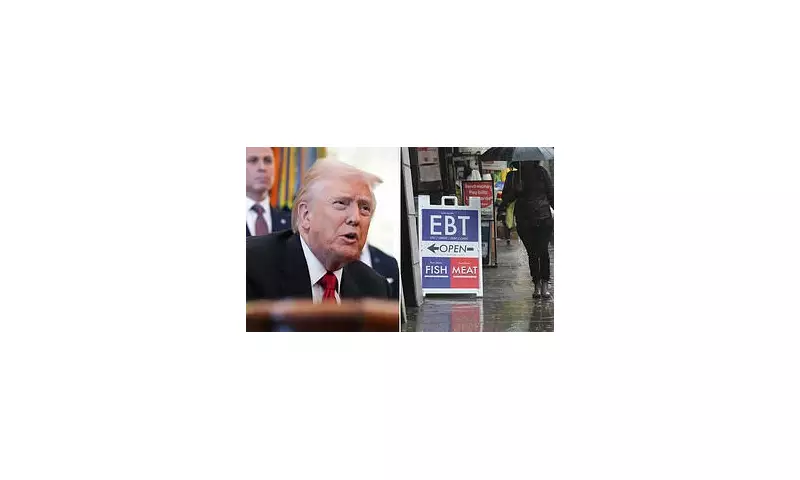
The Trump administration has launched an emergency appeal to the US Supreme Court in a dramatic attempt to halt full SNAP food benefit payments, following a lower court's ruling that required the White House to fund the programme during the ongoing government shutdown.
Legal Battle Over Food Assistance
This legal confrontation erupted after an appeals court affirmed an order compelling the Republican administration to make full payments through the Supplemental Nutrition Assistance Program by Friday. The administration had initially planned to distribute only partial payments for November, covering approximately 65% of the maximum benefit, which could have left some vulnerable recipients with nothing this month.
US District Judge John J. McConnell Jr. had ordered the full payments on Thursday, giving the administration until Friday to comply. However, the Trump administration quickly asked the appeals court to suspend this requirement, arguing it would force them to spend more money than available in contingency funds.
States Rush to Distribute Benefits
Despite the legal uncertainty, several states moved rapidly to issue full November benefits to SNAP recipients. In Wisconsin, more than $104 million of monthly food benefits became available at midnight on electronic cards for approximately 337,000 households, according to a spokesperson for Democratic Governor Tony Evers.
Oregon Governor Tina Kotek, also a Democrat, revealed that state employees "worked through the night" to ensure every Oregon family relying on SNAP could buy groceries by Friday. Hawaii officials had prepared November's payment information in advance, enabling immediate processing after Thursday's court order.
Joseph Campos II, deputy director of Hawaii's Department of Human Services, told The Associated Press: "We moved with haste once we verified everything," acknowledging concerns that a higher court might potentially pause the payments.
Administration's Legal Argument
In court filings, the Trump administration criticised the fast-acting states, accusing them of "trying to seize what they could of the agency's finite set of remaining funds, before any appeal could even be filed, and to the detriment of other States' allotments."
Solicitor General D. John Sauer warned the Supreme Court that "once those billions are out the door, there is no ready mechanism for the government to recover those funds." The administration contended that the judge had usurped both legislative and executive authority, calling the injunction "unprecedented" and claiming it "makes a mockery of the separation of powers."
The administration maintained that Congress should appropriate additional funds for the programme and that remaining money was needed to support other child hunger programmes.
Nationwide Impact and Response
The SNAP programme serves about 1 in 8 Americans, predominantly those with lower incomes. Maximum monthly benefits approach $300 for individuals and nearly $1,000 for a family of four, though many receive less based on income calculations.
States responded differently to the developing situation:
- California, Washington state, Kansas, New Jersey and Pennsylvania issued full benefits on Friday
- Colorado and Massachusetts expected full payments by Saturday
- New York anticipated benefits by Sunday
- Arizona and Connecticut projected accessibility within days
- North Carolina, Illinois, Kentucky, Louisiana and North Dakota distributed partial payments
Delaware took unique action, with Democratic Governor Matt Meyer announcing the state would use its own funds to provide the first of potential weekly relief payments to SNAP recipients.
The court wrangling has prolonged weeks of uncertainty for lower-income Americans, many of whom depend on these benefits for basic nutrition. The programme typically costs between $8.5 billion and $9 billion monthly, with judges ordering the government to use an emergency reserve fund containing more than $4.6 billion to cover November's payments.