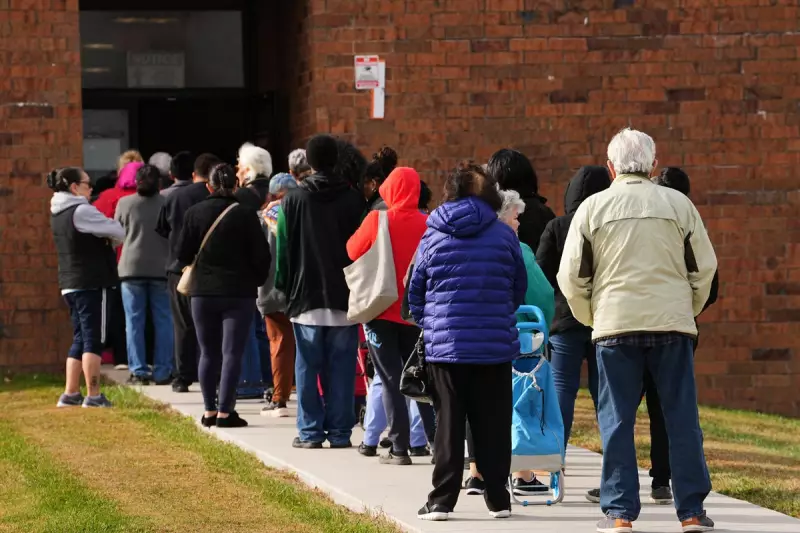
Court Mandate Secures Vital Food Aid for Millions
A federal appeals court has maintained a ruling that compels President Donald Trump's administration to distribute full SNAP food benefits for November, despite an ongoing US government shutdown. The judicial order gave the Republican-led administration a deadline of Friday, 7th November 2025, to process the complete payments through the Supplemental Nutrition Assistance Program.
The administration had petitioned the court to suspend directives requiring expenditure beyond the available contingency fund, arguing instead for the continuation of previously planned partial payments for the month. This legal challenge unfolded even as the U.S. Department of Agriculture informed states via a memo that it was working to release funds for the full monthly SNAP allowance.
States Scramble to Distribute Full Benefits
Officials in numerous states confirmed that full November payments began issuing to recipients on Friday. California's Democratic Governor, Gavin Newsom, announced that food benefits were restarting for families in the state. In Wisconsin, a spokesperson for Democratic Governor Tony Evers confirmed that over $104 million in benefits became available for approximately 337,000 households.
The state achieved this rapid distribution by instructing its electronic benefit card vendor to process payments immediately following a court order issued on Thursday. Oregon's Democratic Governor, Tina Kotek, praised state employees who 'worked through the night' to ensure every family relying on SNAP could purchase groceries by Friday.
Authorities in Kansas, New Jersey, and Pennsylvania also reported swiftly issuing full SNAP benefits. Other states anticipated completing distributions over the weekend or early the following week, while some awaited further guidance from the federal government.
Uncertainty and Relief for SNAP Recipients
The prolonged legal dispute has created significant anxiety for many of the 1 in 8 Americans who depend on the programme, predominantly those with lower incomes. Maximum monthly benefits can reach nearly $300 for an individual and $1,000 for a family of four, though actual amounts are often lower based on an income-based formula.
The human impact was palpable. Jasmen Youngbey, a single mother and college student from Newark, New Jersey, described her reliance on SNAP to feed her two young sons. After finding her account balance at zero, she expressed the widespread struggle: 'Not everybody has cash to pull out... especially with the cost of food right now.' She later confirmed receiving her benefits on Friday.
Similarly, Tihinna Franklin, a school bus guard, was down to three items in her freezer and a SNAP balance of just nine cents. She depends on her roughly $290 monthly allowance to help feed her grandchildren. 'If I don't get it, I won't be eating,' she stated. 'My money I get paid for, that goes to the bills, rent, electricity, personal items. That is not fair to us as mothers and caregivers.' Franklin also reported receiving at least a portion of her benefits later that day.
The Legal Battle Over Emergency Funds
The controversy stems from the Trump administration's initial announcement that SNAP benefits would be unavailable in November due to the federal shutdown. This was challenged successfully in court last week, with U.S. District Judge John J. McConnell Jr. specifically ordering the full payments on Thursday.
The judicial rulings instructed the government to utilise an emergency reserve fund containing over $4.6 billion to cover November's SNAP costs, which total between $8.5 billion and $9 billion monthly. The administration was given flexibility to tap other sources to make the full payments.
However, on Monday, the administration refused to use additional money, asserting that Congress must appropriate programme funds and that remaining reserves were needed for other child hunger initiatives. Thursday's federal court order explicitly rejected the administration's alternative plan to cover only 65% of the maximum benefit, which would have left some recipients with nothing.
In its Friday filing, the Trump administration, through the U.S. Department of Justice, contended that the injunction violated the U.S. Constitution's separation of powers, stating: 'This unprecedented injunction makes a mockery of the separation of powers. Courts hold neither the power to appropriate nor the power to spend.'
In rebuttal, attorneys for the cities and non-profits suing the administration argued that sufficient funds were available and the court should not permit further delays to 'vital food assistance.'
Amid the federal deadlock, some states took independent action. Delaware's Democratic Governor, Matt Meyer, announced the state was using its own funds to provide the first of potential weekly relief payments to SNAP recipients.