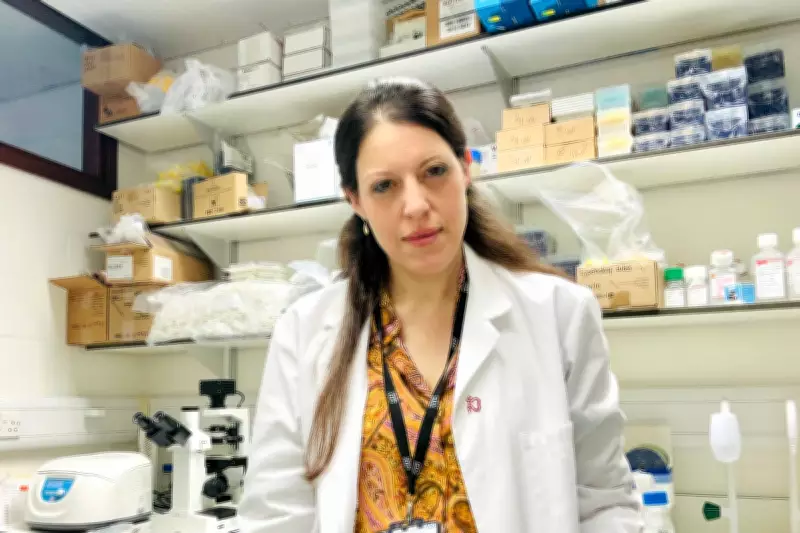
Angeliki Asimaki, a 45-year-old cardiac specialist based in London, has revealed how being born with two congenital heart defects led to her heart stopping for up to 14 seconds at a time and caused a devastating stroke at the age of 26. Over three decades, she has endured nine major medical interventions, including open-heart surgery after doctors discovered a "gaping hole" in her heart.
A Life Transformed by Heart Defects
Ms Asimaki explains that her condition means she cannot run for a bus or walk up multiple flights of stairs. However, she insists these challenges have "definitely" become the foundation for her life's devotion to pioneering heart research. Through her British Heart Foundation-funded work at City St George's, University of London, she has developed a revolutionary cheek swab capable of diagnosing and monitoring arrhythmogenic cardiomyopathy (ACM), a condition associated with high risk of sudden cardiac death.
Symptoms Beginning in Teenage Years
Born and raised in Athens, Greece, Ms Asimaki first experienced symptoms at age 15. These began as dizziness and light-headedness, escalating over several months to fainting up to six times daily. With no family history of heart disease, she underwent extensive tests for brain, blood sugar, and thyroid issues before doctors made a startling discovery.

Medical professionals determined that her heart would stop for up to 14 seconds whenever her heart rate exceeded 120 beats per minute. At 15, she was diagnosed with an intermittent complete AV block, meaning "no electricity was flowing from the upper to the lower chambers" of her heart, necessitating immediate pacemaker implantation.
The Emotional Impact of Diagnosis
"When I was first diagnosed I thought that my life was over," Ms Asimaki told PA Real Life. "I was so scared and angry. I was fainting so frequently during the day that I had reached the point that I couldn't leave my bedroom and go to the bathroom without having to ask a parent to accompany me, just in case I fell in the corridor."
Within six months of her symptoms appearing, Ms Asimaki had a pacemaker fitted. "When you are a teenager and you are told that the only way to stay alive is if you have a machine helping your heart beat, you feel like your wings are being cut off," she explained. "At this age, people feel like they are invincible, and then all of a sudden, my heart needs a device in order to work. So I was very angry."
Medical Challenges and Stroke at 26
Her life changed instantly, as pacemakers in the 1990s were susceptible to magnetic fields. This meant she could not use microwaves or be in confined spaces like taxis with anyone using a mobile phone. At 21, her pacemaker battery ran out, requiring replacement - a procedure that has occurred four more times since, with her most recent MRI-compatible battery fitted two years ago at St George's Hospital in London.
However, Ms Asimaki's heart problems continued. At 21, a combination of pulmonary embolism and pneumonia led to a "long hospital stay" and blood-thinning medication. Then, at 26, she suddenly noticed an inability to focus her right eye while reading on a flight from Boston to Athens.
Initially dismissing it as her "contact lenses were not working," within 24 hours, the entire right side of her body became weak. Rushed to hospital, doctors informed her she was experiencing a haemorrhagic stroke, caused by a ruptured blood vessel in the brain, and she was treated with high doses of steroids for brain inflammation.
Discovering the Root Cause
It was not until she was 29, during a seven-hour surgery to replace pacemaker leads that were draining batteries too quickly, that she finally understood the root cause of her ongoing issues. "When I woke up from that surgery, the surgeon looked worse than me," Ms Asimaki recalled. "He came to tell me that the leads of the pacemaker were in a horrible condition and that he had replaced them."

She continued: "But then he said: 'Angeliki, you have a hole in your heart!' And I started laughing. I mean, I was coming out of anaesthesia, but I thought he was cracking a joke. I said: 'What are you talking about? There's no hole in my heart. They've been checking my heart for 10 years now.' He said: 'No, there's a gaping hole in your heart, so we need to discuss this once you've recovered from surgery.' It was surreal."
Medical Interventions and Recovery
After six months for "the new pacemaker leads to settle," Ms Asimaki underwent open-heart surgery to "physically stitch up the hole," commending the surgeon for his "incredible work." In total, she has had:
- Five pacemaker interventions
- Three ablations (catheter-based procedures for heart rhythm problems)
- One open-heart surgery
This amounts to nine procedures in all.
"Looking back, I think it would have been better if I had gotten both diagnoses at the same time," she reflected. "Because it felt like I was only just coming to terms with one of my problems and then all of a sudden you are dumping a second problem on me. I felt angry with the doctors that were looking after me in Greece. I felt like they could have picked up on this a little earlier and saved me a lot of grief."
Turning Personal Experience into Professional Mission
Despite these challenges, Ms Asimaki's subsequent career as a leading expert in sudden cardiac death was a "no brainer" because she "really wanted to help people that had similar problems" to her own. After high school, she moved to London for university, completed a PhD in cardiomyopathies at Middlesex Hospital, and interned at Harvard University in Boston, where she became a faculty member, spending 11 years in the United States.
Since returning to London in 2017 at age 36, Ms Asimaki has developed a method for diagnosing and monitoring arrhythmogenic cardiomyopathy (ACM) using an at-home cheek swab to examine protein localisations, offering a safer alternative to dangerous heart biopsies.
"I'm not going to rest until I expand it to other diseases, but I can't tell you much more about that because it's not published yet. But we are getting there," she stated with determination.
Personal Health Informing Professional Empathy
On how her personal health influences her professional life, Ms Asimaki said: "It is definitely the reason that I am very empathetic when I meet patients. I truly understand where they're coming from, their fears and anxieties, and when they are nervous about the future. It is very easy for me to say: 'I live on a device too and I'm doing well.'"
Family Life and Looking Forward
In her personal life, Ms Asimaki is a mother to two healthy children, Michail (born 2018) and Helena (born 2021). Both were "high-risk pregnancies" due to her congenital heart conditions, but were closely monitored by "massive multidisciplinary teams" who began imaging their hearts in utero.
She concluded: "Looking back all these years, I could never have imagined how my life would turn out. So the major reason that I'm sharing my story is to give people hope. Let's face it, I'm never going to be cured. I'm always going to be managed. But I want people to see that there are ways that you can turn out all right."
Angeliki is currently walking a total of 28 miles throughout February to raise money for the British Heart Foundation, demonstrating her ongoing commitment to cardiovascular research and patient support.