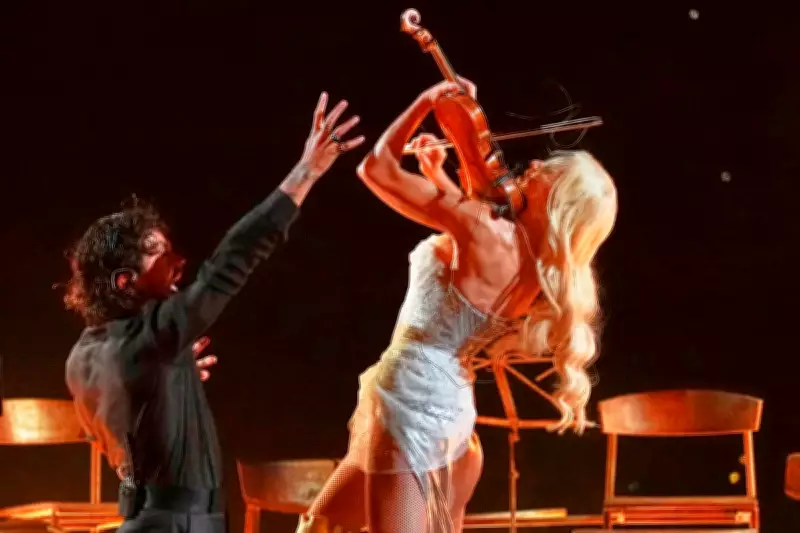
At the Eurovision Song Contest, performers get just three minutes to make a lasting impression. Grabbing viewers' attention among 25 acts competing in Saturday's grand final in Vienna requires pulling out all the stops, both musically and visually.
For this year's favorites to win, the Finnish duo of pop singer Pete Parkkonen and classical violinist Linda Lampenius, that involves jets of flame, a valuable 18th-century violin, and a team of 'ninjas' working to avert disaster. Their song 'Liekinheitin,' or 'Flamethrower,' blends pop and classical influences with spectacular staging, making it a hit with fans and betting markets alike.
Permission to Play
Parkkonen and Lampenius dub their sound 'new pop with a classical touch.' Their song of burning love is an explosion of energy, with Parkkonen's passionate vocals counterpointing Lampenius' frenetic fiddling. The Finnish delegation had to secure special permission for Lampenius to play live. Eurovision rules state that lead vocals must be performed live, but instruments are usually prerecorded to speed up changeovers between songs.

Lampenius explains that 'Flamethrower' was 'written as a duet,' requiring both performers to be live for it to work. 'It's a woman and a man, it's a female voice and a male voice. So I do all my lyrics through my violin, by playing, and you (Parkkonen) are singing it with words. But we are talking. We are (equally) as important, both of us.'
The pair were not certain upon arriving in Vienna that organizers would allow the request. They received final approval only after performing live in front of an audience during a rehearsal. The European Broadcasting Union, which runs Eurovision, stated that contest rules allow 'live audio capture of instruments may exceptionally be permitted where artistically justified.'
Lampenius brought two violins just in case: a treasured Gagliano made in 1781 for live performance to 'sound perfect,' and a cheaper instrument to use if she had to rely on playback, removing any risk to the valuable Gagliano from the slightly hazardous staging.
Practice Makes Perfect
Lampenius and Parkkonen have been rehearsing since November. They won Finland's national selection contest for Eurovision in February and have performed the song hundreds of times. Getting it right is crucial. The performance builds to a climax with jets of flame spurting from a stage where Lampenius, fanned by a leaf blower and wearing a flowing dress, plays her precious violin.
Lampenius concedes it's 'a bit scary when you think of it.' But she feels secure knowing that black-clad stagehands, who call themselves 'ninjas,' are on hand to keep her dress away from the flames—an essential piece of the performance unseen by viewers at home. 'They're running with me—first one guy carrying my dress when I'm running, then the other one catching me during my run,' she says. 'And he helps me also when I jump up on the stage and do the pirouette.'
For the striking final pose, in which Lampenius perches atop chairs in high heels with violin aloft, Parkkonen combines singing with his role as a security spotter, ready to catch her if she topples over. 'That's my work,' the singer says.