

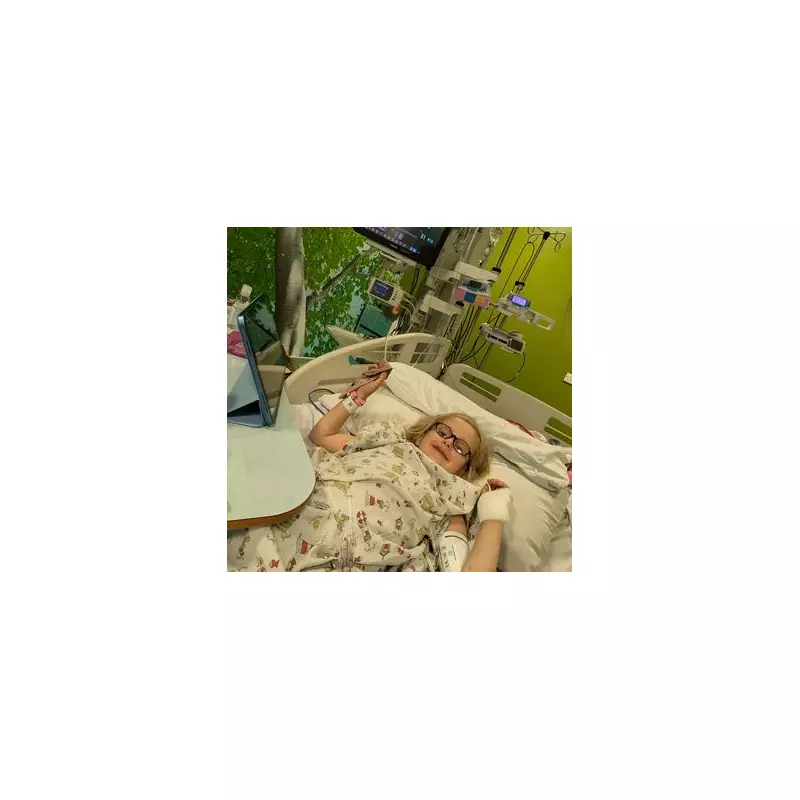
A mother who initially believed her daughter had a simple leg injury has revealed the devastating reality of a diagnosis that brought her family to the brink of a life-or-death decision.
From a Limp to a Life-Threatening Diagnosis
Kate and Pete Hill, from near Bristol, grew concerned about their daughter Sofia in 2024 when the then six-year-old began struggling to walk, frequently stumbling and dragging her leg. Assuming a minor injury, they took her to hospital in June 2024 for checks.
Doctors delivered a shocking verdict. Instead of a sprain or strain, Sofia was diagnosed with an extremely rare spinal arteriovenous malformation (AVM) – a dangerous tangle of abnormal blood vessels on her spinal cord. They were told to rush her to hospital immediately.

"We had the scan at about four o’clock on a Monday in July 2024," recalled 43-year-old Kate. "We came back from London, went to bed, and then woke up at about 7am to a very urgent phone call." The doctor revealed a "huge mass" on Sofia's spine, prompting an immediate dash to Bristol Children’s Hospital.
The Agonising Choice and Its Consequences
Further investigation led to a diagnosis of hereditary haemorrhagic telangiectasia (HHT), also known as Osler-Weber-Rendu syndrome. This inherited disorder causes multiple AVMs to form. Doctors found at least ten in Sofia's lungs and the critical one on her spine, which they described as exceptionally rare in a child so young.
Faced with an urgent need for surgery, Kate and Pete were presented with a harrowing consent form. "They said quite clearly: The risks are this operation is going to paralyse your daughter," Kate said. "But the alternative was she was going to die if we didn’t do the surgery. So it wasn’t kind of a decision."
In July 2024, Sofia underwent two marathon 15-hour surgeries. While the procedures successfully removed the life-threatening AVM, they resulted in an incomplete spinal cord injury, paralysing her from the waist down. "She woke up and she just couldn’t move or feel anything," her mother said.
The Long Road of Rehabilitation
Sofia remained in Bristol Children’s Hospital until February 2025, losing the use of her legs as well as bladder and bowel function. Her recovery has involved intensive, year-long physiotherapy and rehabilitation, including time at a specialist spinal injuries unit in Buckinghamshire.
A key part of her ongoing care is provided by Neurokinex, a not-for-profit offering activity-based rehab for spinal cord injuries. "It’s just brilliant," Kate said. "They try and make it fun, which for Sofia is the main thing."
The family is funding this vital therapy themselves. "It’s not cheap at all," Kate admitted, "but you just have to think: I’ve just got to do what I can... I don’t want to look back and think we could have done more for her."
The determined six-year-old's progress offers a beacon of hope. She can now take steps using crutches, with the next goal being to walk with poles. The condition will require lifelong monitoring for new or growing AVMs.
After celebrating their first Christmas at home since the diagnosis, the family holds onto small victories. Kate recalled her son's heartfelt wish from the previous year: "Dear Santa, please, please make my sister walk again." Now, she can tell him, "Look, she’s walking on her crutches, isn’t she? So we’ll get there."






