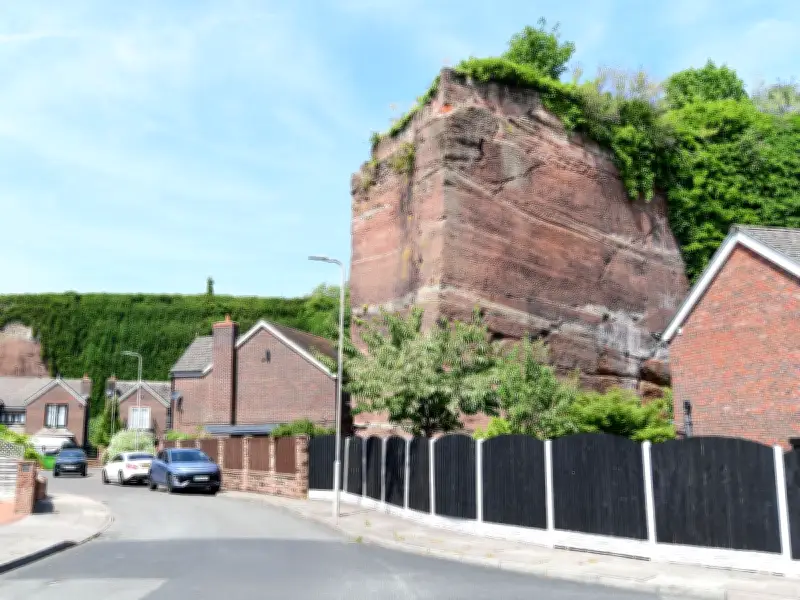
The remnants of Woolton Quarry, now a cliff face overlooking a residential street in Woolton, Liverpool, played a crucial role in constructing some of the city's most remarkable landmarks. Local historian and author Ken Pye told the ECHO: "The quarries themselves developed in the mid-19th century and were quite significant. It was used to build the Anglican Cathedral, but it wasn't just the cathedral that was built using the stone; bits of Speke Hall, All Hallows Church, Gateacre Grange and Beaconsfield House also have pieces of the quarry."
Three Quarries in Woolton
Pye explained that there were actually three quarries, with the north and south quarries being the main ones. These produced sandstone specifically for the Anglican Cathedral. "This is why it was perfect for a building as significant, and as large, and as weighty as the cathedral," he said. In 1903, British architect Giles Gilbert Scott began designing the cathedral, and construction started a year later. The work was finally completed over 70 years later.
Transporting the Stone
When building started on the cathedral, the stone was transported from Woolton by horse-drawn wagons. "Teams of four, six, or sometimes eight horses were used because of the absolute weight of the stone," Pye said. Some carving was done at the quarry site, but most was done on-site at St. James's Mount. Today, a residue of stonemasons still works at the back of the cathedral for maintenance.
Later Uses and Closure
By the 1960s, sandstone extraction had largely scaled down, and new uses were found for the quarry. "Sections of the old quarry were already being leased as a coal yard and a corporation maintenance yard. It was also used as a timber and scaffolding merchants, and parts were let out to a haulage company. But the rear of the big quarry was used as a dump for old and used vehicle tyres," Pye said.
Childhood Memories
As a child, Pye lived nearby in Wavertree and later in Childwall. The quarry became a playground for him and his friends during the 1960s. "I used to play in there as a kid, and I can remember it. The tyres were old and not looked after, and just sort of piled in great stacks. Me and my mates would go on Saturday mornings, and we would play around and chase and tag and all sorts of things in and around the tyres, and we would be filthy. So then we would go into Woolton swimming baths, and it is a wonder we were actually allowed in, we were so filthy. But they would allow us in, and we would go swimming to get clean and have fun in the water at the same time."
Redevelopment into Housing
The quarry officially closed in 1978, with only a small workforce retained until Easter 1979. It was then used as a refuse tip until 1983. In 1986, work began on 22 bungalows and a block of 18 flats named Stonemasons Court, facing directly onto Quarry Street. Pye noted that had it not been for World War II, Liverpool would likely have even more sandstone buildings. "We were the most heavily bombed city in Britain outside London. In the sheer tonnage of high explosive and incendiary bombs that the Germans dropped on us, it destroyed the city centre. So, a lot of the wonderful buildings that were built from the stone from Woolton Quarry were just destroyed."