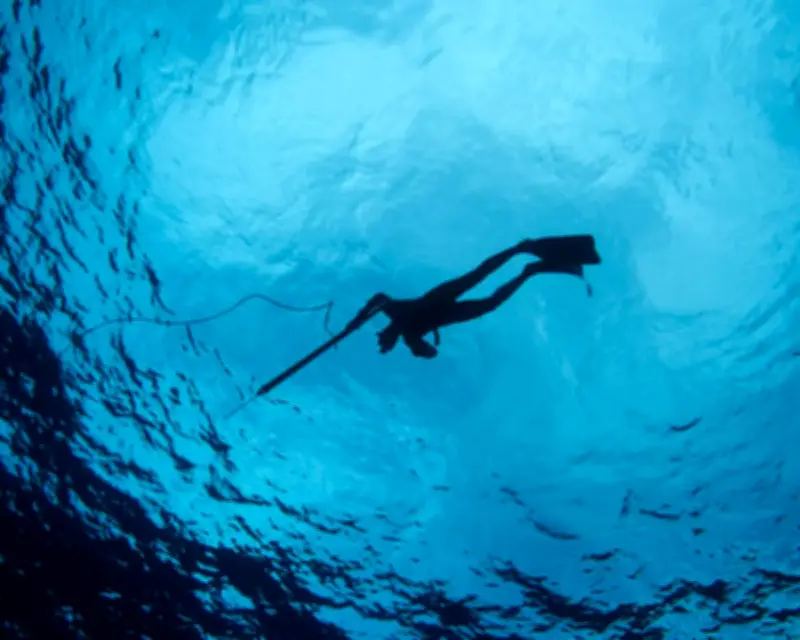
Clarke Gayford, the Emmy-winning New Zealand TV host and avid spearfisher, has observed a notable increase in shark encounters during his decades of ocean activity. In a personal account, he reflects on his first face-to-face meeting with a great white shark and the shifting dynamics underwater, noting that sharks are appearing more frequently both in Australia and New Zealand.
First Encounter with a Great White
Gayford describes the moment he came face to face with a great white shark as a humbling experience. 'One look into those eyes darker than a planet-sucking black hole really does humble you,' he writes. He recalls the shark's gnarled face, scarred from a recent struggle with a seal, and its massive white stomach that gave it a 'dump-truck' girth unlike any other shark he had encountered. This encounter pushed him 'way back down the underwater pecking order,' a mental shift that still lingers.
Spearfishing and Shark Territory
For Gayford, spearfishing is a low-impact pursuit that offers a unique escape. 'With zero bycatch, spearfishing or “spare-fishing” is an extremely selective, low-impact pursuit that for me has never been about the catch but about the entirety of the wild experience possible anytime you pull on a wetsuit,' he explains. He emphasises that dealing with sharks is part of the territory, especially as divers develop skills and explore deeper waters. 'It turns out that sharks like those places too,' he adds, noting that encounters with bronze whalers, bull sharks, silvertips, sevengillers, and aggressive makos have become routine.
Increasing Shark Numbers
Gayford states that he has 'never encountered more sharks than now,' both in Australia and New Zealand. He has stopped spearfishing in some areas because the sound of a speargun attracts sharks, sometimes in groups of three or more. 'Any speared fish is likely to trigger quite the underwater party,' he says, prompting him to move to different spots.
Cultural Attitudes Towards Sharks
Gayford highlights differences in attitudes towards sharks between New Zealanders and Australians. 'There is a belief in New Zealand that “Aussie fishos” love catching sharks, while “Kiwi fushos” frown upon it,' he writes. He references a popular New Zealand fishing TV show that dressed a character as an Australian to catch a tiger shark, calling it 'outrageous.' He also notes Australia's historical ambivalence, pointing to the disappearance of Prime Minister Harold Holt at sea and angler Zane Grey's comment that 'every shark captured a potential life saved.'
Living with Sharks in a New Normal
Gayford suggests that shark numbers may be returning to a baseline that humans have not experienced in decades. 'It’s entirely possible that numbers are returning to a normal that none of us have experienced,' he writes. He connects the increase in great white sharks to the recovery of humpback whale populations off eastern Australia, which have surged past pre-whaling levels to an estimated 60,000 cetaceans. 'When you understand that a humpback calf is born at 1.5 tonnes of pure protein with a one-in-five mortality rate, this collective movement makes so much more sense,' he explains, noting that great whites tagged off Stewart Island, New Zealand, migrate to Australia's east coast annually.
Rational Debate Needed
Gayford laments the polarised debate around sharks, with some portraying them as 'big misunderstood puppy dogs' and others celebrating their capture. 'These extremes make rational conversations in the grey middle area increasingly difficult,' he says. He calls for better science, technology, and surveying to help people adapt to the new normal, as shark bites and sightings increase, especially around Sydney beaches. 'With no obvious answers, better science, technology and surveying is going to play an essential role in finding our way in this new normal,' he concludes.