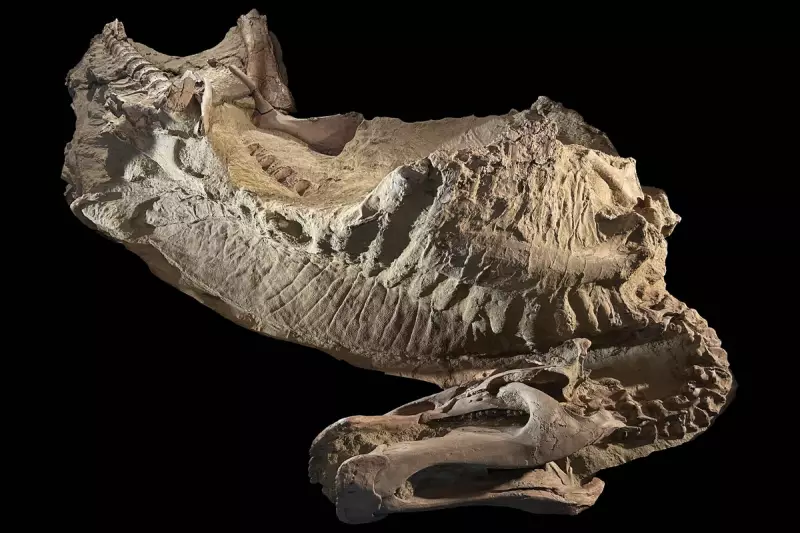
In an extraordinary breakthrough that has sent shockwaves through the scientific community, researchers have unveiled one of the most complete dinosaur skeletons ever discovered—a magnificent 67-million-year-old hadrosaur so impeccably preserved that much of its skin and tendons remain fossilised intact.
The Discovery That Defied Time
The remarkable specimen, an Edmontosaurus measuring approximately seven metres in length, was excavated from the Hell Creek Formation in northwestern Wyoming. What makes this find particularly exceptional isn't just the near-complete skeleton, but the extensive areas of mineralised skin that have survived the millennia, offering an unprecedented window into the ancient past.
"This isn't just another dinosaur fossil—this is a mummy," declared Dr. Tyler Lyson of the Denver Museum of Nature & Science, the paleontologist leading the research. "The level of preservation is so remarkable that we can see the intricate patterns of scales across its body, something we rarely get to observe."

Scientific Significance Beyond Imagination
Unlike typical fossil discoveries where only bones remain, this Edmontosaurus presents researchers with fossilised skin, tendons, and possibly even internal organs. The preservation occurred through a rare process where the carcass was rapidly buried in fine-grained sediment, creating conditions that prevented decomposition and scavenging.
The discovery challenges previous assumptions about how dinosaur remains fossilise and provides crucial evidence about the hadrosaur's physical characteristics, including:
- Detailed skin texture and scale patterns
- Evidence of muscular structure and tendon attachments
- Potential insights into fat deposits and body shape
- Clues about the animal's posture and movement
A Journey to Chicago's Field Museum
After meticulous excavation and preparation, the dinosaur now resides at the Field Museum in Chicago, where it will undergo extensive study. Researchers worldwide are eager to examine the specimen, which promises to rewrite textbooks on dinosaur anatomy and preservation.
"We're looking at a dinosaur in a way that very few people in human history have ever seen one," commented Dr. Lyson. "This isn't just bones—this is as close to seeing the living animal as we're ever likely to get."
The research team continues to analyse the specimen, with future studies planned to investigate the chemical composition of the preserved tissues and what they might reveal about the dinosaur's biology and the environment it inhabited during the final days of the Cretaceous period.