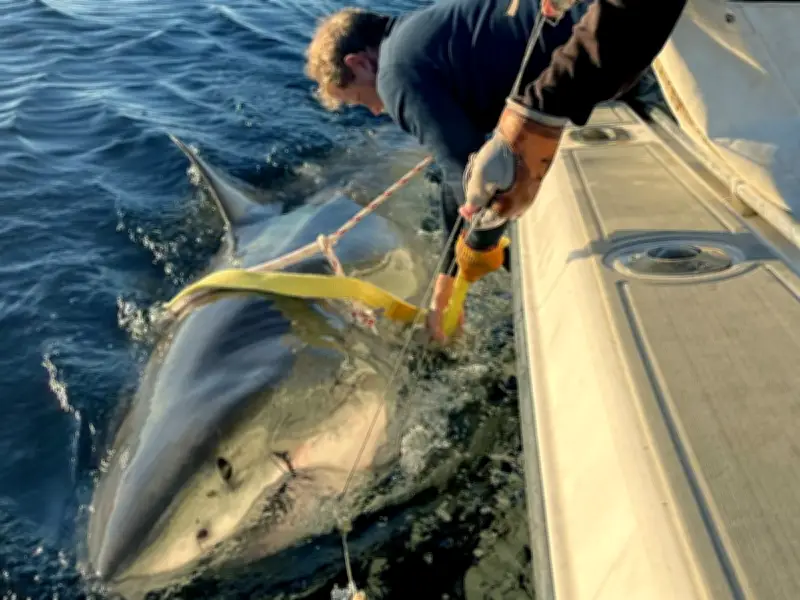
Contender, the largest male great white shark ever recorded in the Atlantic, has resurfaced after months of silence from its satellite tag. Researchers warn the giant predator may be heading towards popular seaside destinations.
Shark's disappearance and reappearance
The 14-foot shark, weighing 750 kilograms (1,700 pounds), vanished from satellite tracking after its last detection off the Outer Banks of North Carolina in the United States in April. However, researchers from the research group OCEARCH have now received a fresh signal from the shark's tracking tag, sparking renewed interest in its whereabouts.
Contender was tagged by OCEARCH about 45 miles off the coast of Georgia and Florida in January 2025. Since then, it has travelled more than 7,000 miles along North America's eastern coastline. The latest detection occurred on June 7, but it was only a weak “Z-ping,” meaning the tracking device was not exposed above the surface long enough to provide an exact location.
Potential migration towards popular beaches
Experts believe Contender may now be making its seasonal migration towards Cape Cod or Atlantic Canada, both regions known for popular seaside destinations. An OCEARCH spokesperson explained, “White sharks in the western North Atlantic typically migrate north and spend the summer and early fall foraging in the waters of Cape Cod or Atlantic Canada. These two regions offer comfortable water temperatures and an abundant food supply, in particular abundant seals and large fish species.”
The organisation noted that the shark's fin-mounted tracking tag can only transmit a location when it briefly breaks the water's surface. They stated, “The Z-ping is a weak non-locational ping. It typically occurs when the shark's fin-mounted tag is briefly at the surface and just one single message is received by an overhead Argos satellite. Normally three or more messages are needed during a single satellite pass to calculate a reliable location.”
They added, “As Shark Tracker shows, we received a non-locational Z-ping from Contender on July 7. The last actual location for Contender was on April 23 when he was off the Outer Banks of North Carolina.”
Tracking and research insights
The 1,700-pound predator has travelled more than 7,000 miles since being tagged, with researchers tracking its movements from waters off Florida to the Gulf of St. Lawrence in Canada. OCEARCH previously stated that Contender is the largest male great white shark it has ever tagged in the Atlantic. On April 1, Contender was pinged past the Gulf Stream deep off the coast of Georgia, but it has since moved rapidly out to deeper waters in the Atlantic, prompting scientists to suggest it could be a sign of breeding.
OCEARCH senior data scientist John Tyminski commented, “This sudden movement could be to forage in deeper waters, but we cannot rule out the possibility that it's related to reproduction at this time of year.” Great white sharks have inhabited the world's oceans for more than 400 million years. Tyminski added, “Each new ping deepens our understanding of these apex predators—their life history, movements, and potential breeding areas—offering critical insights for conservation.” Researchers hope that tracking Contender's movements will help them better understand the migration, behaviour, and potential breeding patterns of great white sharks.