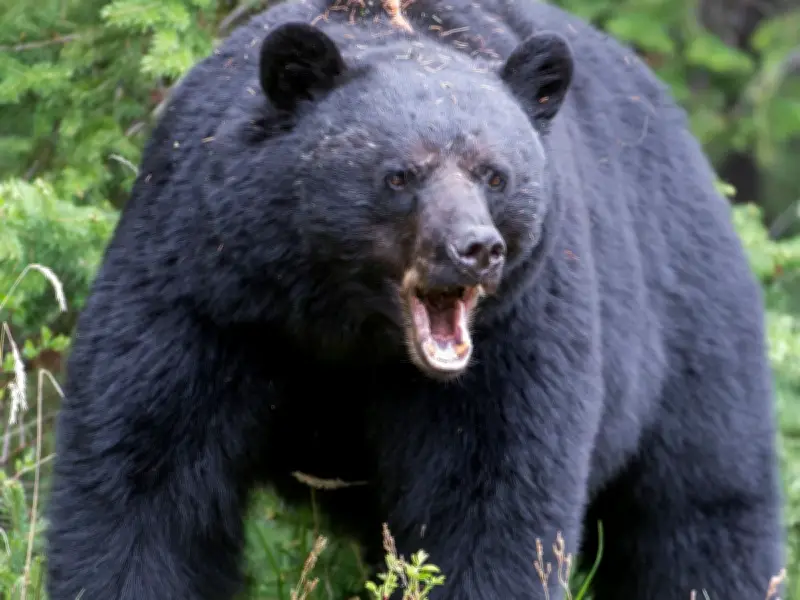
A gruesome discovery at a popular mountain beauty spot has sparked an investigation after human remains were found apparently eaten by bears and other wildlife. The grim find was made at the scenic Wild Rose Picnic Area on Lands End Road, near Grand Mesa in western Colorado.
Investigation Underway
Officials launched an investigation following the discovery, but investigators currently believe the unidentified victim was not actually hunted down by the beasts. According to KKCO News 11, there is no evidence of a fatal animal attack prior to the body being scavenged by a bear, or bears, alongside other wildlife.
The Mesa County Coroner's Office is now working to establish exactly how the person died. The identity of the victim is expected to be released once next of kin have been informed.
No Threat to Public Safety
Despite the stomach-churning nature of the find, Colorado Parks and Wildlife (CPW) confirmed they are not planning to hunt the animals down. CPW spokesman Luke Perkins told Cowboy State Daily that the tragedy is not being treated as a bear-attack fatality. When questioned on whether the scavengers could develop a taste for human flesh after feeding on the body, Perkins reassured the public that the agency does not believe there is any threat to human safety.
Experts have also weighed in to calm public fears. Retired federal ecologist Chuck Neal, from Cody, explained that the lack of data makes it tough to predict exact animal behaviour, but added that the risk of a repeat incident is incredibly small. He said: 'However, if it is true that a bear didn't kill the person before eating from the body, the risk of that bear trying to eat more people is extremely low.'
Bears as Opportunistic Omnivores
Neal explained that bears are opportunistic omnivores who simply viewed the tragic discovery as an easy, free meal. He said: 'If it was a one-off thing that doesn't make that particular bear any more dangerous to human beings. I would not think that just one taste would make that bear extremely dangerous.'
He added that if the remains had already begun to decompose, it would have a completely different scent and flavour profile to a living person. Neal said: 'It would just be another lump of rotten flesh.'
Historical Context
According to the expert, history is packed with examples of wild predators scavenging human bodies without turning into man-hunters. During the American frontier era, many pioneers died on the trails and were buried in shallow graves, offering a morbid buffet for local wolf packs. Neal said: 'It became routine for wolves to dig up and eat human bodies, but they didn't then start trying to prey on live humans.'
Bear Species and Risks
While grizzly bears often trigger the most primal fear in humans due to high-profile maulings, Neal warned that male black bears can actually pose a more calculating threat in the US. Most grizzly incidents are defensive or territorial reactions to being startled at close range. True predatory hunting of humans is exceptionally rare, but when it does happen, male black bears are usually the culprits.
Neal said: 'A male black bear is the most predacious bear toward humans in the Lower 48. Polar bears are the most predacious of any species, but we don't have to deal with them here.' He explained that male black bears must become 'the biggest, strongest male out there' to secure mating rights with females. In incredibly rare circumstances, an aggressive male looking to bulk up might view a person as a meal. He said: 'They might see a human as a high-quality lump of protein. Sort of like a hot dog.'
In contrast, male grizzlies are already so massive and powerful that they can easily hunt large game, meaning they rarely have any reason to bother with humans.