
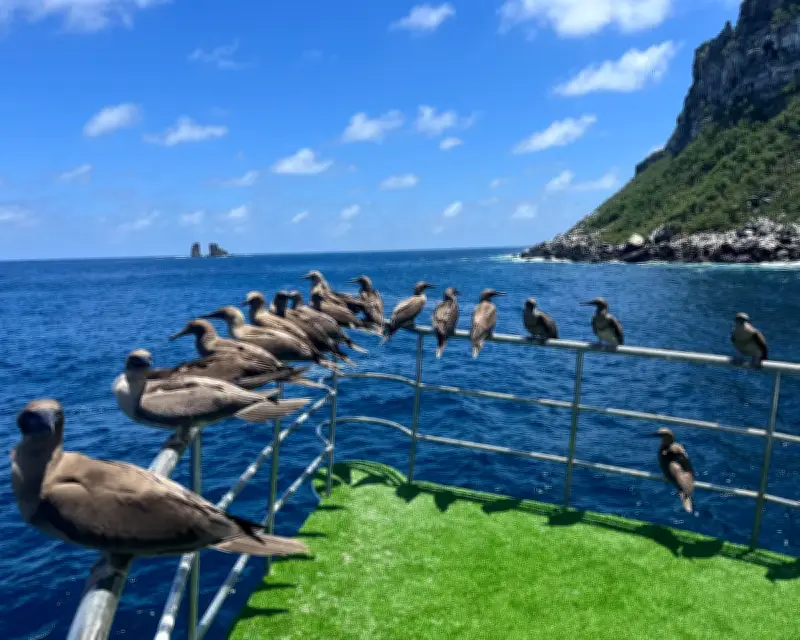
Boobies perched on the diving yacht used by Helen Scales and the research team. Photograph: Helen Scales/The Guardian
The underwater wonders I saw on my once-in-a-lifetime trip to the Galápagos
In this week’s newsletter: Joining a research team on the Darwin and Wolf Islands off the Ecuadorian coast revealed how critically endangered species are reacting to their rapidly changing ocean environment. Don’t get Down to Earth delivered to your inbox? Sign up here
Darwin and Wolf Islands in the Galápagos archipelago are the kinds of places scuba divers and marine biologists dream of visiting, myself included. I even wrote a children’s book imagining a team of scientists exploring the underwater wonders of the Galápagos islands on a beautiful sailing ship.
That’s why I’m still pinching myself that earlier this year I got to take part in a real expedition to Darwin and Wolf.
More on my incredible journey and what I saw on these remote, uninhabited islands, after this week’s most important reads.
Essential reads
- ‘Super-rich’s assets cause outsized amount of climate harm’
- ‘An equal and habitable world is possible’: academics set out sweeping vision for planetary survival
- ‘This may be our last chance’: rising sea levels threaten Kiribati’s World Cup dream | The Hotspot
In focus
The Charles Darwin Foundation science team at work in Galápagos. Photograph: Helen Scales/The Guardian
Back in March, I was the first reporter to be invited to join a team from the Charles Darwin Foundation, who twice each year go to these special islands, the most northerly of the Galápagos archipelago, which sits about 1,000km (620 miles) off the coast of Ecuador. For two weeks, I lived at sea on a 22-metre (71ft) diving yacht with 12 scientists and crew. Every day, while we were scuba diving, freediving and working from inflatable boats, we were constantly surrounded by wildlife. Green sea turtles popped their bald heads above the waterline. Sea lions waved their flippers in the air as they lazed at the surface. Flocks of boobies flew alongside us while we zoomed around on boats and seemed determined to try to land on our heads.
I had gone on this adventure to tell a story: that of the epic migrations of scalloped hammerhead sharks, a critically endangered species that aggregates in huge numbers at Darwin and Wolf Islands. Pregnant females swim more than 1,000km from the Galápagos back to the mainland to give birth in the mangrove forests of Panama.
After more than 20 years of marine research and reporting around the world, this was my first time encountering a hammerhead shark. Seeing dozens at a time was an exhilarating reminder that there’s still so much to care for and protect in our ocean.
The team I was accompanying weren’t solely focused on scalloped hammerheads, but the wider marine ecosystem too. We spent long days motoring around the islands, lowering waterproof cameras into the sea then hauling them back up hours later. Scuba divers pushed cameras on horizontal paths underwater. The team does this work in the same places year after year.
One of the team is Katherine Rezabala, an Ecuadorian marine biologist. Back at the research station, she’s in charge of analysing the video footage, counting, identifying and measuring every fish that swims by. She’s been doing this for two years and has learned to recognise more than 50 species of teleosts, a bony fish. I saw proud tears in Katherine’s eyes as she told me how she felt diving off Darwin and Wolf Islands knowing every single species around her. “Everyone else is looking at the sharks,” she told me. “I’m looking at the teleosts.”
Long-term monitoring of this kind may not be as glamorous as tagging hammerhead sharks with satellite trackers, but Katherine’s work is crucial for understanding how this region of the ocean is changing. The Galápagos are naturally turbulent, with mingling currents of cold and warm water. I experienced this while I was scuba diving. Sometimes, cooler pools of water shimmered in front of me like a mirage. I swam into them, shivered for a moment or two, then warmed up on the other side. But there are bigger forces at play, altering the conditions in the Galápagos above and below the waves.
You may have read that El Niño is likely returning this year, with far-reaching repercussions for global temperatures and rainfall patterns (for more, read Gabrielle Canon’s explainer in Down to Earth back in April). The Galápagos will be at its heart. Cold, upwelling currents that normally bring vital nutrients will diminish as warmer water sweeps in. Forecasts suggest it will be another big one – the fourth since the 1980s – and could kill off swathes of ocean life.
The team from the Charles Darwin Foundation will be back at Darwin and Wolf Islands in September to find out how the hammerhead sharks and all the other fish are getting on.
Read more: Giving guitarfish a chance: one man’s mission to persuade fishers to farm giant snails instead. Canada endorses embattled marine park’s plan to relocate 30 beluga whales. ‘Severe’ stress on oceans as rate of sea level rise doubles in 10 years, UN warns. To read the complete version of this newsletter – subscribe to receive Down to Earth in your inbox every Thursday.
Explore more on these topics: Environment, Down to Earth newsletter, newsletters, Share, Reuse this content




