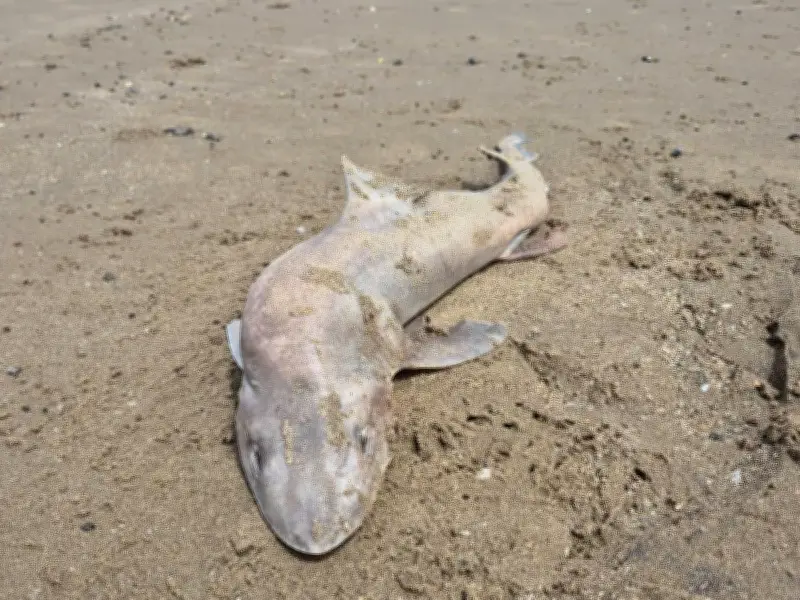
A creature that washed up on a Welsh beach is believed to be a critically endangered species of shark, according to a wildlife expert. Marine conservationists suspect the animal, which was pictured washed up on Newton Beach in Porthcawl on Wednesday, July 1, is a type of smooth-hound.
Expert Identification
The decline in smooth-hound populations has been linked to commercial fishing, both through targeted catches and accidental bycatch in other fisheries. Marine Conservation and Research Manager at the Wildlife Trust of South & West Wales, Dr Sarah Perry, said: "Common smooth-hounds are classed as globally Endangered and Vulnerable in Europe, and starry smooth-hounds are classed as Near Threatened in Europe on the IUCN Red List. Smooth-hounds are commonly caught along the coast by anglers."
Conservation Status
Like many shark species, smooth-hounds mature relatively slowly and produce fewer young than many bony fish, making it harder for populations to recover from sustained fishing pressure. Habitat degradation in some coastal areas has also contributed to pressures on the species.
Despite their conservation status, smooth-hounds can be found in UK waters, particularly around the Welsh coast, where they are commonly caught and released by recreational anglers.
Species Characteristics
The smooth-hound belongs to a group of small, bottom-dwelling sharks. Common smooth-hounds (Mustelus mustelus) and starry smooth-hounds (Mustelus asterias) can grow to around 1.5m in length, although most individuals are smaller. Unlike many sharks, smooth-hounds pose no threat to people. They spend much of their time hunting along the seabed, feeding mainly on crabs, lobsters, shrimps and other crustaceans, using their flattened teeth to crush hard shells. They will also eat small fish and worms.
Habitat and Behavior
The species is most often seen in shallow coastal waters during the warmer months, when it moves closer to shore to feed. They are a familiar catch for recreational anglers around the Welsh coast, who are encouraged to return them to the sea after capture.