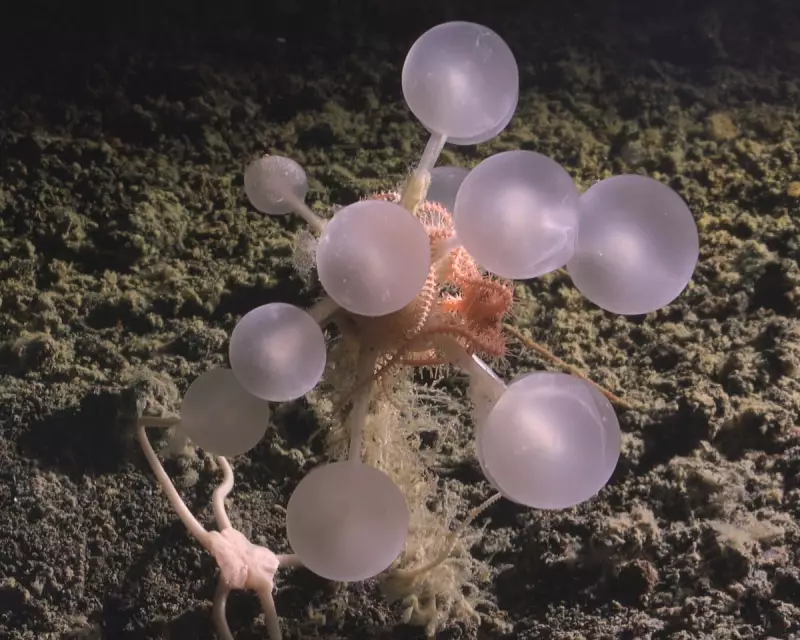
In a breathtaking revelation from Earth's final frontier, marine scientists have uncovered a treasure trove of previously unknown creatures thriving in the crushing darkness of the Southern Ocean's depths. The most startling discovery among them: a carnivorous "death ball" sponge that represents nature's ingenuity at its most brutal.
The Predator That Defies Convention
Dubbed the "death ball" by researchers, this extraordinary sponge captures small crustaceans and other prey using its spherical body as a natural trap. Unlike most sponges that filter feed passively, this newly identified species actively hunts - a terrifying adaptation to the nutrient-scarce environment of the deep sea floor.
"It's like finding a lion in a field of grazing sheep," explained Dr. Marina Silva, lead researcher on the expedition. "This sponge completely overturns our understanding of how these ancient creatures survive in such extreme conditions."
A Hidden World Revealed
The international research team, using state-of-the-art remotely operated vehicles, explored previously unmapped regions near Antarctica at depths exceeding 3,000 metres. What they found surpassed all expectations:
- Multiple new sponge species with unique survival adaptations
- Brittle stars and sea cucumbers unknown to science
- Complex ecosystems thriving in complete darkness and freezing temperatures
- Life forms that have evolved separately for millions of years
Why This Discovery Matters
These findings come at a critical time for ocean conservation. As climate change threatens marine environments worldwide, understanding these unique ecosystems becomes increasingly urgent. The Southern Ocean's deep waters act as a natural laboratory for evolution, showing how life adapts to Earth's most challenging conditions.
Each new species discovered provides crucial insights into:
- The limits of life on Earth and potentially other planets
- Medical breakthroughs through study of unique biological compounds
- Climate change impacts on deep-sea ecosystems
- Conservation strategies for protecting these fragile environments
The research team emphasizes that this is just the beginning. With over 80% of the world's oceans remaining unexplored, each expedition reveals just how much we have yet to learn about the mysterious world beneath the waves.