Alder Trees Herald Spring's Arrival with Vibrant Purple Catkins
After several sodden weeks in Hurstpierpoint, West Sussex, the waterlogged ground presents a challenging terrain for walkers. Even wellington boots with sprung leaks cannot dampen the spirit when nature begins its seasonal transformation. Amidst the lingering dampness, a clear signal of drier, brighter days emerges along the local stream banks.
The Distinctive Maroon Haze of Alders
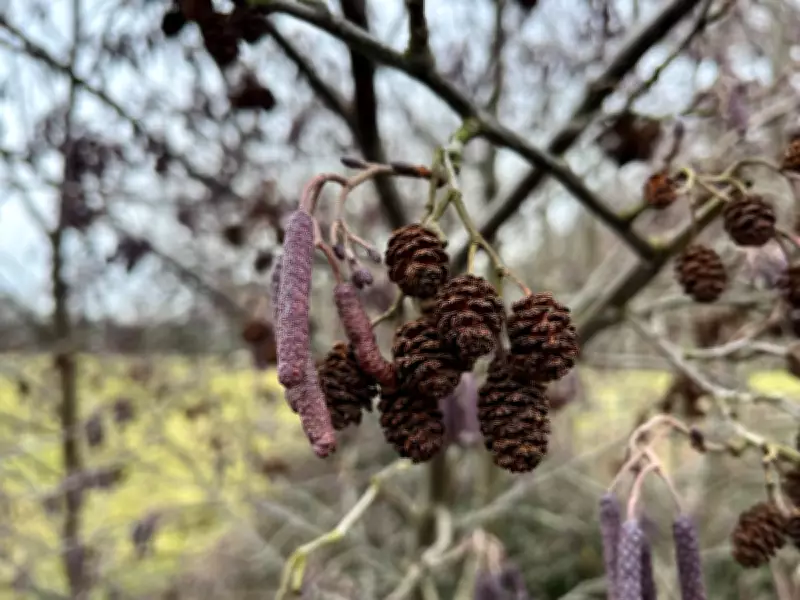
A line of alder trees (Alnus glutinosa) gracefully marks the watercourse, their silhouettes bathed in a distinctive maroon haze. Upon closer inspection, this beautiful effect resolves into delicate purple catkins, which dangle in generous bunches from the tip of each slender twig. These catkins formed at the end of the previous summer and have recently begun to lengthen and unclench, gently coaxed by the gradually warming days.
Soon, well before the tree's characteristic round leaves unfurl, these catkins will split open to reveal hundreds of vivid yellow stamens. These tiny, lantern-like structures act as beacons, guiding observers through the murk and mire of late winter. Alongside its birch-family cousin, the hazel (Corylus avellana), the alder stands as one of Britain's first trees to bloom each year.

Ecological Importance and Seasonal Cycle
The alder's light, wind-blown pollen provides essential early forage for emerging bee queens, offering a crucial food source when little else is available. Once fertilised, the currently inconspicuous female flowers will swell into fleshy, grape-sized green cones. These casings protect seeds that become a favoured food for hungry finches later in the season.
One of the alder's most striking features is the persistence of last year's spent cones, which remain on the branches, now darkened and woody, often positioned right beside the fresh, new catkins. Their fragile, rattling presence offers an easy way to identify this ecologically vital, though often understated, species throughout the year.
Alders as Pioneers and Problem-Solvers
Alders are remarkable pioneer trees, capable of transforming challenging environments. They tolerate compacted, infertile soils, creating more porous and welcoming structures for other plants to follow. Their roots house special bacteria that convert atmospheric nitrogen into a usable form, naturally enriching the soil.
These qualities make alders invaluable for healing damaged post-industrial landscapes, turning barren mine spoil and toxic tailings into thriving, biodiverse ecosystems. Furthermore, alders possess a unique relationship with water, being strengthened by wet conditions rather than weakened.
Historical Uses and Modern Relevance
Historically, this water-resistant quality made alder wood invaluable for aquatic engineering. Much of Venice famously stands upon alder pilings, demonstrating the timber's durability in saturated environments. During the 19th century, coppiced alder was widely used to sole the clogs of factory workers, prized for being both water-resistant and grease-proof while moulding snugly to the wearer's foot.
This historical application feels particularly relevant when considering modern wellington boots, suggesting that alder's practical benefits remain as valuable today as in centuries past. As winter gradually recedes, these unshowy but extraordinary trees continue to light the way toward spring, offering both ecological sustenance and enduring lessons in resilience.