Pigeon Feud in Norwich: Hawk vs. Contraceptives in Urban Bird Battle
At nine o'clock on a Saturday morning, Norwich market is slowly awakening, with shutters still down and aisles quiet. Yet, in the nearby Memorial Gardens, a large crowd has already gathered: the market's pigeons are eagerly awaiting their breakfast. Jenny Coupland arrives slightly later than usual, her backpack overflowing with seed. As she distributes the feed, the birds descend from their perches, covering the ground in a frenzy of pecking. Sunlight catches their bobbing heads, casting iridescent shimmers across their brown and grey feathers.
A few passersby pause to watch the spectacle; one snaps a photo. The sheer number of birds is startling, especially when they abruptly take flight. "They're a bit jumpy today," remarks Coupland, 43. Her wary glances at onlookers suggest she's not just referring to the birds. As the founder of the avian welfare group Peck Savers, Coupland has been feeding pigeons around Norwich for a decade, but in recent months, she describes the situation as "a tinderbox."
Council Measures and Public Backlash
Over the past year, the flock at Norwich market has swelled to approximately 300 pigeons, leading to a surge in complaints from shoppers and traders. Eddie Graci from Horsford, sipping tea at the market's picnic tables, voices a common sentiment: "I think they're a damned nuisance." He recounts birds taking over tables, stealing chips, and defecating on clothing, while the Memorial Gardens are left in a "damn mess" with droppings everywhere.

National media have likened the scenes to a Hitchcock film. In response, Norwich City Council has implemented extreme measures, including deploying a Harris's hawk to scare off pigeons and administering oral contraceptives. However, these efforts have hit snags: bird contraceptives are not licensed in the UK, and the hawk pilot was suspended. Councillor Carli Harper, the Labour cabinet member for finance and major projects, has accused some individuals of exacerbating the issue by providing "industrial amounts of birdfeed" to save the pigeons. While feeding birds is not illegal, Harper stated the council is exploring legal avenues to curb "irresponsible ... selfish few who do not see reason."
Global Context and Local Passion
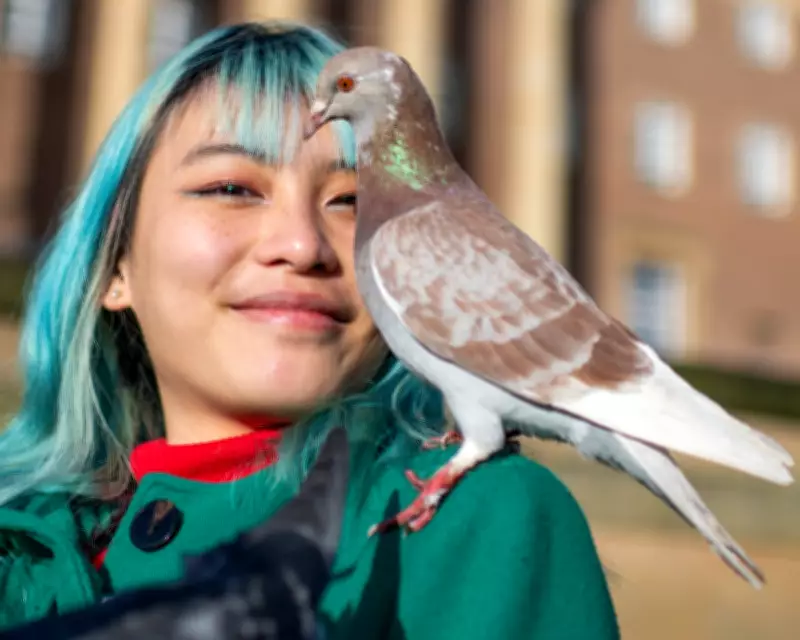
This local story reflects a global issue. Cities like Rome, Venice, New York, Singapore, and London have restrictions and penalties for pigeon feeding, with fines up to £500 in London's Trafalgar Square. In Mumbai, a citywide ban led to protests and clashes with police, highlighting the deep cultural ties some communities have to pigeon feeding. Activists worldwide have attempted to rebrand pigeons as "sky puppies," but Coupland needs no persuasion. She describes pigeons as "just perfect," praising their jewelled plumage and unique personalities. "If you've seen one robin, you've basically seen another one – but not with pigeons," she asserts.
Coupland acknowledges not everyone shares her view but urges people not to dislike pigeons based on misconceptions about dirtiness or disease. Will Smith, an evolutionary biologist at the University of Nottingham, specialising in pigeons, supports this. He notes that while pigeons carry parasites and bacteria, the risk to humans is often overstated. Disease transmission typically requires close contact with droppings, and infections are uncommon in the UK, though immunocompromised individuals face higher risks. In 2019, pigeon droppings contributed to a child's death in a Glasgow hospital, but such cases are rare.
Health Risks and Population Management
Respiratory illnesses like psittacosis and allergies from dust in roosts are possible but not widespread. Regarding avian influenza, Smith explains pigeons are lower risk than ducks or geese, as they are unusually resistant to infection. However, legitimate concerns about population numbers exist. A single pair can produce up to 12 squabs annually, leading to exponential flock growth. Feral pigeons, descendants of domesticated rock doves, are dependent on urban environments. "Their natural diet is McDonald's," Smith quips, emphasising that pushing flocks elsewhere is impractical.

Smith argues that overcrowding necessitates management for both pigeon and human health, but methods matter. Moving birds simply shifts the problem; in Norwich, development at Anglia Square likely displaced a flock to the market. Abruptly cutting off food would cause suffering, so Smith advocates for gradual reduction over months. Coupland defends feeding as a civic tradition and welfare act, removing debris from birds' feet and facilitating veterinary care. "They rely on us to help them, and to live," she says, warning that without feeders, streets would be littered with dead pigeons.
Proposed Solutions and Cultural Divide
Coupland and supporter Summer Loh, a 19-year-old student from Singapore, propose building a dovecote in Chapelfield Gardens to draw birds away from the market. This would allow ethical management, such as replacing eggs with dummies to reduce numbers. Loh's Change.org petition has garnered over 4,000 signatures, but Harper dismissed it as a poor use of funds, despite the council spending £4,000 on a hawk. In a statement, Harper said the council is exploring "more suitable locations" for pigeons, with proposals expected later this year.
Smith praises the dovecote idea, noting similar successes overseas, but foresees cultural resistance in the UK. Pigeons are often overlooked in science and conservation, despite their abundance. "If we want to understand future ecosystems, we have to learn about the things that are thriving," he argues. Coupland adds that pigeons are survivors, and the debate over their goodness is moot: "They're always going to be here."
Community Perspectives and Ironies
At the market, Andy Guy from Wymondham doubts a "cure" for pigeons, focusing instead on council mismanagement of market funds. Later, 13-year-old Amelie arrives to feed the birds, adoring them and pointing out the irony of shifting pigeons from a war memorial, given their role in delivering coded messages during World War I. "If they really did spread disease, surely half of Norwich would be sick by now," she remarks, calling the council's efforts "rather silly."
As the row rumbles on, Norwich's pigeon problem highlights broader issues of urban wildlife management, community values, and the enduring divide between those who see pigeons as pooping menaces and others who cherish them as feathered friends.