
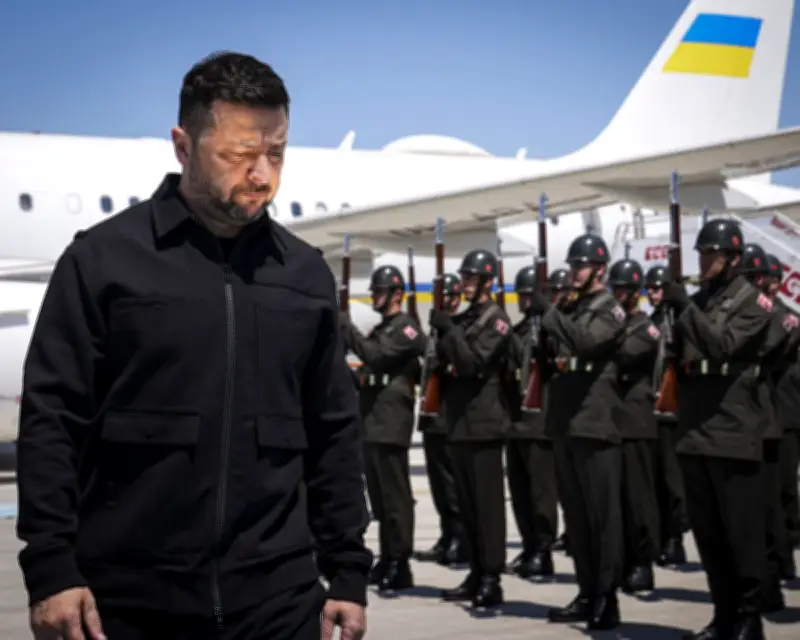
On 26 June 2025, Ukrainian President Volodymyr Zelenskyy ordered a 40-day campaign against Russian targets, aiming to compel Russia to end its invasion. Since then, Ukraine has sharply escalated attacks on Russian territory, including Crimea, Moscow, and St Petersburg, triggering a fuel crisis and shifting the war's dynamics.
Why a 40-Day Campaign?
Orysia Lutsevych, head of the Ukraine Forum at Chatham House, interprets the 40-day timeframe as an Orthodox Christian reference. She states: “Zelenskyy is the master of narrative performance. I think it is a reference to the 40 days in purgatory waiting for the decision to go to hell or heaven. The message is that we already think of you as dead. Now it is your decision whether to save yourselves or not.”
Lutsevych also notes a political angle: “Elections for the Duma are in September. Part of the idea is to make Putin understand that it hurts his hold on power by doing everything to bring the war to Moscow and St Petersburg in particular.”
Phillips O’Brien, professor of strategic studies at the University of St Andrews, adds: “It is a psychological campaign. I don’t think there is an expectation that the 40-day campaign will force Russia to surrender. It is a way of saying: ‘We can take the war to you’.”
What Does the Campaign Involve?
The campaign encompasses several ongoing efforts: the middle strike strategy disrupting Russia’s supply lines, long-range strikes on military industrial sites, refineries, shipping, and major cities. Retired Australian General Mick Ryan, writing in Futura Doctrina Substack, describes it as an “influence operation” intended to force Russia to end its invasion.
Ryan writes: “This is a unified campaign of deep strikes against oil refineries, military facilities and major cities intended to press Moscow toward ending the war.” He highlights that by 5 July, Ukraine’s general staff claimed to have disabled 42.74% of Russia’s oil refining capacity, hitting eight refineries in a month, destroying or damaging over 60 storage tanks, and causing cumulative industry losses of $13.5bn.
Impact on Russia
The stepped-up strikes have shocked Muscovites, with towering smoke columns from burning refineries and large drone flights over Moscow and St Petersburg. Russians face long queues at petrol stations, with some sleeping in cars. In Crimea, strikes on key bridges and roads have caused power cuts and a siege-like atmosphere.
The Institute for the Study of War reports that Ukraine’s strikes have forced a reckoning within Russia’s ultranationalist information space, causing commentators to blame the federal government for failing to create a cohesive air defence system.
International Implications
Ukraine’s success in bringing the war to Russia may have shifted the Trump administration’s attitude. At the July 2025 Nato summit in Ankara, US President Donald Trump suggested Kyiv could produce Patriot missile interceptors under licence. Lutsevych calls this “the biggest visible success of Ankara. It is psychologically important because before it would have seemed unbelievable.”
Future Prospects
Denys Shtilerman, chief designer of Ukraine’s missile producer Fire Point, hints at strikes on key military facilities in Moscow with newly produced ballistic missiles, possibly in September. He says: “First is Moscow … where the military facilities are protected. I am practically 100% certain they won’t be able to intercept effectively.”
There is speculation that Ukraine may attempt to retake territory from Russia, as Russian forces become thinly spread. Lutsevych believes the campaign is likely to continue and intensify beyond the 40-day frame.




