Outcry in Texas Over Trump Admin Waivers to Build Border Wall in Big Bend National Park
The Trump administration has waived a series of environmental and historical preservation laws to expedite construction of a towering border wall through Big Bend National Park, a vast protected wilderness in south Texas. Despite plunging border crossings, the move has drawn fierce backlash from local leaders, environmentalists, and public land advocates.
Congress allocated $46.5 billion for border wall construction in the "Big, Beautiful" bill last year, fueling President Donald Trump's ambition to wall off the southern border. The longest unwalled stretches lie along a roughly 500-mile section of west Texas known as the "Big Bend sector," which includes some of the largest protected lands in a state that is 95% privately owned.
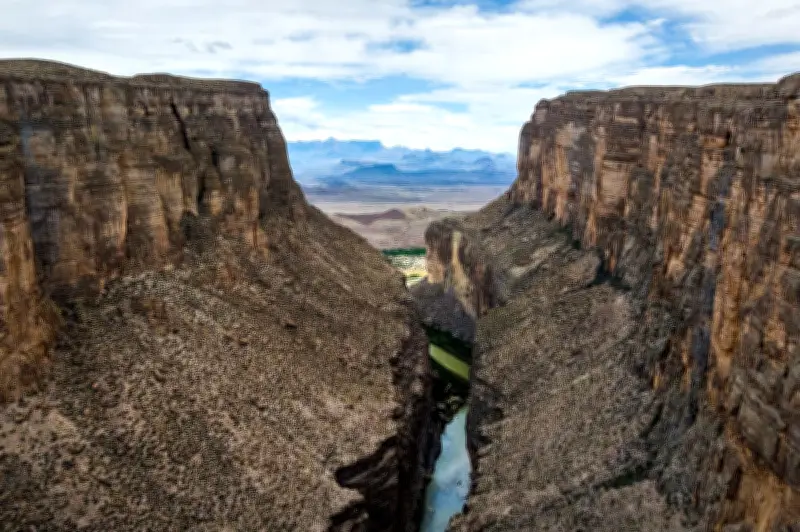
The prospect of marring landscapes like Big Bend National Park, Big Bend Ranch State Park, and Black Gap Wildlife Management Area has sparked outrage. The 800,000-acre Chihuahuan desert expanse, punctuated by the Chisos mountain range, draws half a million visitors annually for hiking, camping, stargazing, and floating the Rio Grande.

Mixed Signals and Legal Maneuvers
For months, U.S. Customs and Border Protection (CBP) sent mixed signals about its intentions. In February, CBP updated an interactive map to indicate plans for a steel bollard wall along the park's river frontage, sparking outcry. CBP later changed the map to show only detection technology along the border, but the current iteration includes new roads and four separate 4-6-foot-tall vehicle barriers.
The waiver, published by the Department of Homeland Security (DHS) in the Federal Register, empowers CBP to build any security infrastructure it wants, from 30-foot steel fencing to unpaved roads. It bypasses protections under the National Environmental Policy Act, Endangered Species Act, Clean Water Act, Native American Graves Protection and Repatriation Act, and others.
The Big Bend area is home to endangered species, a struggling bighorn sheep population, and significant Native American rock art and petroglyphs. U.S. Representative Lloyd Doggett, a Texas Democrat, criticized the move as "ludicrous" given that illegal crossings in the area account for less than half a percent of all such crossings nationwide.
Proposed Infrastructure and Environmental Impact
The only formally proposed infrastructure within the park is a 17-mile, non-contiguous "vehicle barrier system" with steel rails and posts 4-6 feet tall, along with 205 miles of roads up to 24 feet wide equipped with detection technology, utility poles, lighting, and surveillance cameras. Two of the four barriers are located in the middle of the park's river frontage.
Bob Krumenaker, former Big Bend National Park superintendent, described the plan as "massive destruction" that would alter some of the most remote parts of a remote national park. He noted that while a 30-foot steel wall is an unlikely worst-case scenario, the waiver's broad authority allows CBP to add virtually any infrastructure without accountability.
"Waiving the law undermines all credibility and makes them completely unaccountable," Krumenaker said. "They don't care about the impact on the environment. If they have a fuel spill, they're not subject to any laws – they've just waived the Clean Water Act and the Clean Air Act."
In a statement, a CBP spokesperson said plans are still in the planning stages, with CBP focusing on higher priority locations. The agency continues to coordinate with the National Park Service, Texas Parks and Wildlife Department, and other agencies.
Border Crossings Remain Low
The Big Bend sector is one of the least-trafficked corridors on the southern border, with steep cliffs and vast desert on both sides making it unattractive for crossings. Unauthorized immigrant crossings have plummeted since Trump took office in 2025, as his administration dismantled humanitarian protections and Congress allocated billions for border security.
Within Big Bend National Park, Border Patrol made only 100 arrests in 2023 and 125 in 2024, according to data obtained by Krumenaker. Those numbers likely dropped further in 2025. CBP Commissioner Rodney Scott told the Washington Examiner that it would be "kind of silly to put a 30-foot border wall on top of a 90-foot granite cliff."

Legal Challenge and Bipartisan Opposition
Democrats in Congress attempted to block DHS from using funds for barriers in the park, but the measure failed in an appropriations committee vote. The waiver has already prompted a legal challenge from Friends of the Ruidosa Church, river guide Billy Miller, and the Center for Biological Diversity, arguing violations of due process and constitutional rights.
"This is an attack on the integrity of the National Park Service itself," said Laiken Jordahl, a national public lands advocate with the Center for Biological Diversity. "If they're willing to do this in a national park, where virtually no one is crossing the border, where won't they?"
The story is co-published with Public Domain, an investigative newsroom covering public lands, wildlife, and government.