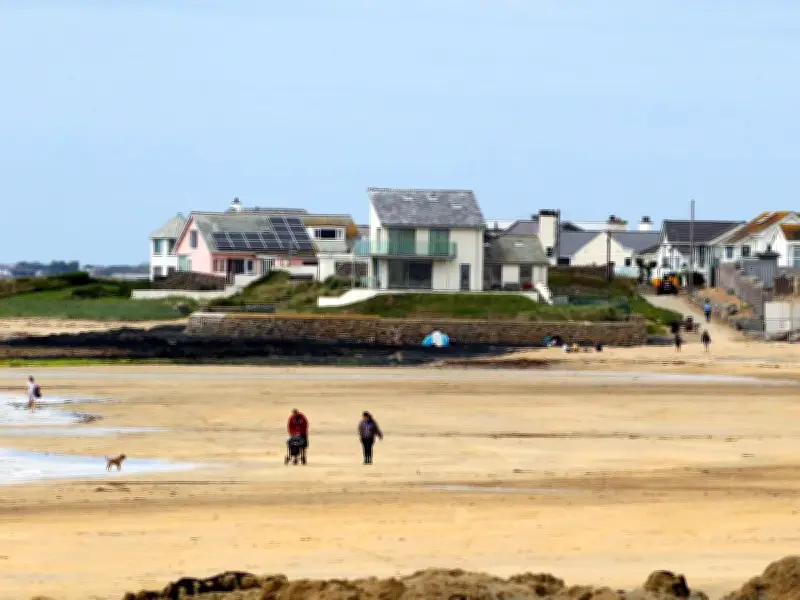
A North Wales councillor has claimed a seaside village has been "taken over by outsiders" with Welsh no longer heard in shops and cafes. Veteran Holyhead Councillor Robert Llewelyn-Jones made the comments during a planning meeting about a retrospective application to retain the use of a holiday let at Llanfaelog, near Rhosneigr, Anglesey.
His views were called "unfair" and "disappointing" by another councillor, local member Douglas Fowlie. The intervention was made in a discussion about the one-bedroomed holiday property, The Hoot, described as a converted outbuilding at Ty Llwyd, at Llanfaelog, near Rhosneigr. The retrospective application had been submitted by Gillian and Richard Jones.
Planning recommendation and refusal
Head of Development and Planning Rhys Lloyd-Jones recommended refusal, but councillors voted in favour – meaning the matter must now be reconsidered. Mr Lloyd-Jones said the building had been "subject to an enforcement investigation" and continued being used as holiday accommodation.
Constructed in 2012, the applicant claimed it had been used as holiday accommodation since then, he said. "However, (after) a certificate of lawful use was submitted in August 2025, it was concluded the development was unlawful.
"There's some evidence it was used as holiday accommodation in the early years, the building was not marketed online until July 2023. It's also been used as a photography studio. It was concluded that it was not continuously used as holiday accommodation for a period of 10 years or more. There's no certificate of lawful use, the application must be assessed against current policies."
Impact on community and Welsh language
Mr Lloyd Jones said there was a "high concentration" of holiday homes and short term lets in the wider Rhosneigr area and this "can significantly change communities". He added: "The percentage in the Llanfaelog Community Council area was 37.49% – well over double the guidelines. Areas with a high density of holiday accommodation face a knock on effect, high house prices, cultural changes, pressure on local infrastructure and loss of community facilities serving the permanent population.
"Although it may be considered this is only one holiday let, consistency is required. This policy must be applied strictly especially in areas where the percentage of holiday accommodation and second homes is so high."
Cllr Fowlie read a document from Jamie Miles, managing director of Anglesey Holiday Lettings, for the applicants. It stated: "The Hoot is not a residential house in the heart of Rhosneigr, removed from the housing stock, it's a one-room converted outbuilding at Llanfaelog accommodating just two people. Whatever one's wider view about the number of holiday accommodation in Rhosneigr, refusing the use of The Hoot does not return a house to the residential market, there's no house to return.
"During 2025, the property achieved 40 bookings, accounting for 252 occupied nights, equating to 69% occupancy across the year; the average stay was five nights. The Hoot isn't an anonymous holiday property remotely operated through a national call centre. Richard and Gill personally host their guests; it is professionally managed on Anglesey by a local company. We employ local people, use local trades and local contractors. Guests spend money in our local pubs, restaurants, cafés, shops and attractions."
Councillors' differing views
Mr Lloyd Jones "accepted" it was only a one bedroom property, for two people, but said the percentage of holiday accommodation was "already extremely high, if you permit this you would have to permit others". "The fact it's not a new application sends out the wrong message to the public, if you have already done it without planning permission for years, you are giving the impression that is OK. That might set a very important and dangerous precedent, that people can do things without permission."
Cllr Llewelyn Jones feared that approving the application would have a negative impact on the Welsh language: "When we visit Rhosneigr it's full of tourists. There are hotels in the area that people can stay in. I'm familiar with Rhosneigr, I lived there during the Second World War. I was evacuated from Holyhead, my sister went to school there. The place has changed, the village has changed. I visit sometimes for a cup of coffee. I don't hear anybody speaking Welsh in cafés or anywhere. It's a place for holiday makers for three to four months, then quiet the rest of the year. When you visit the shops, people don't speak Welsh. The place has changed, transformed, it's been taken over by outsiders. I am sure it creates work for people but we have to look at what the officers are trying to do, to stick to policies, trying to keep the original Rhosneigr, to preserve that. When I lived there everybody spoke Welsh."
Cllr Fowlie, for the Crigyll ward, said: "I disagree with Cllr Jones, when you say the Welsh language is not thriving in Rhosneigr. If you go to the shop and say Welsh is not spoken, you will have a real shock, but we are here for planning, we are going on policy today. If this was one field further on, it would be in the Bryngwran ward. The only issue is that it falls in the Llanfaelog community council area. I'm disappointed with comments about Rhosneigr, this is an application in Llanfaelog. I think it's unfair when you say the Welsh language is not used. You have only to look at the trades people working, they are Welsh speaking, we can't mislead the public."
Clr Ken Hughes said found it "very difficult to vote against" and proposed approving the application. "There's been no local objection, it did not impact amenities of the area, and tourism is extremely important for Anglesey, bringing millions of pounds," he added. Cllr Jeff Evans seconded this saying "sometimes we need the wisdom of Job to consider applications such as this".