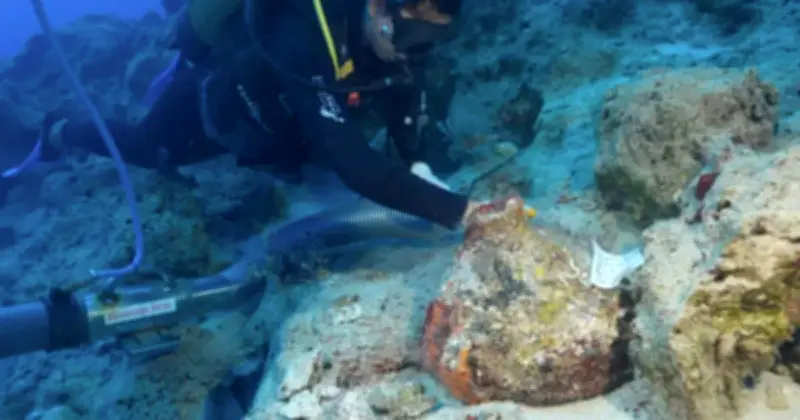
Archaeologists have uncovered what is believed to be the world's oldest shipwreck at the bottom of the Mediterranean, dating back 4,700 years. The ancient vessel sank off the coast of Turkey near Kekova Island in Antalya between 2600 BC and 2400 BC, placing it in the same era as the construction of the Great Pyramid of Giza.
Although the ship's wooden hull has long since decayed, divers found a rich cargo of ancient storage pots and stone anchors resting just 30 metres (nearly 100ft) below the surface on an underwater slope. The find officially predates the famous Dokos wreck in Greece, previously regarded as the world's oldest known shipwreck, which dates to roughly 4,200 years ago.
Time Capsule at the Bottom of the Sea
Professor Hakan Öniz from Akdeniz University, who led the Mediterranean Archaeology Association expedition, described the discovery. "The shipwreck is a time capsule at the bottom of the sea," he said. "We are the first humans who have touched these objects after 5,000 years."
Prof Öniz added: "We are always thinking of the sailors, the producers of the amphorae, and the women who were waiting for their husbands who, unfortunately, couldn't go back." The 32-foot (10m) trade vessel is believed to have departed from a port on the Levantine coast before heading west towards Troy or the Minoans on the island of Crete when disaster struck.
Ancient Cargo and Dating Methods
Divers identified more than 30 ceramic storage jars, known as amphorae, alongside three large stone anchors. Because no wooden structure survived for radiocarbon dating, archaeologists determined the ship's age by examining the unique design of the pottery, distinguished by two handles, a central ridge and a flat base.
"Comparing the decoration techniques… we can definitely say our wreck is Early Bronze Age. This is 100%," Prof Öniz explained. Dr Karin Sowada, an archaeologist from Macquarie University in Australia, examined the recovered jars and was stunned to find intact, glossy residues still preserved inside them after thousands of years underwater. "I looked inside and nearly fainted," Dr Sowada said. "I could not believe how much residue was still remaining."
Origins and Significance
Scientific analysis of the clay suggests the jars were likely produced in workshops across the Jordan Valley. Similar vessels have previously been unearthed at major ancient sites including Giza, Saqqara, Troy and Crete, confirming the existence of vast Early Bronze Age maritime networks. Researchers believe the vessels may have carried essential commodities such as olive oil, wine, or tree resin.
Turkey's Culture and Tourism Minister, Mehmet Nuri Ersoy, hailed the find as a monumental moment for understanding Anatolia's maritime past. He noted that one particular amphora featured nine distinct markings and two body holes, leading experts to believe it may have served as an onboard churn for producing cheese or butter during long voyages.
The recovered artefacts are set to go on public display at the new Mediterranean Underwater Archaeology Museum in Antalya when it opens in the coming months. The Kekova find officially claims the title of the world's oldest known shipwreck, snatching the record from a 4,200-year-old vessel discovered off the Greek island of Dokos. However, while only the Kekova cargo survived, the title of the world's oldest intact shipwreck - where the wooden hull remains extraordinarily preserved - still belongs to a 2,400-year-old vessel lying at the bottom of the Black Sea off the Bulgarian coast.