Groundbreaking Discovery of Southern Africa's Youngest Dinosaur Tracks
In a remarkable breakthrough for palaeontology, researchers have unearthed the youngest dinosaur tracks ever discovered in Southern Africa along the Western Cape coastline. These extraordinary fossilised footprints, estimated to be approximately 132 million years old, provide compelling evidence that dinosaurs persisted in the region far longer than scientists previously believed.
Revolutionising Understanding of Regional Dinosaur History
Southern Africa has long been celebrated for its exceptional fossil record documenting ancient life forms, including numerous dinosaur species. However, scientific understanding faced a significant gap following massive volcanic eruptions around 182 million years ago. These cataclysmic events, which produced vast lava flows known as the Drakensberg Group, blanketed much of the inland Karoo Basin where most dinosaurs roamed, creating an apparent fossil void throughout the Jurassic Period.
The recent discoveries fundamentally challenge previous assumptions about dinosaur extinction timelines in the region. The newly identified tracks represent a crucial missing chapter in Southern Africa's prehistoric narrative, demonstrating that dinosaur populations survived and thrived millions of years after the volcanic events that reshaped their environment.

Discovery at Knysna's Coastal Formation
The groundbreaking find occurred during a routine expedition to the Knysna area of South Africa's Western Cape province. A research team specialising in ichnology—the study of fossil tracks and traces—was investigating coastal aeolianites when they decided to examine a small, rarely exposed rock formation dating to the early Cretaceous Period.
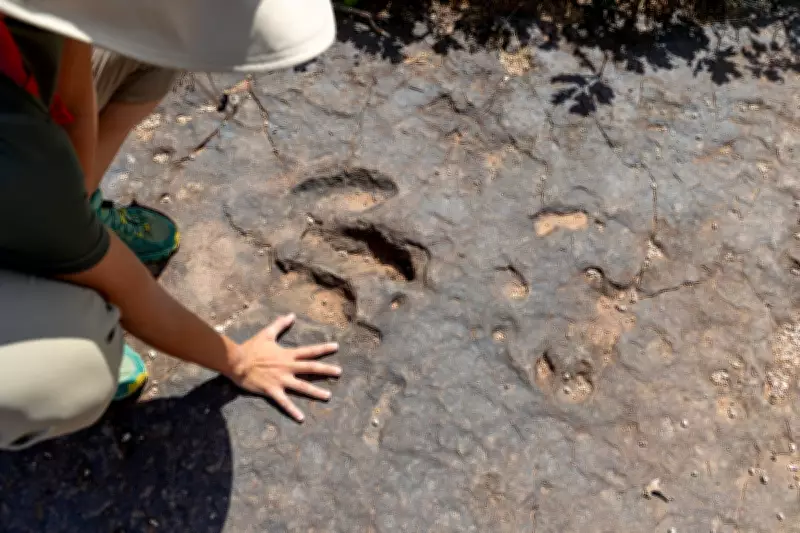
"We were absolutely astonished when Linda Helm, a member of our party, excitedly reported discovering dinosaur tracks," explained the research team. "This particular rock exposure measures no more than forty metres in length and five metres in width, making the discovery of over two dozen probable tracks within such a confined area particularly significant."
The tracks, preserved in what geologists call the Brenton Formation, now lie within the modern intertidal zone where high tides submerge them twice daily. This challenging location contrasts dramatically with the prehistoric landscape where these dinosaurs once walked—a world of tidal channels, river beaches, and vegetation vastly different from today's developed coastline.
Scientific Significance and Future Implications
These 132-million-year-old footprints represent an extraordinary scientific milestone, being approximately fifty million years younger than the most recent tracks previously documented from the Karoo Basin. They constitute only the second recorded instance of dinosaur tracks from South Africa's Cretaceous Period and the second such discovery within the Western Cape province.
Analysis suggests the tracks were made by various dinosaur groups including theropods (carnivorous bipeds), possible ornithopods (herbivorous bipeds), and potentially sauropods (gigantic long-necked herbivores that walked on four legs). While precise identification proves challenging due to preservation factors, the sheer quantity of tracks indicates a substantial dinosaur presence in the region during the early Cretaceous.
"This discovery fundamentally alters our understanding of dinosaur persistence in Southern Africa," the researchers emphasised. "The identification of early Cretaceous dinosaur tracks in both the Robberg and Brenton Formations suggests numerous additional discoveries await systematic exploration of appropriate geological exposures throughout the Western and Eastern Cape provinces."
The research team advocates for comprehensive investigation of other non-marine Cretaceous rock formations in the region, anticipating further discoveries of dinosaur skeletal material, additional tracks, and potentially traces of other prehistoric vertebrates. This systematic approach promises to substantially enrich scientific knowledge about Southern Africa's ancient ecosystems and the remarkable creatures that inhabited them millions of years after catastrophic volcanic events.