What was once considered mere seafood waste is now at the heart of a revolutionary green business venture, receiving royal endorsement from King Charles himself.
From Seafood Waste to Sustainable Solution
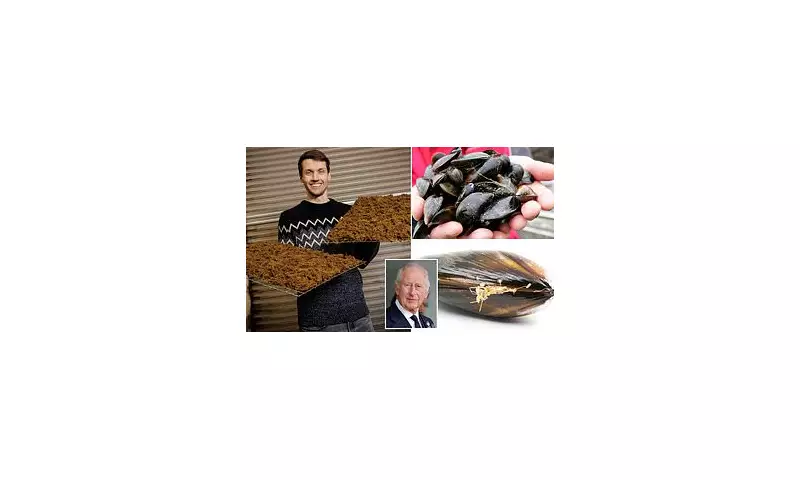
Belgian businessman Sander Nevejans, 35, has developed an ingenious method to transform mussel beards – the green, hairy protrusions that mussels use to attach themselves to surfaces – into high-performance acoustic insulation panels. These straggly fibres are typically discarded by seafood processors as worthless byproducts.
Mr Nevejans discovered the potential of this overlooked material while working in interior design in London during 2021. After watching a documentary about mussel production, he became fascinated by the vast quantities of beards being thrown away and requested samples from shellfish growers to experiment with.

"In Belgium, the national dish is moules-frites - mussels and chips," Mr Nevejans recalled. "As a kid our summer holidays were always at the Belgian coast and I would use mussels to fish for little crabs. At first, I didn't even notice those little fibres; you just pull them off and discard them without even looking at them."
The Science Behind the Innovation
Mussels anchor themselves using byssus threads, which form their distinctive "beards". These threads feature a hard-coated exterior with a soft, elastic interior and natural adhesive pads, making them ideal for textile transformation.
Leveraging his background in electro-mechanics and fine art, Mr Nevejans engineered custom machinery to process the sticky fibres into a wool-like textile at his company, Seastex. He then frames this material in aluminium to create acoustic panels that effectively block noise while retaining heat.
The resulting products offer multiple environmental benefits: they're completely plastic-free, fully recyclable, and naturally flame-retardant without requiring chemical treatments. This makes them particularly attractive for use in offices, music studios, and restaurants seeking sustainable building materials.
Royal Recognition and Expansion Plans
The project's green credentials captured the attention of King Charles through The King's Foundation, which selected Seastex among 35 small businesses championed for their environmental innovation. Mr Nevejans recently met the monarch at the foundation's Dumfries House headquarters in Ayrshire.
"I had the honour to show byssus wool to the King," Mr Nevejans said. "We spoke for two or three minutes and, to my surprise, he was very informed. He was talking about sheep's wool and whether it had the same properties. I'm a simple son of a blacksmith. I'm just working to do something different, and, out of nowhere, I meet the King."
Scotland's shellfish industry provides a ready supply of raw materials, with 37 farms around Shetland and the west coast sending their products for processing in Bellshill, Lanarkshire. From this facility alone, Seastex collects portions of the four tons of mussel beards discarded weekly.
Currently operating with a UK Government grant and handling all production stages himself, Mr Nevejans is now seeking £2.5 million in venture capital investment to scale up operations. The expansion plans include moving to larger premises and creating eleven new jobs, significantly boosting the company's production capacity.
A spokesman for The King's Foundation commented: "Sander's application caught our eye given his innovative use of sustainable materials. It is also exciting to see this work happening across Scotland. We are looking forward to seeing what he does next."
This innovative approach not only reduces waste from the seafood industry but provides the construction sector with a sustainable alternative to conventional insulation materials, demonstrating how circular economy principles can create both environmental and business benefits.