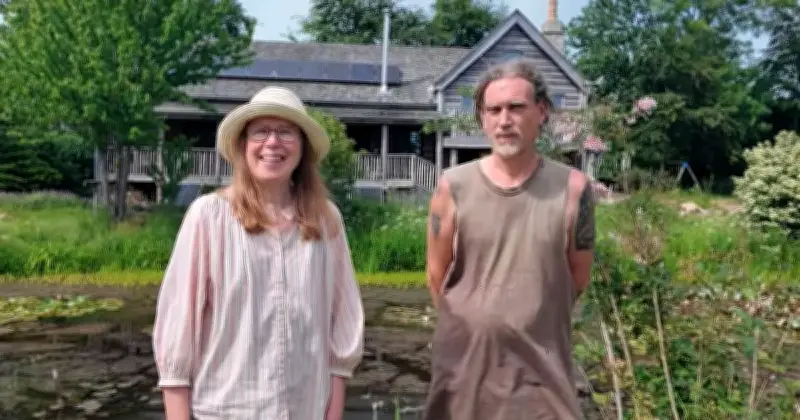
A man who built his own sustainable eco house from reclaimed wood has explained how his 'off-grid' lifestyle means he only has minimal outgoings. Electricity bills are on the rise across the UK, with the Ofgem price cap increasing by 13%. While many households are tightening their belts, one couple have found a more radical way to cut down on bills – barely paying a penny for months.
YouTuber David Burnip travelled down to Dorset to meet with Alex Reeves – who built his eco-home from scratch, with solar panels and natural water purification strategies designed from the ground up. While the initial cost of the build was over £300,000, Alex’s regular outgoings, he explains, are close to zero.
Touring the Eco House
Touring the house for his Wandering Turnip channel, David marvelled: “An entirely off-grid house built from reclaimed timber, stained glass, covered in solar panels. It's absolutely wonderful.” Alex admits that the build wasn’t easy – it took eight years just to get planning permission – but with the help of some skilled tradesmen he managed to assemble a spectacular house from reclaimed timber, with doors and windows picked up from eBay and reclamation yards.
Solar Power System
But the real star of the show is the house’s off-grid solar power system, which makes it completely self-sufficient. “We're not connected to anything,” Alex said, explaining that he started with a basic system that he bought from high street gadget store Maplins and, with a little trial and error, learned how to create a sophisticated solar power system.
Alex showed how his system runs a washing machine, a fridge-freezer, two other freezers, a pump for his fresh water system, and even an LED imitation “skylight” in the ceiling of one of the rooms. “You've just got to work out how it how it's all going to go,” he says. “A good solar system, a good inverter, a good battery system, the right batteries.”
He started with a room full of old car batteries, he says, before upgrading to lithium ion technology. Even now, Alex admits, that the short days of winter-time can make surviving on solar power a struggle. He continued: “We have to be a little bit conservative in winter … it gets a bit tight. It’s a prolonged period where there's not much sunshine.”
Heating and Cooking
Log-burners also provide supplemental heating, as well as incorporating a small oven, and a larger oven is fuelled by propane cylinders. Alex also takes advantage of natural conditions, using a traditional cellar pantry for food storage. He surprised David by telling him how long it took to excavate the root cellar. Rather than the long, laborious process we might have expected, he says it just took “about 30 minutes with a mini-digger.”
Water and Food Self-Sufficiency
A natural freshwater stream also provides a little extra cooling for the occasional beer, and of course Alex grows much of his own veg on the extensive parcel of land that only cost him £103,000. Another remarkable solution is Alex’s water-purification system, which uses reed beds as a natural filter. That’s connected to his day-job, running a successful business specialising in aquatic plants. Despite his off-grid home life he manages to run a fully-featured website for his business. He’s still busy at home, though, showing David a new shower cubicle that he has under construction: “Always a project on the go,” he says.