
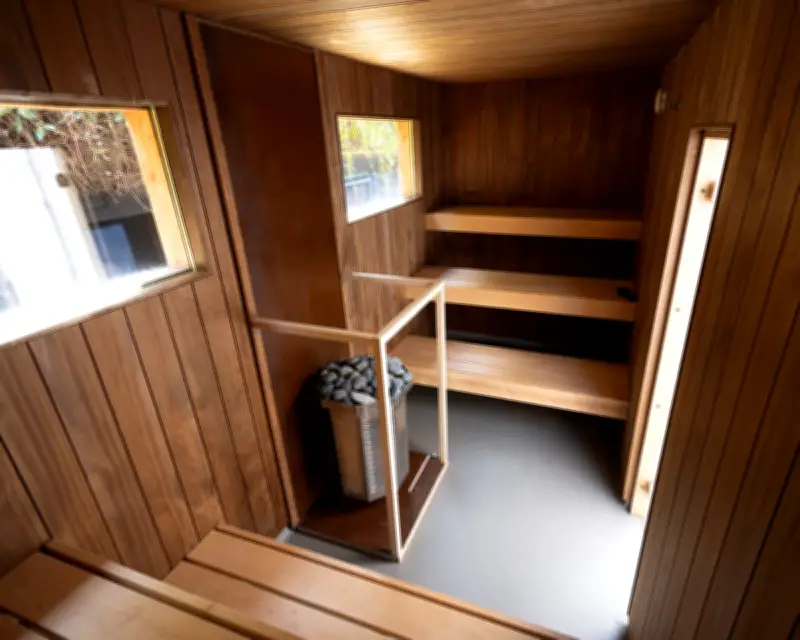
On a stiflingly hot morning during the summer's third heatwave, traffic thunders along the A12 through east London. Behind a high, ivy-topped red-brick wall lies an urban oasis housing an unprecedented sustainable project: the world's first community-powered sauna, heated by food waste from residents of the neighbouring Teviot estate in Poplar.
Circular Design and Anaerobic Digester
Scraps from residents' kitchens will be processed in a local-scale anaerobic digester—another UK first—to produce methane gas that powers the sauna. This completely circular design is part of R-Urban Poplar, a civic space and 'living lab' where community members experiment with taking charge of their food supply while adapting to climate breakdown.
'As far as we are aware this is the UK's – and the world's – first community powered sauna,' says Andy Belfield, an architect from the R-Urban Poplar team.
From Car Park to Ecology Hub
Nine years ago, the site was an unused car park and empty garages. Now, butterflies flutter among raised no-dig beds, micro-allotments, and communal growing spaces where locals cultivate herbs, courgettes, potatoes, and passion flowers. R-Urban Poplar is more than a community garden; it is an ecology hub prototyping circular urban farming, mushroom growing, and restore-and-repair services. Wild spaces encourage pollinators, and the site includes a community kitchen, classroom, workshop, tool library, and even a mushroom farm.
Designers and backers see it as a tentative vision of a society that can thrive despite accelerating climate breakdown.
Combining Technology and Community
'That's why this site is particularly interesting,' says Elle McAll from the Women's Environmental Network (Wen), which has helped fund R-Urban for five years and coordinates its work with similar local projects. 'It's combining the technology and the technical side with the community building, the community side. Addressing the climate crisis isn't about just those technical solutions in isolation. Sites like this really show the possibility of bringing those things together.'
R-Urban Poplar is one of 26 sites in a Wen-led project embedding an environmentally sustainable, socially just, and community-led food system across Tower Hamlets, one of London's most deprived boroughs.
Addressing Deprivation and Pollution
Outdoor space is rare in Tower Hamlets, where about four in five households live in flats and four in 10 families live in poverty. The borough has the UK's highest population density and high air pollution levels. 'The whole thing really has been about how can we reimagine our local food system so it really does genuinely benefit local communities,' says McAll.
At a second Wen-supported site on the Limborough estate, Toyoba Chowdhuri tends her micro-allotment, growing aubergines, courgettes, black chillies, malabar spinach, and snake gourds. 'I'm living in Commercial Road. I haven't got any [outside space] there,' she says. City life severs her connection to the land she had in rural Bangladesh; her plot restores it. She takes two buses to reach the site, coming morning and evening every day.
Food as a Unifying Force
Food provides something fundamental to organise around, building networks and communities ready to tackle wider problems, says McAll. Both R-Urban Poplar and the Limborough hub include communal kitchens and eating spaces, giving people reason and space to connect. 'Food is something that everybody needs but also has deep emotional connection to memories. It represents so much. It's such a simple, unifying thing that can be a starting point for a lot of conversations,' she adds.
The Limborough site, made available by landlord Poplar Harca, hosts a weekly food market distributing cut-price organic produce, sometimes from local growers.
Sauna as Economic Driver
For R-Urban Poplar, the sauna will be pivotal. 'What we can see from the modelling is that for food growing you have to do it at a certain scale to make it really economical,' says Rokiah Yaman of Mad Leap, masterminding the anaerobic digester. 'But actually something like the community sauna is a brilliant way of really making the most value out of what we're doing. If you heat a sauna and then you charge for those sauna spaces and you have multiple sessions a day with 10 people in the session, that makes a big difference.'




