
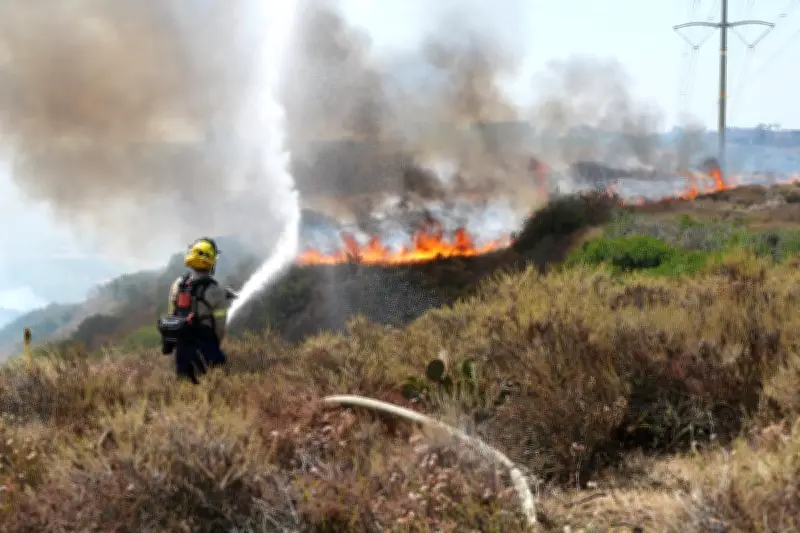
Smoke billows over Sorrento Valley as firefighters battle the fast-moving Sorrento fire near a highway interchange in San Diego, California, on 8 June 2026. Photograph: Anadolu/Getty Images
US political and media discourse has drifted away from the climate crisis amid a frontal assault by Donald Trump upon policies to limit global heating and the president's pugnacious demands to "drill, baby, drill" for more oil and gas.
Yet while elite attention on climate has waned, even among some previously vocal Democrats who have wound back on criticism of the fossil fuels that are overheating our planet, the American public remains concerned about the climate crisis and continues to favour action to deal with it, according to experts and polling.
"The 2024 election was not a referendum on climate change – Americans believe in climate change, worry about climate change and support action on climate change," said Anthony Leiserowitz, director of the climate communication program at Yale University. "That didn't change before, during or after the election."
About two-thirds of Americans say they are worried about the climate crisis, Yale's longstanding climate polling has found, with this proportion staying consistent even as other topics such as the Iran war and inflation have dominated news cycles.
However, people in the US are hearing and reading less about climate change as the media shrinks its coverage of the issue, despite mounting heatwaves, droughts and other impacts that have roiled parts of the country. Outlets including the Washington Post, NPR and CBS have also cut climate journalist positions.
"Voting priorities haven't changed much in terms of climate but other issues have leapfrogged over it, such as the Iran war, and the lack of coverage in the media means that people aren't hearing or talking about it as much," said Leiserowitz.
"There is this spiral of climate silence. I've even heard some leaders of climate groups say, 'don't mention climate change.' I don't know why they'd make that decision, there's absolutely no evidence that people care about this less than they did."
A majority of US voters now link rising costs in their lives to the climate crisis, Yale has found, despite this lack of coverage, with global dependence on oil resulting in higher gasoline costs as the Iran war dragged on.
Meanwhile, Trump's faltering attempts to halt renewable energy projects and escalate oil, gas and coal production are also broadly unpopular with the American public, despite some assumptions that embracing fossil fuels is a mainstream position.
"I'm proudly telling you that we're going to try and have no windmills built in the United States," Trump said in March. The president, who denies the reality of climate change, has previously called clean energy "the scam of the century" and blocked wind and solar projects, only to be rebuffed by the courts.
This month, his administration handed out $700m to prop up coal-fired power plants, which spew out deadly air pollution and are a leading source of planet-heating emissions.
Yet a mere 7% of American voters say they would support a candidate who advocates decreasing the use of renewables, Yale's polling has found, while just 14% want a candidate who pushes for more fossil fuels.
"The president's viewpoint is not shared by most Americans or even most conservative Republicans," said Leiserowitz.
"This war on renewables isn't even shared by his own base. Climate is still very polarized in the US. But, on the whole, Americans have positive views of clean energy and pretty negative views of fossil fuel energy, which they think is dirty and polluting."
The climate crisis has rarely been a headline political issue in the US, despite its worsening impacts, and progress in confronting global heating has been erratic, with landmark climate legislation under Joe Biden since unwound by Republicans in Congress. Trump has also fired climate scientists and withdrawn the US from international climate agreements.
But rising temperatures are already taking a significant toll upon Americans' health and bank balances, via punishing heat, wildfire smoke and storms. Research from earlier this year found that US households are paying between $400 and $900 more each year because of the impacts of the climate crisis, with costs ballooning to more than $1,300 in some counties in states such as California, Louisiana and Florida.
"The status quo has a lot of real negative consequences for American households," said Kimberly Clausing, an economist at the UCLA School of Law and one of the study's co-authors, who added that home insurance rates and, less obviously, health costs are being accelerated by the climate crisis.
"If you live on the Gulf coast or in the rural American west you'd have to be out to lunch to not notice how climate change is affecting you in very real ways," she said. "But if you're sitting in Chicago or Boston it could be harder to realize this on a daily basis. That makes it difficult for policymakers to respond, as people often do not connect the dots."
The received political wisdom that Biden's climate policies were unpopular will probably deter any imminent reversal in this, despite the polling, Clausing said.
"People on the left know this is a problem and worry about it but think 'why talk about this if I want to win elections?'" she said. "The last guy did, he did something about it and then this happened [election defeat]. It's hard for politicians to get excited about it at the moment."




