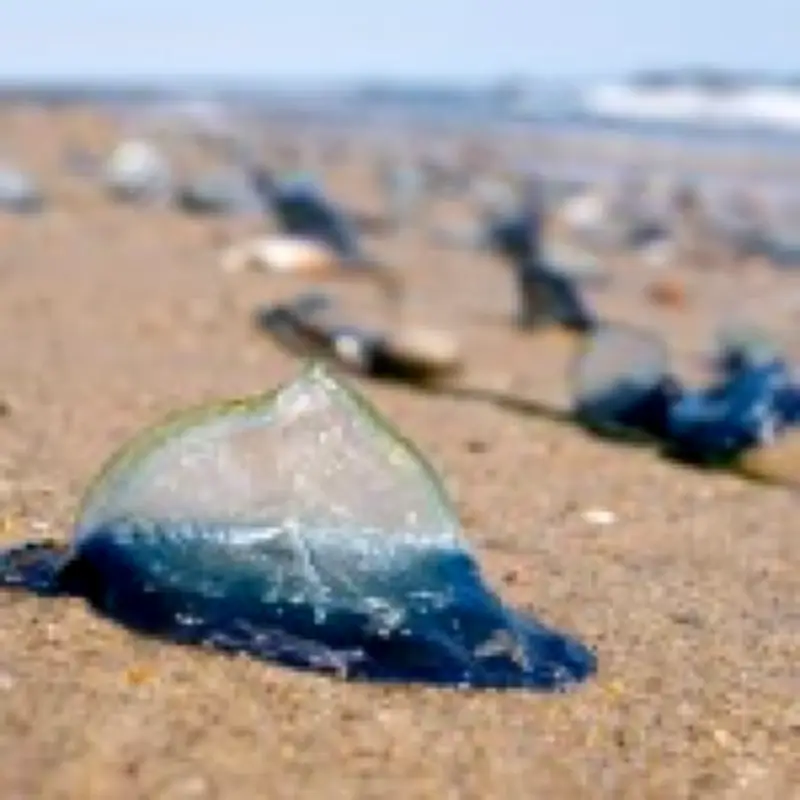
Thousands of bright electric blue creatures, thought to be Velella velella, have washed ashore on St Bees beach in Cumbria over the weekend after a scorching heatwave.
The organisms, dubbed “alien jellyfish”, are normally found in exotic climes like Portugal or the Caribbean. Louise Nicholson nearly mistook one for a mound of seaweed before finding hundreds more.
Speaking to BBC Cumbria, she said: “There were hundreds of them and there were lots of visitors to the area taking photos. They are absolutely beautiful, only about 2ins in size. It was a great find on a beautiful day.”
What are by-the-wind sailors?
Velella velella, known as By-the-wind Sailors, use a “sail” to travel across oceans and are usually rolled into strange territories in the wake of a storm. They have not been swept here in such huge numbers in more than a decade.
Despite being related to the deadly Portuguese man o’ war, the two-inch creatures are harmless to humans, and the worst they offer is a mild sting. They are colonial hydroids, meaning they are not jellyfish but a colony of tiny individual animals, living partly in and partly out of the water with tentacles dangling to catch plankton.
Conservationist warns of changing weather
Conservationist Steve Trewhella said: “They only wash up after prolonged gales and storms. Because they travel in the same way, in theory Portugese man o’ wars could come in as well, and that would be something to worry about. They pose a real threat and can kill people in the water. We are noticing a trend in these unusual marine animals coming into our shores on a more regular basis recently. It’s because our weather appears to be changing. Velella velella are deep blue or purple in colour and often cause confusion if they wash in, in vast numbers, creating a blue beach.”
Mild sting, but heat alerts issued
Marine specialist Frankie Hobro, owner of Anglesey Sea Zoo in Bynsiencyn, said their sting is “mild” in comparison to their cousins – the deadly Portuguese man o’ war. “If you touched your lips, face or another sensitive area, it could be quite painful and cause a tingling sensation,” she said.
“What is slightly worrying is that Portuguese Man o’ War are arriving earlier in the year and more frequently, overlapping with marine creatures like By-the-wind-sailors. It shows how climate change is affecting ocean currents.”
Temperatures could reach 35C in the South East on Monday, according to the Met Office, higher than forecasts for the islands of Mykonos, Rhodes and Santorini. Much of central and southern England is set to see highs in the upper 20s to low 30s before temperatures ease later in the week.
The UK Health Security Agency (UKHSA) has issued amber heat-health alerts for the East Midlands, East of England, South East and London from Monday until Wednesday morning.