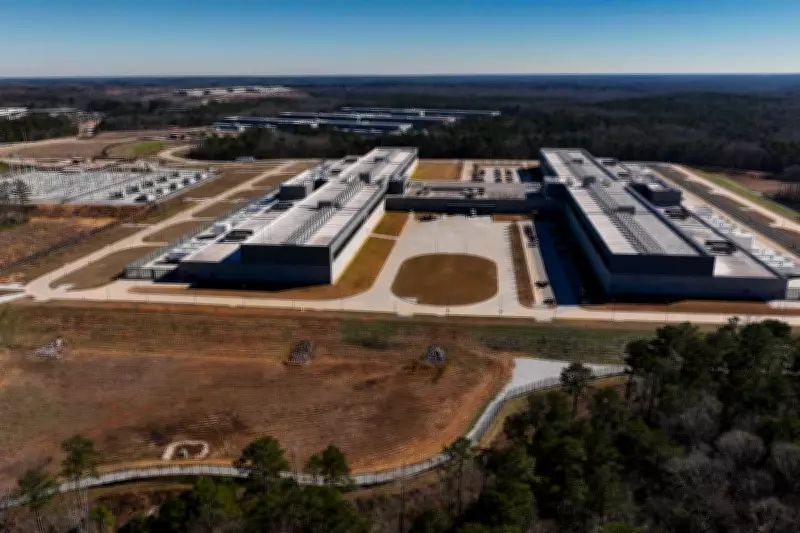
A recent report from the United Nations University has revealed that the environmental footprint of data centres now rivals that of some of the world's largest nations. The study, published on Wednesday, warns that water and energy usage, along with pollution from these facilities, could double within just four years as artificial intelligence continues to expand.
Current and Projected Impacts
In 2025, global data centres consumed 448 trillion watt-hours of electricity, surpassing all but ten countries. This energy use resulted in approximately 208 million tons of carbon dioxide emissions, comparable to the total emissions of Argentina. Furthermore, the generation of this energy required about 1.2 trillion gallons of water, according to the report.
By 2030, data centres are projected to account for nearly 3% of the world's electricity consumption, reaching 935 trillion watt-hours. If data centres were a nation, they would rank sixth-highest in power use. Their carbon emissions would rise to nearly 440 million tons, the report estimates.

AI's Role in Driving Growth
Artificial intelligence is a major driver of this growth. Currently, AI accounts for about 20% of data centre energy use, but this share is expected to increase to 40% by 2030. The study focused on energy consumption and did not fully examine water usage for cooling, which is also substantial.
Kaveh Madani, a co-author and water scientist at the United Nations University Institute for Water, Environment and Health in Canada, stated: “If you look at these numbers, we're seeing scales comparable to nations. The demand is enormous.”
Expert Reactions
Fengqi You, a Cornell University professor of energy engineering, noted the significance of the report due to the UN's credibility. “Its value is that a UN institution is putting carbon, water, land, life-cycle impacts and environmental justice into one frame,” he said, adding that the public should be concerned but not panicked.
Jean Su, director of the Energy Justice Program at the Center for Biological Diversity, called the report the first global assessment to highlight the environmental harms of AI.
However, industry representatives defended the technology. Caleb Max, president of the National Artificial Intelligence Association, emphasised efficiency gains and societal benefits, stating: “AI is rapidly becoming part of our everyday lives and adding benefits that improve safety, live longer, work more efficiently, enhance food production, and reduce poverty.”
Josh Levi, president of the Data Center Coalition, said the industry is committed to responsible growth, working with policymakers and communities to adopt best practices.
Practical Steps for Users
Madani suggested that individuals can help reduce AI's energy appetite by being more concise in their queries. The report found that cutting word use by 30% can reduce energy consumption by 25%, saving as much electricity as 700,000 people in Africa use annually. “If you're too polite, then that extra 'please' you put there can make a huge difference,” Madani said. “You've got to be very precise and be short.”
Energy Intensity of AI Tasks
A typical ChatGPT-style query uses about 200 times more energy than a basic text classification task like an email spam filter. AI-generated images or videos require even more energy. Training complex AI models also consumes vast amounts of power; for instance, GPT-3 used about 1.3 billion watt-hours, while its successor used 50 to 70 billion watt-hours.
However, the majority of AI power use—about 90%—comes from operational requests rather than training, according to co-author Miriam Aczel, a UN University environmental policy researcher. GPT alone handles 2.5 billion prompts daily.
The Efficiency Paradox
Madani pointed out a paradox: as technology becomes more efficient, it is used more frequently, leading to higher total energy consumption. While some companies use renewable energy for data centres, Madani argued that this depletes clean electricity supplies, forcing other sectors to rely on dirtier sources.
Transparency remains a challenge, as many companies do not disclose data centre locations, sizes, or consumption figures. “We cannot manage what companies do not disclose,” You said.

The Associated Press’ climate and environmental coverage receives financial support from multiple private foundations. AP is solely responsible for all content.