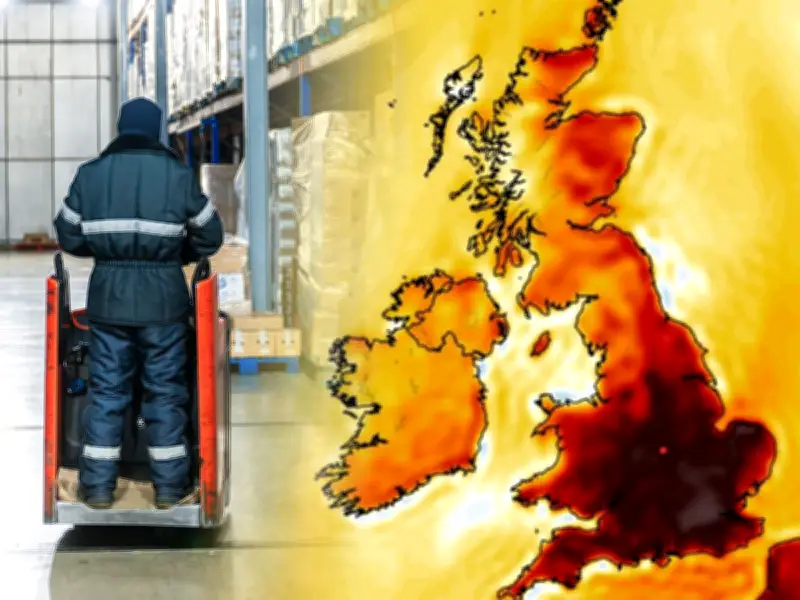
The UK's food and medicine supply chain is facing unprecedented strain as ageing refrigerated warehouses struggle to cope with increasingly frequent heatwaves, industry leaders have warned. Experts say that five consecutive days of temperatures approaching 40C could trigger mechanical failures in buildings not designed for modern summer conditions, potentially disrupting supplies of essential items like milk, yoghurt, fresh fruit, and temperature-sensitive medicines such as insulin and cancer treatments.
Ageing Infrastructure Under Pressure
Around half of all food consumed in the UK passes through a concentrated network of just 460 temperature-controlled warehouses before reaching supermarkets, restaurants, and hospitals. These facilities run around the clock, consuming roughly the same amount of electricity as Greater Manchester and Leeds combined. They handle everything from fresh meat and dairy to life-saving medication, relying on massive refrigeration systems.
Phil Pluck, chief executive of the Cold Chain Federation, described the strain on these buildings as reaching unsustainable levels. "You've got 50C on the roof surface and below that roof you're operating at -20C, so there's a 70C difference," he told the Mirror. "Our units have to work harder just to maintain that and keep food safe. They are simply not designed for the kind of temperatures we are experiencing."

Energy Grid Challenges
During the recent June heatwave, one Cold Chain Federation member was denied additional electricity because their local network had already reached maximum capacity. Tom Southall, deputy chief executive of the federation, said several members feared exceeding their energy allocations. "The industry needs power to keep food cold, and that's becoming an emerging threat. There are already questions around how the electricity system will cope with increasing demand as temperatures rise," he added.
Mr Pluck said operators desperately needed extra power as refrigeration systems worked harder. "Two weeks ago, the heat plumes were coming up from the south with no breeze. We were asking for extra energy, and we were being told by energy providers that the grid would not supply us with more energy because they were at maximum capacity."
However, the National Energy System Operator (NESO) said they were unaware of the specific incident and that the network remained entirely secure. A spokesperson told the Mirror: "Because warehouses, refrigerated transport, and retail coolers require electricity to maintain strict temperatures, they pull their power from the local distribution network, rather than directly from the high-voltage transmission network. This would therefore be a matter to raise with the distribution network operators."
Risk of Prolonged Heatwaves
Logistics experts say that while the supply chain can cope during a brief heatwave, a five-day streak of 40C heat - a scenario the Met Office views as increasingly likely - could trigger more serious issues. "The key challenge is we're having more heatwaves, more days where temperatures are creeping higher, and a lot of these buildings are old and weren't designed with these temperatures in mind," said Mr Southall.
"When we do hit those temperatures, it's all hands on deck to make sure the refrigeration systems are working properly and are clean, but the feedback from our members during the last heatwave was that they could cope for a couple of days. If we started experiencing those temperatures for more than five days, some of those systems would start failing. Consumers would start to see gaps on the shelves caused by a lack of supply."
If systems suffer heat-induced faults, chilled items like dairy and fresh produce would be affected far more rapidly than frozen goods. Mr Southall warned that any gaps could trigger panic buying. "We've done work looking at how resilient the country is, and there is academic research showing that if there are gaps on supermarket shelves, people start stockpiling. The view is that we came close to some disruption during the last heatwave."

National Security Vulnerability
The concentration of the supply chain creates a national security vulnerability. Because a relatively small number of warehouses hold the vast majority of the nation's food, the network is an attractive target for hostile foreign actors. "Russian cyber attackers know if they take one or two major players out of the game, they're going to take millions of meals out of the food chain," Mr Pluck warned. "If they succeed, shelves can empty in a matter of days. That has a psychological effect on the public because people panic, and empty supermarket shelves are very visible."
Modern attacks rarely rely on sophisticated hacking, he said, with criminals increasingly using social engineering tactics, impersonating trusted contractors or IT staff to gain access to warehouse management systems. The sector is continually strengthening its cyber defences, but Mr Pluck warned: "This isn't a matter of if the next attack will happen - it's when."
Impact on Medicines and NHS
The same network also underpins the distribution of temperature-sensitive medicines, vaccines, and other medical products. Pharmaceuticals are much more tightly controlled than food, and clinical treatments have strict temperature ranges, meaning they must be discarded if breached. Mr Southall said: "Clearly there are impacts in administering those medicines, rooms not being at the right temperature and products having to remain in cold storage for longer. There were reports of CT scanners and MRI scanners that are calibrated to work at certain temperatures. Routine scans had to be postponed because they weren't operating within their safe temperature range."
The NHS Blood and Transport service has been hit by stock shortages, with hot weather historically causing donations to drop as schedules shift and donors' iron levels fluctuate. An NHS Blood and Transplant spokesperson urged people to donate, adding: "This summer, our stocks have been hit. So we’re asking people to donate, especially if they are O negative, B negative or Ro. We have robust critical incident plans in place. We continue to prioritise strengthening our supply chains, ensuring that life-saving blood, plasma, stem cells and organs are available when patients need them, and this includes planning for extreme weather scenarios."
Calls for Critical National Infrastructure Designation
The Cold Chain Federation is now calling on the government to designate the hubs as Critical National Infrastructure. This would guarantee the sector the same emergency grid protections as energy and water systems, allow a team of senior government officials to monitor and anticipate potential threats, provide access to security agencies, and help co-ordinate access to emergency services. It would also boost business confidence in the sector, which employs approximately 184,000 people, according to the federation.
Mr Pluck said: "We want recognition of our criticality so the Government can say, along with hospitals and data centres, you get priority energy. We carry 50 percent of the UK's food, but we can be switched off at any minute." Tom added: "There's an emergency code for the grid that prioritises hospitals and other critical infrastructure, but cold stores don't currently have that protection. This issue leads to the potential of blackouts. That's really an emerging threat coming out of this year's heatwave. Our argument is that those sites should receive some support or protection as critical assets."
Industry Response and Investment
High street brands are already taking action. Marks & Spencer is investing in next-generation in-store chillers engineered to run efficiently in temperatures up to 45°C after its food halls struggled in June. Speaking at the M&S annual general meeting in London on July 7, chief executive Stuart Machin said: "There's no doubt we were struggling in those nine days of extreme heat."
Rupert Ashby, chief executive of the British Frozen Food Federation, maintained a reassuring stance. He noted that while lighter frozen products like herbs and fruit are vulnerable to sudden freezer faults, the sector possesses extensive contingency plans, including alternative storage facilities and backup units. "The UK's frozen food supply chain is actually highly resilient. For the vast majority of the year, consumers can access a wide range of frozen products whenever they want them. The heatwaves we see tend to be relatively short and, on the whole, the sector is well equipped to manage them, especially if equipment is clean, well maintained and operating at full capacity," he told the Mirror.
Last month, he said that a major supermarket chain would probably have to spend "hundreds of millions" to replace older units. Tom believes those investments are essential, but says they need to happen faster. "Every degree makes a difference. Thirty to 35 degrees is manageable, but once temperatures go above that, as we've already seen this year, it needs urgent attention. The industry is investing in new sites, but the pace of climate change is outstripping those natural investment cycles. This is an issue now. We can't pretend it's not. We can cope for a couple of days, but looking at the forecasts, prolonged extreme heat could happen at any time."
Logistics experts like Mr Pluck argue that government intervention is essential, adding: "We are not children - you can tell us when the country is under pressure. The worst thing you can do is pretend there isn't a problem. We know there are times when the grid gets close to its limits, and we need to be planning for that now."
A Government spokesperson countered the federation's anxieties, stating: "We are very confident in our security of supply arrangements, and that NESO have the tools they need to manage the system and meet our energy demand - even during the current heatwave."
A NESO spokesperson said: "At the end of June, Great Britain and parts of Europe experienced unusually high temperatures. At the same time, wind and gas generation availability was lower than expected. That's partly because gas power stations need cool water to help their processes, meaning some have reduced their output or taken a unit off as a response. There's been a similar effect on the continent, affecting some of the nuclear fleet in France, for example due to rivers being warmer. These factors resulted in tighter electricity margins than we would normally expect for this time of year. Britain has one of the most reliable energy systems in the world. We are of course confident that households and businesses can continue to use electricity as normal during hot weather."