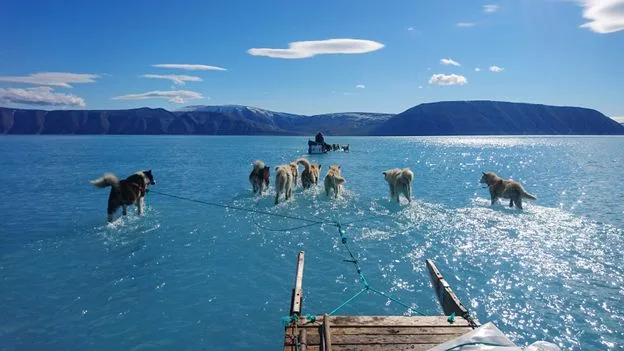
Greenland's Sled Dog Champion Fears Cultural Loss as Ice Melts Away
In the remote northern reaches of Greenland, a five-time sled dog champion is witnessing the rapid erosion of a cultural tradition that has defined his life and his people for over a millennium. Jørgen Kristensen, 62, grew up in a village where his closest companions were his stepfather's sled dogs, finding solace in their company during a childhood marked by bullying over his fair hair inherited from his Danish father.
"The dogs were a great support," Kristensen told The Associated Press. "They lifted me up when I was sad." This bond began when he first ventured onto the ice to fish alone at age nine, sparking a lifelong passion that would see him become a celebrated champion in Greenlandic dog sledding.
The Disappearing Ice Highway
This winter in Ilulissat, approximately 300 kilometers north of the Arctic Circle, the traditional sledding season has been upended. Instead of gliding across snow and ice, Kristensen's sled now bounces over exposed earth and rock. He gestures to the barren hills, noting this is the first January he can recall with no snow or ice in the bay.
"When the sea ice used to come, we felt completely open along the entire coast and we could decide where to go," Kristensen explained. "Driving a dog sled on ice is like being completely without boundaries—like on the world's longest and widest highway." This January, that highway vanished entirely.
The rising temperatures are causing permafrost to melt, buildings to sink, and pipes to crack. Winter temperatures that once regularly hovered around -25°C (-13°F) in the 1980s now frequently climb above freezing, sometimes reaching as high as 10°C (50°F). Kristensen now must carry snow for his dogs to drink during journeys because none remains along their routes.
Global Consequences of Local Melting
The warming in Ilulissat has implications that ripple across the globe. The nearby Sermeq Kujalleq glacier, one of the fastest-moving and most active on Earth, is retreating at an accelerated pace. According to NASA, this glacier contributes significantly to rising sea levels affecting regions from Europe to Pacific Islands.
Karl Sandgreen, 46, head of Ilulissat's Icefjord Center, has observed the glacier retreat approximately 40 kilometers (25 miles) over his lifetime. He describes mountain rock revealed by melting ice and previously ice-covered valleys now empty. "There's nothing now," Sandgreen said, looking at hills that should be snow-covered.
Pollution is exacerbating the melt. Black carbon (soot) from ship engines and debris from volcanic eruptions blanket the snow with dark material, reducing sunlight reflection and absorbing more heat. With increased Arctic ship traffic and periodic Icelandic volcanic eruptions, this problem is intensifying.
Cultural Survival at Stake
"If we lose the dog sledding, we have large parts of our culture that we're losing. That scares me," Kristensen said, becoming emotional during the interview. For over a thousand years, dogs have pulled sleds across the Arctic for Inuit seal hunters and fishermen. The sea ice traditionally acted as "big bridges" connecting Greenlanders to hunting grounds and other Inuit communities across Canada, the United States, and Russia.
Sara Olsvig, chair of the Inuit Circumpolar Council, noted that Greenland's government has had to provide financial support to northern families when sea ice didn't freeze hard enough for hunting. The Arctic is "warming three to four times faster than the global average," she emphasized.
The warming also creates new dangers. Fishermen who have swapped sleds for boats face increased risks because more rain instead of snow creates transparent ice that blends with seawater. "It can sink you or throw you off your boat," explained Morgan Angaju Josefsen Røjkjær, Kristensen's business partner.
Geopolitical Dimensions and Education
Many Greenlanders believe melting ice revealing untapped mineral deposits explains former U.S. President Donald Trump's interest in acquiring the island. "His agenda is to get the minerals," Sandgreen suggested. Since Trump returned to office, fewer U.S. climate scientists have visited Ilulissat, Sandgreen observed, urging leaders to "listen to the scientists" documenting global warming impacts.
Kristensen, who now runs a tourism company showcasing his Arctic homeland, tries to educate visitors about climate consequences. He tells them Greenland's glaciers are as crucial as the Amazon rainforest. While international climate summits matter, Kristensen believes teaching children worldwide about ice and oceans is equally vital alongside subjects like mathematics.
"If we don't start with the children, we can't really do anything to help nature. We can only destroy it," Kristensen warned, highlighting the urgent need to preserve both environmental systems and cultural traditions threatened by rapid climate change.




