
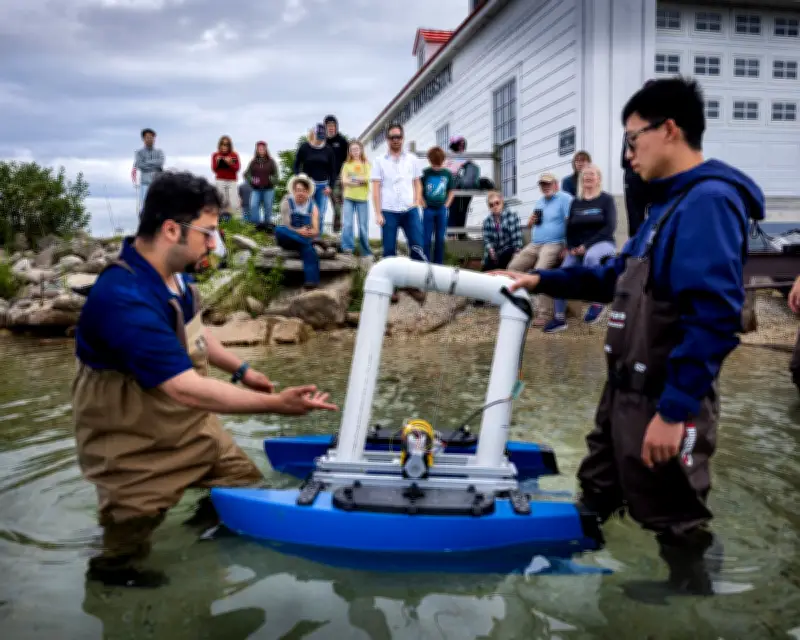
Researchers from the University of Michigan have deployed prototype wave energy converters on Beaver Island in Lake Michigan, successfully powering a lightbulb and charging a mobile phone. The project addresses frequent power outages caused by extreme weather damaging the island's 30-mile submarine cables from the mainland.
Community-Driven Design
Led by engineering professor Lei Zuo, the team spent two years gathering input from the island's 600 permanent residents. A priority was providing dependable power to the local airport. "We need to work with the community together to identify the need and design together with them," Zuo said.
The prototypes, resembling small boats with PVC frames about the size of a yoga ball, convert wave kinetic energy into electricity. Seamus Norgaard, a summer resident, highlighted the dual motivation: "It's a combination of looking at cost savings and also wanting to be independent and not dependent on the mainland for everything."
Renewable Energy Context
Beaver Island already uses solar and geothermal energy, with federal grants supporting renewables. However, the Trump administration's cancellation of some grants raises funding uncertainties. Similar efforts are underway in Galena, Alaska (solar and biomass), and Adjuntas, Puerto Rico (community-owned solar microgrid). Dan Hellin, director of Oregon's PacWave facility, noted: "Finding something that works within the region is critical. It's developing a whole suite of renewables and applying them based on local conditions."
Challenges and Potential
Wave power remains expensive and lacks standardized designs. Most US projects rely on federal funding; the Michigan experiment uses National Science Foundation grants from 2022. However, marine energy under hydropower has avoided some political opposition. The Department of Energy's Hydropower and Hydrokinetic Office plans to use $220 million appropriated by Congress for continued research.
Saeid Bayat, a researcher on the project, emphasized the Great Lakes' advantages: "The Great Lakes provide real-world wave conditions while being much easier, safer and less expensive to access than most ocean sites." Waves here are smaller and more seasonal than ocean waves, but the research could improve the technology overall.
Future Plans
The team will refine the prototype and install a final version on Beaver Island in the coming years. Norgaard expressed excitement: "There is that excitement about these new futures and cleaner sources, and more locally produced, dependable sources of energy." The project is part of broader commercialization efforts, including similar work in North Carolina's Outer Banks, CalWave testing off California, and a decade-old testing site in Hawaii.




