There is perhaps nothing more frustrating than being stuck at a red traffic light, but your daily commute could soon become even longer if scientists have their way. Researchers have argued that increasing the amount of time cars spend waiting at red lights could encourage commuters to switch to more sustainable modes of transport.
Traffic lights as powerful behavioral tools
The study, conducted by a team from the University of Parma in Italy, suggests that traffic lights strongly influence behaviour. By making drivers wait longer, they might be prompted to explore alternative options such as walking, cycling, or using public transport. To make these alternatives even more appealing, the researchers propose giving buses, cyclists, and pedestrians longer green-light periods.
‘Our simulations show that modest reductions in car-prioritized green time shift commuters toward walking, cycling, and public transport without costly infrastructure changes,’ the researchers stated. ‘These findings reveal that traffic lights are not just flow regulators but powerful tools to promote sustainable urban mobility and healthier, more efficient cities.’

Impact on commute times
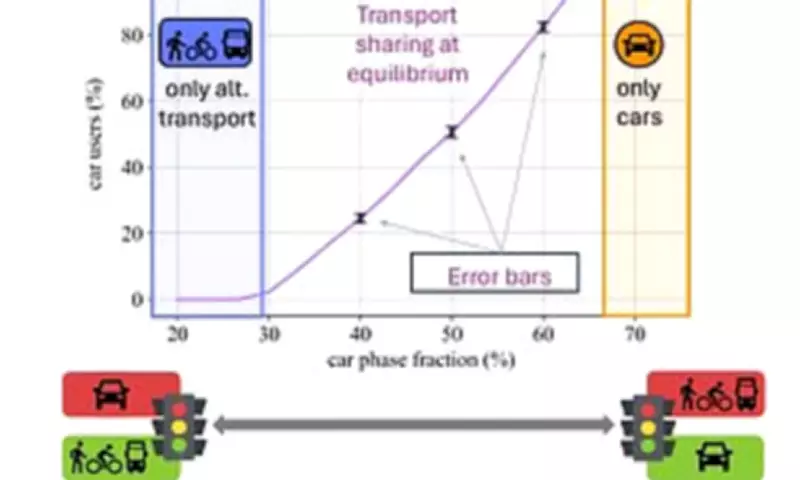
The researchers found that just a 10-20 per cent decrease in the amount of green-light time allocated to cars is enough to have a significant impact. However, this could add several minutes to each commute, making it substantially longer. In the UK, cars typically wait between 60 and 90 seconds for a light to change. A 20 per cent reduction could mean cars receive up to 18 seconds less green time and are forced to wait 18 seconds longer at red.
Interestingly, the researchers argue that giving cars more green-light time can actually slow down car travel, as better conditions attract more drivers, thereby increasing congestion. Writing in the journal Royal Society Open Science, they noted: ‘In many urban settings, traffic light cycles are often designed to favour car traffic by allocating a larger share of green time to vehicles. However, our results suggest that this strategy can backfire: by prioritizing cars, more commuters are encouraged to drive, which increases congestion and ultimately penalizes car users themselves.’
Simulation findings
For their study, the team created an online model to simulate various traffic scenarios. They programmed intersections with different proportions of green-light time for cars and other modes of transport. After running thousands of simulations, they discovered that even modest reductions in car green-light time would likely drive more people to alternative transport. They concluded that simply adjusting traffic light cycle lengths can promote sustainable transport without major infrastructure changes.
‘By shortening the green time for cars or lengthening it for buses, walking and cycling, cities can make alternative modes more attractive and competitive,’ they added.
Driver frustration
Previous research by the RAC has highlighted driver frustration at traffic lights. Nearly half of the 2,498 drivers surveyed said they become angry and frustrated if the driver in front does not move off within three seconds of a light turning green. This is especially true for younger drivers under 44. Almost a third admitted they regularly fail to get through a set of lights due to slow-moving drivers ahead.
RAC spokesman Simon Williams commented: ‘While three seconds is obviously a very short time, anything longer than this can start to seem like an eternity when you desperately want to get through a set of traffic lights and the person in front is taking forever to get going. When you think that some lights only stay green for 15 seconds, this severely limits the number of vehicles that can get through before red comes up again, and this in turn makes jams – and potentially even air pollution – worse.’