
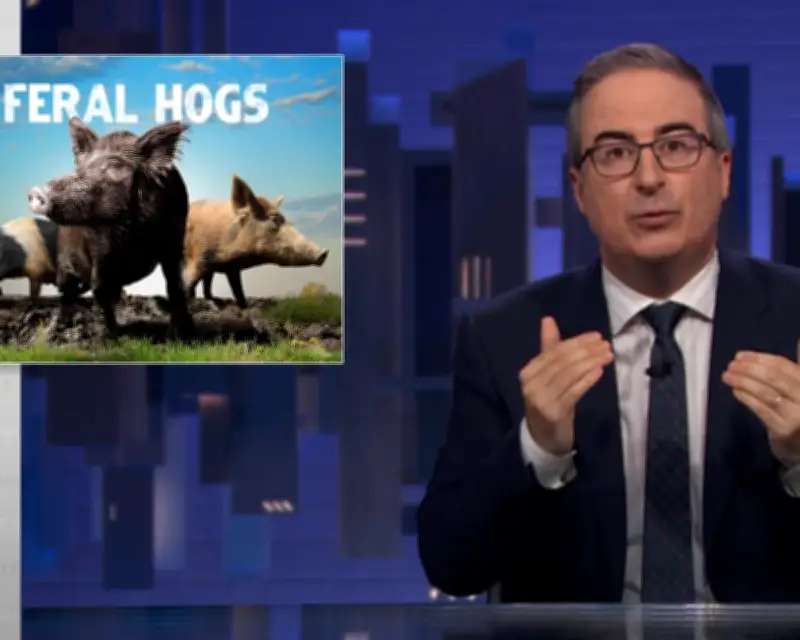
John Oliver addressed the destructive nature of feral hogs on his HBO show Last Week Tonight, detailing how they have become an almost impossible problem to solve. He described them as “one of the most destructive species in the country” and noted that their impact is “genuinely shocking” for an animal that “looks adorable.”
Massive Population and Agricultural Damage
Oliver said there are now over six million feral hogs in the US, causing around $3bn of damage to agriculture each year. They are “spreading at an alarming rate” and are not confined to rural areas; they have also been spotted in urban settings. The hogs weigh up to 400lbs and have “devastating effects on food production and the environment.”
In the last 20 years, feral hogs have killed slightly more people than sharks, though Oliver pointed out that many animals kill more people than sharks, including cows—“and yet the cowards at Discovery Channel refuse to do Cow Week.”
Origins and Lack of Natural Predators
Pigs are not native to the US; they were brought by Christopher Columbus and later by game hunters. Hogs have very few natural predators and are incredibly resourceful, with complex social relationships. A major problem is their high reproductive rate: “they cannot stop fucking,” leading to rising numbers even in urban areas.
Environmental and Economic Impact
Feral hogs eat farmers’ crops, destroy seedlings, break irrigation lines, and create major holes in fields. They consume almost anything, from corn and soybeans to peanuts and even sea turtles. “No wonder some of those who study them describe hogs in apocalyptic terms,” Oliver said. They have been “annihilating” most living things they encounter, with 300 native plants and animals declining as a result, over 250 of which are threatened or endangered.
They also spread diseases rapidly, carrying 30 pathogens and 40 parasites, making them “incredibly difficult to contain.”
Control Efforts and Challenges
Oliver said there have been “varying degrees of success” in controlling the population. Authorities have loosened laws on sport hunting and done “everything they can to encourage hunters to kill as many hogs as possible.” However, hogs are hard to outsmart, and the hunting industry has sometimes made the problem worse by transporting hogs to new states for hunting.
Oliver noted that hunting “isn’t going to be the sole answer here.” Trapping and poison have been used, but a humane method hasn’t been discovered, as poison invites “a toxic ingredient into a whole ecosystem.” Contraceptive bait exists that would “neutralise the ability to reproduce,” but it’s female hogs that drive fertility.
“As it stands, no single method is going to be able to control our feral hog population by itself,” Oliver said. “Instead, it’s going to take a bunch of tools and the key thing is to use them wisely.”
Regional Differences and Future Outlook
States like Iowa, New York, and Idaho addressed the problem early and have no feral hogs, while Texas now has a huge problem. Oliver concluded that hogs are “probably always gonna be with us in some capacity.”




