
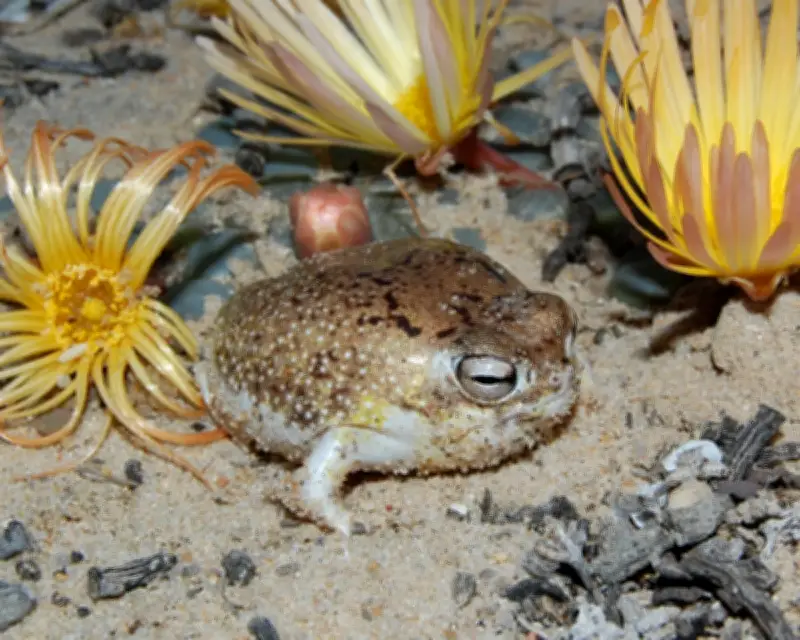
The desert rain frog, which has evolved to survive without water, and molluscs living on deep-sea hydrothermal vents are newly listed as endangered on the International Union for Conservation of Nature (IUCN) Red List due to mining activities. Meanwhile, the numbat, an Australian marsupial, has been downlisted from endangered to near threatened thanks to decades of conservation efforts.
Desert Rain Frog Threatened by Diamond Mining
The desert rain frog (Breviceps macrops), a bulbous amphibian found along the west coast of South Africa and Namibia, is now classified as vulnerable. It has adapted to arid conditions by burying itself in sand and emerging only at night to hunt insects. However, diamond mining and energy infrastructure expansion are destroying its habitat. Additional pressure comes from the exotic pet trade, which surged after a viral video showed the frog squeaking its distress call.
Deep-Sea Mining Endangers Vent Molluscs
An assessment for the Red List found that two-thirds of the 200-plus mollusc species that live exclusively on hydrothermal vents are at risk of extinction. These snails, limpets, and clams thrive in crushing depths where water temperatures reach 450°C (842°F). Deep-sea mining operations stir up sediments that smother these animals. One species, the snail Lirapex felix, is critically endangered due to mining in the Indian Ocean. However, more than 30 vent species are safe because they inhabit marine protected areas where mining is banned, such as the Mariana Arc of Fire national wildlife refuge, home to the ornate snail Provanna exquisita.
“This global assessment reveals that [vent] molluscs are one of the most highly threatened of all animal groups,” said Prof Julia Sigwart at Senckenberg Nature Research, the IUCN Red List partner that coordinated the assessment. “It provides important information as the International Seabed Authority meets in Jamaica this month.” The IUCN voted for a moratorium on deep-sea mining in 2021.
Numbat Recovery Shows Conservation Works
The numbat (Myrmecobius fasciatus), a termite-eating marsupial with striped fur, has moved from endangered to near threatened. Its population has rebounded from just 300 individuals in the late 1970s to between 2,000 and 3,000 today. This recovery was achieved through baiting and predator-proof fencing to control feral cats and red foxes, captive breeding at Perth Zoo, and translocations. At least five new self-sustaining populations have been established. However, the numbat now occupies only 0.04% of its original range across southern Australia, so continued management is essential.
“The [numbat] assessment shows that long-term conservation effort works; without it, invasive cats and foxes will continue to drive Australia’s small marsupials and native rodents to extinction,” said Prof John Woinarski, co-chair of the IUCN species survival commission group on Australasian marsupials and monotremes. “Continued management is vital not only to maintain the numbat’s unique evolutionary line as the last surviving member of the Myrmecobiidae family, but also to support its role in maintaining a healthy ecosystem, as digging for the termites it eats increases rain penetration into the soil, helping protect woodlands.”
Broader Context of Biodiversity Loss
“Life on Earth has adapted to survive in the most hostile and unusual habitats [but] as pressures on biodiversity mount across the planet, even the creatures with the most ingenious survival strategies are under threat,” said Dr Grethel Aguilar, the IUCN director general. “But there is a clear path out of the biodiversity crisis: nature conservation works. By protecting the astounding range of biodiversity on this planet, we can preserve a welcoming environment for humans and wildlife alike.”
An IUCN update in April declared emperor penguins officially endangered due to climate change causing sea ice loss and chick drownings. Additionally, five Australian marsupials—the crest-tailed, southern, northern, and little mulgaras, and the little bettong—have been confirmed extinct, likely due to predation by feral cats and foxes. More than 40 modern mammal extinctions have been recorded in Australia.
The IUCN Red List now includes 175,909 species, of which 49,505 are threatened with extinction, although many species have yet to be formally assessed.




