
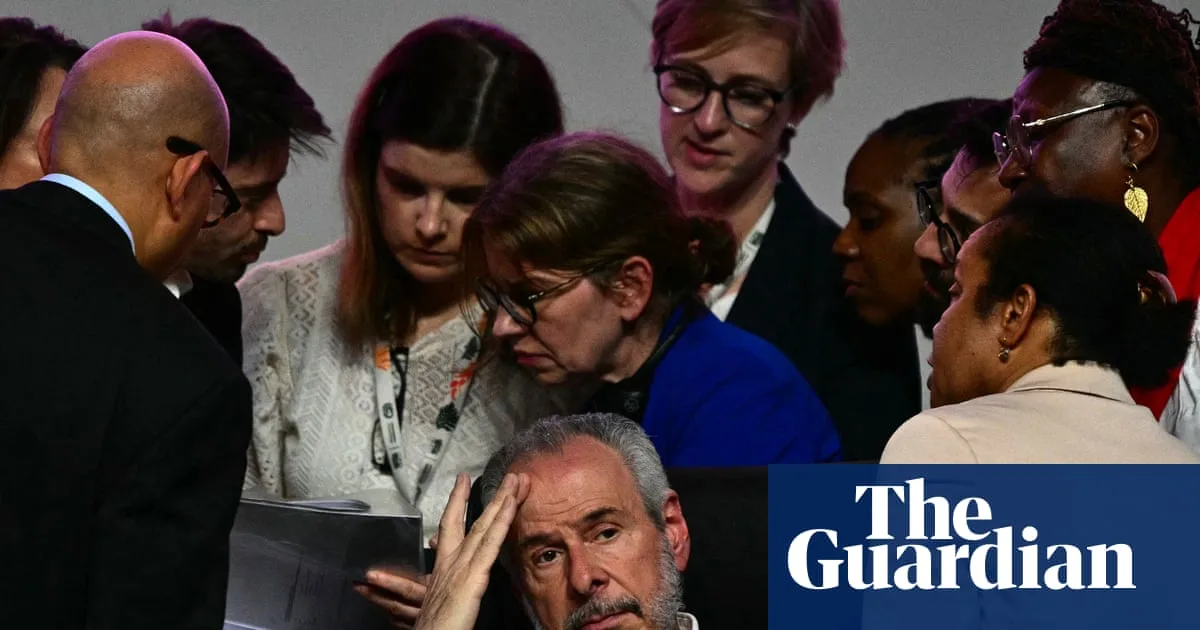
The world is not winning the fight against the climate crisis but remains in the fight, the UN climate chief has said after a bitterly contested Cop30 summit in Belém, Brazil, reached a deal on Saturday. The agreement came after fears of collapse amid deep divisions among the 194 participating nations.
Countries failed to end the fossil fuel age, with opposition led by Saudi Arabia, and underdelivered on hopes to halt deforestation, a key goal for a summit held in the Amazon. Proposals for transition roadmaps and ending deforestation were set aside for separate processes outside the UN.
Simon Stiell, the UN climate chief, acknowledged the difficult political landscape, saying: 'We knew this Cop would take place in stormy political waters. Denial, division and geopolitics has dealt international cooperation some heavy blows this year.' He added that 'climate cooperation is alive and kicking', despite the US under Donald Trump opting not to send representatives.
Stiell pointed to a line in the agreement stating the global transition to low emissions is 'irreversible', calling it a 'political and market signal that cannot be ignored'. The summit produced pledges to triple adaptation funding, establish a just transition mechanism, and recognise Indigenous peoples' rights, but environmental groups expressed disappointment. Jasper Inventor of Greenpeace International said the summit 'started with a bang of ambition but ended with a whimper of disappointment'.
UN Secretary General António Guterres warned that geopolitical divides make consensus harder, and the gap between promises and science 'remains dangerously wide'. The EU's Wopke Hoekstra called the deal 'not perfect' but 'a huge step in the right direction', while Anna Åberg of Chatham House noted that avoiding a 'Cop collapse' was positive, even if many are disappointed with the level of ambition.




