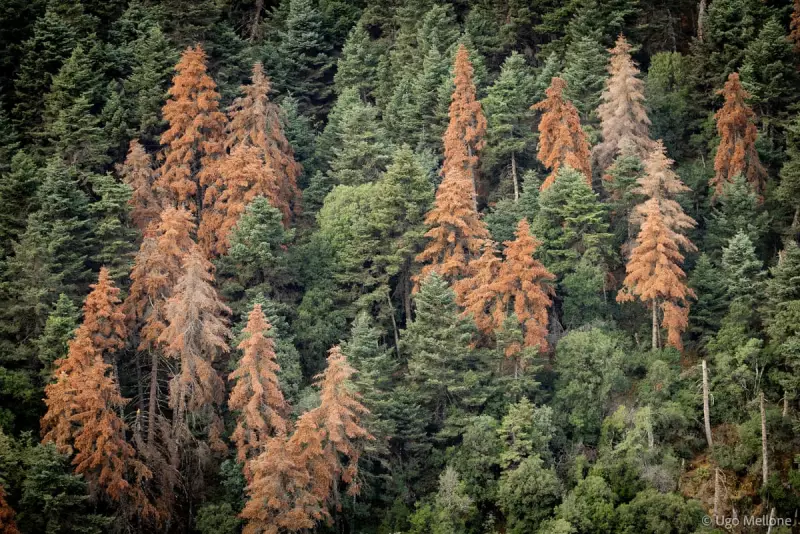
In the high mountains of Greece's Peloponnese region, a silent ecological catastrophe is unfolding. Vast swathes of the iconic Greek fir, a tree species renowned for its resilience, are turning a sinister shade of red and brown before dying off. This alarming phenomenon is occurring even in areas untouched by wildfire, signalling a complex crisis driven by the cascading effects of climate breakdown.
A Forester's Alarming Discovery
Dimitrios Avtzis, a senior researcher at the Forest Research Institute of Elgo-Dimitra, initially set out on a routine mission. His task was to document the aftermath of a spring wildfire in the Peloponnese, a familiar duty in a country where forests and fire have coexisted for millennia. However, the scene that greeted him was far from ordinary.
The scale of the damage was immediately and profoundly different. Beyond the expected fire-ravaged patches, Avtzis and his team found "hundreds upon hundreds of hectares worth of lost trees" standing dead and dying among the living green canopy, in places the flames had never reached. The level of destruction was so severe that he felt compelled to contact the Greek environment ministry directly to sound the alarm.

The Perfect Storm of Climate Pressures
What Avtzis witnessed is not the result of a single factor, but a deadly convergence of climate-amplified threats stacking upon one another. The primary driver is a severe and prolonged drought, which has become a defining feature of Greece's changing climate. This aridity is worsened by a steady decline in vital winter snow cover.
A critical study by the Institute for Environmental Research and Sustainable Development and the National Observatory of Athens revealed that between 1991 and 2020, Greece lost an average of 1.5 days of snow cover each year. This erosion of a key slow-release water source leaves soils parched and groundwater depleted.
Weakened by this chronic water stress, the mighty firs become vulnerable to a secondary, biological assault. "We found bark beetles had taken advantage. They were attacking the trees," Avtzis explains. Insects from the Scolytinae subfamily bore under the bark, severing the trees' vital nutrient and water transport systems. In drought-stressed forests, their populations can explode into uncontrollable outbreaks, delivering the final blow to already struggling trees.
A European-Scale Warning Sign
This crisis extends beyond Greece's borders. Bark beetle outbreaks have become a major concern across Europe, with similar patterns observed in countries like Spain. The implication is stark: the drivers behind the Peloponnese die-offs are not local anomalies but symptoms of a continent-wide ecological shift.
While data from Global Forest Watch shows Greece has lost 200,000 hectares of tree cover to fire since 2001, the current threat is more insidious. It is the combination of fire, drought, and insect infestation—all turbocharged by climate change—that is pushing these ancient ecosystems into uncharted territory.
Glimmers of Hope Amidst the Crisis
Despite the grim outlook, experts point to reasons for cautious optimism. Nikos Markos, a forest climatologist at the Forest Research Institute, highlights the innate regenerative capacity of Mediterranean ecosystems. "Post-fire regeneration can be quite satisfactory," he notes, though he cautions that recovery is slow and uneven, often taking four or five years to become visible.
The path forward, according to Avtzis, demands urgent action. "The government and the ministries have to take the initiative and mobilise the necessary funding to confront this problem," he states pragmatically. He confirms that some initial steps were taken following his report, with authorities contacting regional forest services to assess funding needs. The critical test, he stresses, is whether these plans are translated into concrete action on the ground.

When asked if Greece's shifting climate patterns pose an existential risk to its forests, Avtzis offers a determined response. "There is no time to be pessimistic. But we have a lot of work to do." He emphasises that the tools and knowledge exist. "We have the scientists. Now, we need to start going out and talking about this," he urges, "because what we're seeing now is only going to become more frequent and more intense." The dying firs of the Peloponnese stand as a stark, red warning for forests across a warming Europe.