
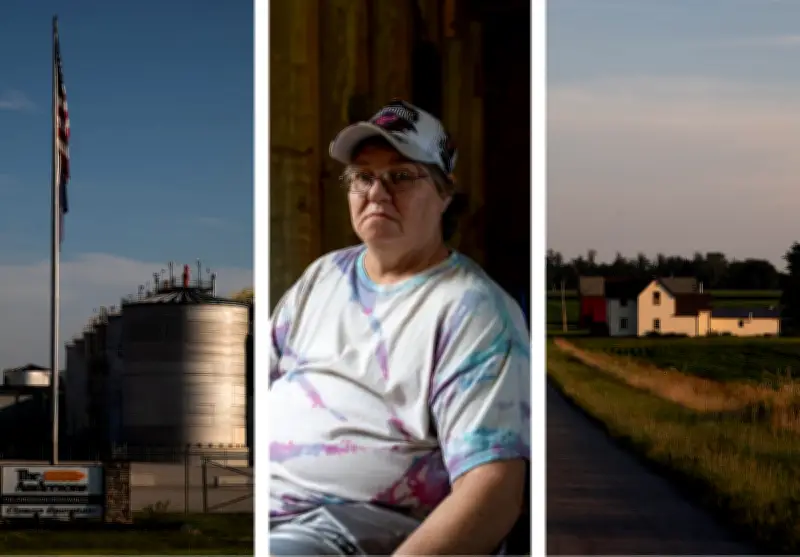
A plan to bury carbon dioxide deep under remote Indiana farmland has triggered a fierce backlash from residents who say it threatens their community. The project, led by The Andersons Renewables at its ethanol plant in Clymers, Indiana, is one of dozens of carbon sequestration developments awaiting approval across the United States, buoyed by generous federal tax credits.
Residents Fear Community Demise
Melissa Harrison, a lifelong resident of Clymers, fears the project could spell the end of her town. Generations of her family are buried in the local cemetery, and she is raising five grandchildren in a modest home surrounded by corn fields and industrial facilities. “This is our place,” she said. The town already struggles with contaminated well water, a lack of sewage facilities, and high poverty rates, according to Harrison.
Residents received letters offering $150 per year in exchange for allowing carbon storage under their properties. Harrison worries that if the area becomes undesirable, developers could take over the entire town cheaply. “If they make Clymers bad enough that no one wants to live here, they can take over the whole town, real cheap,” she said.
Company Defends Safety
The Andersons Renewables, partly owned by a Marathon Oil subsidiary, stated that the project uses safe, established technology with rigorous permitting and monitoring to protect groundwater and public health. The company plans to capture carbon dioxide from ethanol production, compress it, and inject it more than 3,000 feet underground into geologic formations identified for permanent storage. “We were able to determine the site’s suitability through seismic analysis and by drilling a test well,” the company said.
Federal Incentives Drive Rush
The Biden administration's Inflation Reduction Act authorized lucrative tax credits for carbon sequestration, which the Trump administration continued despite calling climate change a hoax. The 45Q tax credit offers $85 per metric ton of stored carbon, making projects highly profitable. Even small projects storing 200,000 metric tons annually can earn $17 million per year. Brad Johnston, an analyst at Enverus, noted that a “huge wave” of approvals is imminent, with many projects proposed at ethanol plants that emit nearly pure CO2 streams.
Environmental and Safety Concerns
Environmental groups criticize the projects as subsidies for the oil and gas industry that do not reliably cut emissions. Risks include earthquakes, water table contamination, and lethal carbon leaks. In 2024, the first commercial carbon capture project in Illinois developed two leaks under a drinking water lake, prompting a state ban on new projects under major aquifers. In 2020, a CO2 pipeline rupture in Mississippi hospitalized 45 people and forced 200 evacuations. Emergency responders described the scene as like a “zombie apocalypse.”
Charles Harvey, a professor at MIT who once co-founded a carbon sequestration company, now opposes the strategy. “It’s just the stupidest way to reduce emissions,” he said, arguing that funds should go to renewable energy instead. He likened his regret to that of J. Robert Oppenheimer over the atomic bomb.
Local Resistance Persists
Farmer Dennis Crume, who grows soybeans and corn near Clymers, refused to sign the $150-per-acre offer. “I said that’s bullcrap. I’m worried about my well,” he said. However, Indiana state law largely strips landowners of the right to reject such proposals. Crume, who has 11 grandchildren living nearby, worries about increasing pollution. “We’ve got to do something for the environment,” he said.




