
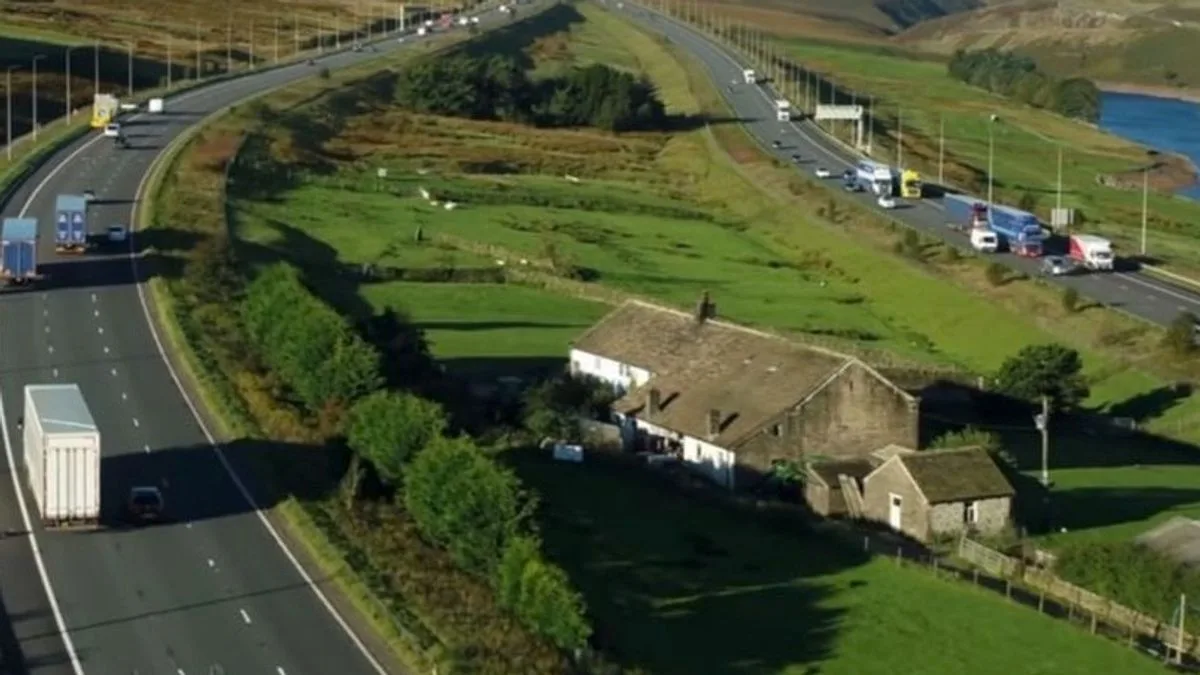
Stott Hall Farm, a historic farmhouse dating back to 1737, sits incongruously in the middle of the M62 motorway near Huddersfield, Yorkshire. The six-lane carriageway splits around the property, creating a unique island that has puzzled travellers for decades. Despite its picturesque stone walls and cosy hearth, the farm is surrounded by the constant roar of traffic linking Liverpool, Manchester, and Leeds.
Urban myths have long suggested that the farm's owner, Ken Wild, stubbornly refused to sell his land when the motorway was planned in the 1960s, forcing engineers to build around it. However, a 1983 documentary, 'Clegg's People', released by the British Film Institute (BFI), reveals the true reason. Journalist Michael Clegg explained that a geological fault beneath the farmhouse made it more practical for engineers to leave it rather than blast through and destroy it.
Ken Wild and his wife Beth moved into the farm in 1934 and lived there throughout the motorway's construction. Beth admitted that the traffic created extra dust, making cleaning harder, and the couple witnessed several fatal crashes. The closest they came to disaster was when a lorry overturned in their yard at 4.20 am; the driver escaped unhurt. Despite the challenges, they insisted the motorway did not bother them.
Today, the farm is run by sheep farmer Paul Thorp and his wife Jill Falkingham-Thorp, who bought the property just over a decade ago. They live there with their son John-William, tending to over 900 ewes and 20 Angus cattle. The family renovated the home and have adapted to life in the middle of the motorway. Jill noted that while the traffic is close, the constant wind disperses pollution, and treble glazing keeps the noise manageable. She described the setting as beautiful, contrasting with those who find it bleak.
Paul Thorp, appearing on Channel 4's 'The Pennines: Backbone of Britain', said the opportunity to take on such a large farm was once in a lifetime. He acknowledged the unique challenges of having six lanes of traffic through the property but emphasised that it is otherwise like any other farm. The family's love for their unusual home endures, despite the relentless noise and dust.




