Spanish Coastal Councils Slam Government Over Invasive Seaweed Crisis
The Spanish government is facing severe criticism for its perceived failure to address a growing environmental crisis on the nation's beaches, just as the Easter holiday and the new tourist season approach. Local authorities, particularly in popular destinations like Marbella, are struggling to manage overwhelming accumulations of invasive seaweed, which they say threatens both the environment and the vital tourism economy.
Marbella's Massive Clean-Up Effort
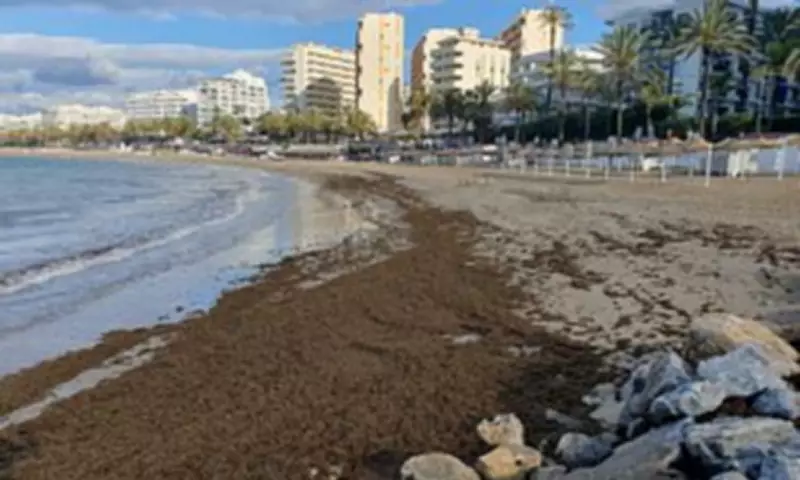
Marbella City Council has reported that it is contending with mountains of rotting invasive seaweed, with a staggering 374 tons removed in a single day alone. The council has activated a special operational device to handle these recurrent episodes, which are increasingly plaguing the coastline. However, officials express deep frustration, fearing they are engaged in a losing battle due to a lack of support from the central government.
Diego Lopez, a local councillor, detailed the challenges: 'Despite the significant volume we have removed, the water continues to hold a high concentration of biomass. This severely hinders direct action, as our machinery cannot access the sea to perform removal work in that area. Our intervention is currently focused on cleaning and collecting the seaweed that washes ashore, but the presence of material in the water is entirely dependent on currents and sea conditions.'

Lopez further emphasised the council's stance: 'In the face of the inactivity of the central government, which holds competency in this matter, the council will maintain the operational device and coordinate the cleaning service. We will continue removing algae as they reach the coast, reinforcing our available means when necessary and adapting our operations to maritime conditions.'
The Source of the Problem
This phenomenon is directly linked to the expansion of Rugulopteryx okamurae, an invasive exotic Asian algae species that has caused recurrent episodes along various parts of the Spanish coast for years. The seaweed buildup has become a significant eyesore, with environmental and economic consequences. Municipalities are forced to undertake increasingly frequent and costly cleanups to preserve the state of their beaches, which are crucial for tourism.
Marbella council asserts it remains 'committed to conserving the coast' and will continue 'working to minimise the effects of this and future episodes, prioritising safety, health, and the image of the municipality's beaches.' Other Spanish holiday resorts are confronting the same daily problem, with reports of rotting seaweed piles reaching up to three feet high in some areas. Bathers often must climb over or wade through the unpleasant mess to enter the sea.
A Heated Environmental Debate
However, the issue has sparked a significant controversy. Environmentalists argue that the rotting seaweed, particularly masses of dried posidonia, should not be removed at all. They plead that tourists should tolerate it in the interest of nature, stating: 'The masses of dried posidonia on beaches are not waste and should not be removed.'
This stance clashes directly with the concerns of hoteliers and tourism leaders, who annually complain that the huge mounds of seaweed produce a negative effect on bathers, obstruct the coastline, and generate a foul odour. They claim it damages the tourist experience and the local economy.
Conversely, many experts and scientific conservation entities, including a long list from the Balearic Islands, have urged administrations to leave the material in place. They argue that these accumulations of marine plants and algae form a natural shield that protects beaches from erosion by waves. 'The accumulations of marine plants and algae are not a sign of a neglected beach, but are part of the nature of the place,' they assert.
Thus, Spanish coastal communities find themselves caught between urgent practical clean-up demands, economic pressures from the tourism sector, and strong environmental advocacy for natural preservation, all while feeling abandoned by higher governmental support.