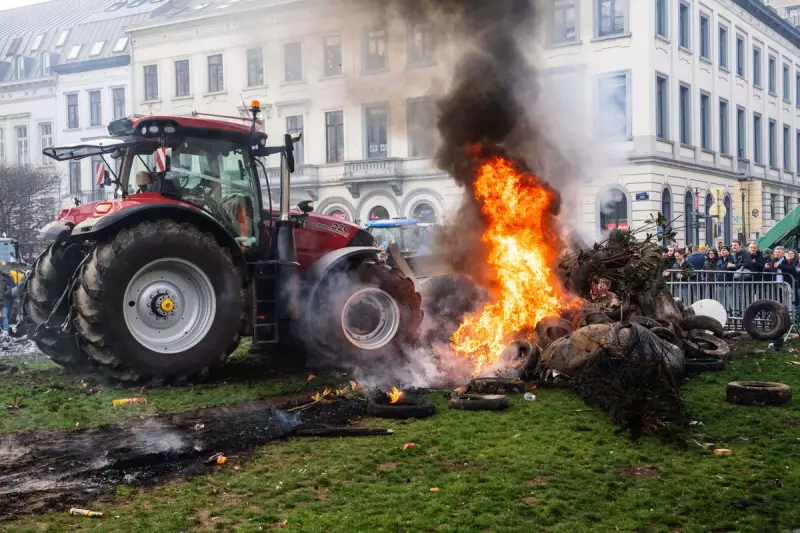
European farmers brought chaos to the heart of Brussels this week, using tractors to blockade streets and clashing violently with police in a dramatic protest against a landmark free-trade deal with South America. The demonstrations unfolded just outside the venue where leaders of the 27 EU nations were gathering for a critical summit.
Streets of Brussels Turn into Battleground
The scene turned confrontational as protesters, who had travelled from countries including France, Spain, Poland, and Belgium, hurled potatoes and eggs at police lines. They set tyres alight, creating thick black smoke that mingled with white tear gas fired by officers, who also deployed water cannons to disperse the crowds. A symbolic wooden coffin marked with the word "Agriculture" was burned, underscoring the farmers' fears for their future.
Armand Chevron, a 23-year-old French farmer, told The Associated Press the group was fighting to defend jobs across Europe. He cited opposition to carbon taxes, reductions in farming subsidies, and the unfair competition they believe the Mercosur agreement will unleash.

Pierre Vromann, a 60-year-old Belgian farmer from Waterloo, declared the deal would be "bad for farmers, bad for consumers, bad for citizens and bad for Europe." Hundreds of tractors were used to seal off roads around the EU's key institutions, bringing the city to a standstill.
Growing Political Resistance to the Pact
Inside the Europa building, the protests cast a long shadow over discussions about the trade pact, which has been under negotiation for a quarter of a century. The proposed deal would progressively eliminate duties on most goods traded between the EU and the Mercosur bloc—comprising Brazil, Argentina, Uruguay, Paraguay, and Bolivia—over 15 years.
French President Emmanuel Macron led the charge against signing the agreement, insisting it would sacrifice farmers already facing immense challenges. He pushed for further concessions and a delay until at least January, citing discussions with Italian, Polish, Belgian, Austrian, and Irish leaders.
In a significant move, Italy's Prime Minister Giorgia Meloni told her parliament that signing now "would be premature," demanding stronger guarantees for the agricultural sector. Italy's opposition is crucial, as it gives France enough votes to potentially veto the signature of European Commission President Ursula von der Leyen, who is determined to finalise the accord.
Macron's government, worried by surging far-right support linked to criticism of the deal, has demanded robust safeguards against economic disruption, stricter regulations on pesticides in Mercosur nations, and heightened import inspections at EU ports.
A Strategic Deal Hanging in the Balance
Supporters argue the agreement is a vital strategic counterweight to both China's export controls and Washington's tariff policies, covering a combined market of 780 million people. German Chancellor Friedrich Merz warned that the EU's global credibility would be damaged by further delay or scrapping the deal.
Agathe Demarais of the European Council on Foreign Relations noted the pact is also about strategic competition with China in Latin America, suggesting failure could push those economies closer to Beijing.
The tensions have agitated South American leaders. Brazil's President Lula da Silva, a fervent promoter of the deal, warned that Saturday's planned signing in Brazil was a make-or-break moment, threatening no further agreements if it collapses. Argentina's President Javier Milei, a Trump ally, also supports the pact, viewing it as a spear to penetrate global markets.
The Brussels protests are part of a wider wave of agricultural unrest across Europe, with Greek farmers maintaining highway blockades for weeks over subsidy delays and production costs, including a major disruption at Crete's international airport.