
In the fall of 2024, I spotted a middle-aged couple standing on their front lawn in Bucks County, Pennsylvania. I waved and gingerly approached. The woman, whose name appeared in my canvassing app, told me she had never voted in an election before, had never seen politics as relevant to her life. And her husband, she said, was a lifelong Republican. But after the return of Donald Trump as the Republican presidential nominee, it felt like it was time to take a stand. They were both going to vote for Democrats up and down the ballot in November.
On the other side of the street, directly facing their house, were two of the biggest Trump 2024 flags I had ever seen, along with a life-size cutout of Trump on a third lawn.
I have now been canvassing regularly for Democratic candidates for almost 10 years, and I will be honest: that first door still feels intimidating. The thought of knocking on a stranger's door and asking them to talk politics makes my hands feel clammy and my heart beat erratically.
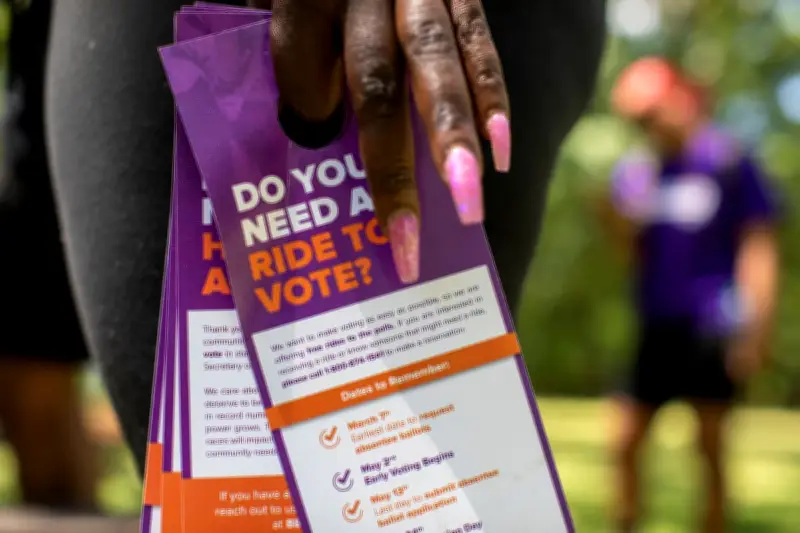
You arrive with a few dozen names and addresses listed on a bespoke app, a comfortable pair of shoes for walking, and a good lunch. (Canvassing makes you hungry.) Mostly, you leave behind flyers and door-hangers, but every time you canvass, you might connect with someone who had been hoping, whether they knew it or not, to talk with someone just like you.
We show up as canvassers to engage in good-faith dialogue with strangers about what a better tomorrow might look like. It is grounded in the belief that conversation can be powerful, that hearing from a neighbor who has given up their afternoon to show up at your door could prod you into action.
Newcomers on one of my group's past canvassing trips would get on-the-fly tutorials in passenger seats and on sidewalks, offering hands-on canvassing guidance: don't put flyers in mailboxes (it's illegal); skip doors with scary dogs or Maga flags; develop a one-to-two sentence introductory patter, then listen for clues as to what the person at the door might care about. Canvassing could be stressful but was not hard, and newbies could become adepts after two or three Sundays. And our work played a small part in flipping a New York City congressional seat from red to blue in 2018, and winning the gubernatorial and Senate races in Pennsylvania in 2022.
Try as we might, we could not close the deal at every door. I still think regularly about a Bucks County man I met in the fall of 2024 who told me that he could not imagine his state supporting Donald Trump, but he refused to cast a vote for Kamala Harris. I wish I had done more to convince him to hold strong for democracy.
Some of the Democratic party's collective confidence about the efficacy of canvassing has been shaken after 2024. Does the door-to-door approach still work when Republicans are successfully using digital strategies that seem to bypass the doorbell entirely? Those questions feel valid, particularly in a country where so many have fallen prey to the lures of Trumpian authoritarianism. My hope that a silent majority of Democrats and sensible centrists revolted by Trump, like my Bucks County couple, would carry states like Pennsylvania in 2024 proved illusory.
I believe in canvassing nonetheless because I see it as one of the strongest weapons we have against creeping autocracy. But might I suggest it, too, as a kind of spiritual workout, exorcising the demons of negativity and despair and the misguided belief that all our fellow Americans are beyond redemption, or that the future has already been written?
For those of us who have been feeling unmoored by the state of the country and the future of US democracy, those doors are where our ideals meet unforgiving reality. If we want to build a better future, we will have to do it right here, surrounded by unfriendly dogs and intrusive Ring doorbell cameras. Knocking on someone's door is not the same as being in community with them, but it is a similar act of optimism, grounded in a belief that there might still be a shared American language not yet corroded by the toxicity of homegrown authoritarianism.
Each time I canvass, about halfway through my designated round of 40 or 50 doors, I start to experience a sense of contentment that I encounter nowhere else. In this moment, at this door, I know where I am supposed to be, and what I am supposed to do. When I hit that last door, I find myself letting out the breath I didn't know I'd been holding.
The other night, about 40 people crowded into my living room to listen to some witty, politically-minded country folk songs by the great Oscar Owens of Gangstagrass. Oscar was playing at our fundraiser for Movement Voter Project, an organization that supports grassroots groups in battleground districts and states. Campaigns tend to burn money at staggering rates and leave no usable infrastructure behind. MVP supports the kind of slow, year-round work that actually builds winning coalitions for November and far beyond.
Saul Austerlitz is the author of How to Assemble an Activist.




