
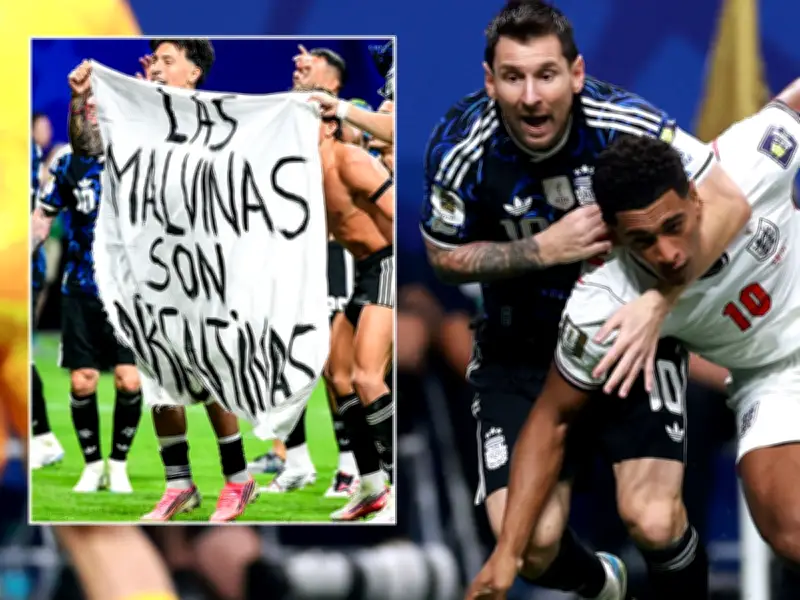
Argentina's 2-1 victory over England in the World Cup semi-final has sparked widespread allegations of rigging, with fans pointing to a series of controversial moments involving Lionel Messi and the refereeing. The match, held at the Atlanta Stadium in Georgia, saw England take the lead before Argentina equalised and scored a last-minute winner through Enzo Fernández. However, the result has been overshadowed by claims of favouritism towards the Argentine team.
Messi's 'Rugby Tackle' and Other Incidents
One of the most talked-about moments was when Messi appeared to put England's Jude Bellingham in a headlock during the first half. The incident, which went unpunished by referee Ismail Elfath, drew comparisons to a rugby tackle on social media. Bellingham later downplayed the clash, saying: "We was discussing a foul actually, it was nothing bad. I'm sure everyone will do their thing and make it a big deal but it was nothing big really."
Another controversial moment came in the build-up to Argentina's winning goal, when Messi appeared to stamp on England full-back Djed Spence. Fans questioned why VAR did not intervene, with one writing: "Messi's stamp on Spence before Lautaro's goal, why does VAR only work when the goal is against Argentina?"
Referee Bias Allegations
Referee Ismail Elfath, who has officiated four Inter Miami games featuring Messi, was described as Messi's 'favourite referee' by fans. At half-time, Messi was seen approaching Elfath for a conversation, which sparked further suspicion. England fans took to social media, with one complaining: "Messi trying to sweet talk the ref." Elfath awarded only two yellow cards in the first half despite 19 fouls, with 12 committed by Argentina.
The foul count for the match reached 26, with Argentina receiving three yellow cards and England one. This made it one of the most physical World Cup clashes, yet many felt Argentina escaped harsher punishment.
Previous Tournament Controversies
Conspiracy theories had been building throughout the tournament. In Argentina's group stage match against Algeria, Messi escaped a red card after appearing to rake his studs down an opponent's leg. Argentina received zero bookings in that game despite committing 13 fouls. Similarly, in their round of 32 match against Cape Verde, FIFA President Gianni Infantino was seen congratulating Argentina on television, which fans interpreted as bias.
The most contentious match before the semi-final was against Egypt, where a VAR decision ruled out a second Egyptian goal for a foul that occurred 100 yards away and 20 seconds earlier. Egypt's manager called the match "clearly rigged" after a late penalty claim was denied and Argentina scored a 93rd-minute winner.
In the quarter-final against Switzerland, a VAR review overturned a yellow card for Argentina's Leandro Paredes and instead booked Switzerland's Breel Embolo, leading to a red card. Fans accused FIFA of skewing the tournament for Argentina.
Falklands Banner Sparks Political Row
After the match, Argentina players Lisandro Martínez and Giovani Lo Celso held up a banner reading "Las Malvinas son Argentinas" (The Falklands are Argentine). The Falkland Islands, a British Overseas Territory, were the subject of a 1982 war between the UK and Argentina. The banner has led to calls for FIFA disciplinary action, as political slogans are prohibited on the field.
Argentina Vice-President Victoria Villarruel had earlier described England as "invaders" and "usurping pirates," and she shared a photo of the banner after the match. UK Business Secretary Peter Kyle called the players' behaviour "entirely inappropriate," adding: "Politics needs to be separate from football... that is now a matter for Fifa."
Argentina boss Lionel Scaloni had previously said he did not want the fixture to become about the conflict. FIFA fined the Argentine Football Association £20,000 in 2014 for a similar banner display.




