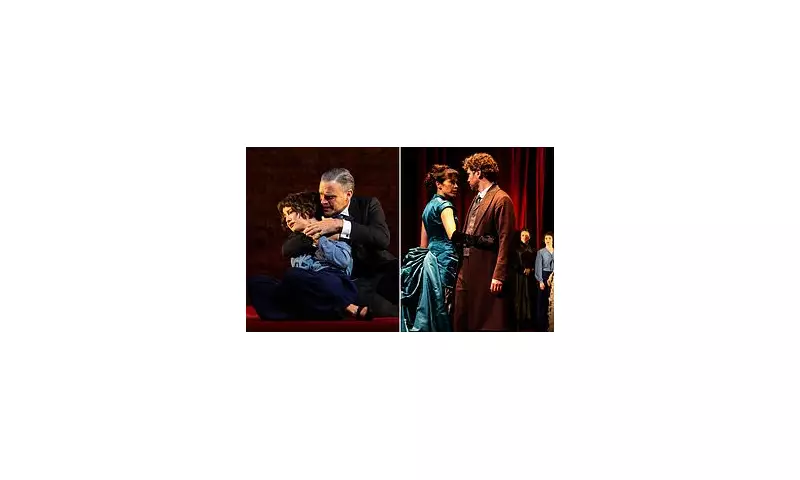
Two major theatrical productions are currently reimagining Victorian-era stories for modern audiences, offering powerful and distinct interpretations of classic narratives. In Stratford-upon-Avon, John Galsworthy's sprawling family epic The Forsyte Saga is presented in a stark, intense adaptation, while Sheffield's Crucible Theatre injects local flavour into Charles Dickens's perennial festive favourite, A Christmas Carol.
A Greek Tragedy of Victorian Propriety
At the Swan Theatre in Stratford-upon-Avon, Lin Coghlan and Shaun McKenna have masterfully condensed John Galsworthy's monumental The Forsyte Saga into a gripping, two-part drama. Directed by Josh Roche, the production strips the story back to its essential conflicts, played out on a bare stage adorned only with red curtains, a carpet, and a handful of chairs.
The story is framed by the modern reflection of Fleur Forsyte, portrayed by Flora Spencer-Longhurst, who questions her family's legacy. The answer unfolds with what one critic described as "the savage intensity of Greek tragedy," exploring the dark inheritance of money, property, and deep-seated familial feuds.

The oppressive world of the Forsytes is immediately established through costume. Women are laced into corsets, legally rendered the property of their rigid, frock-coated husbands. This dynamic is chillingly embodied by Joseph Millson as the deeply complex Soames Forsyte, a man both hateful and pitiable. His possession of his first wife, the enchanting Irene (a beautifully restrained Fiona Hampton), leads to catastrophic consequences.
The central crisis ignites when Irene falls passionately for the architect Philip Bosinney (Andy Rush), hired by Soames himself. Their connection, witnessed by the horrified family, is likened to a match flaring in a dark room. The production's power lies in its sparse dialogue and potent imagery, from a devastating marital rape scene to the sweeping shifts in location achieved through Alex Musgrave's lighting and Max Pappenheim's soundscape.
Legacy of Obsession
While the first part stands powerfully alone, the second delves into the next generation. It reveals how Fleur has inherited her father's entitled and obsessive nature, as she sets her sights on Jon, the son of Irene and Bosinney (played again by Andy Rush). This continuation underscores the inescapable cycle of familial traits and passions, making for utterly enthralling theatre where every second counts.
This acclaimed production of The Forsyte Saga continues at the Swan Theatre in Stratford-upon-Avon until January 10.
A Sheffield Carol for a Christmas Conversion
Meanwhile, at the Sheffield Crucible, director Elin Schofield has crafted a uniquely local take on Dickens's A Christmas Carol. Aisha Khan's fresh yet faithful adaptation is ingeniously woven with the tradition of Sheffield Carols—folk hymns that found a home in the city's pubs after being banned from churches during Queen Victoria's reign.
These robust, acapella songs, arranged by Matthew Malone, provide a heartwarming and earthy backbone to the story. From the full-throated "Hail Smiling Morn" to the atmospheric "Sweet Chiming Bells," they enrich a beautifully staged and costumed production.
Ian Midlane plays Ebenezer Scrooge, whose journey from miser to benefactor forms the core of the tale. A cheerful narrator, played by Mel Lowe, conjures the story for his impoverished siblings, ensuring the audience never doubts the story's redemptive conclusion. Midlane's Scrooge, while grumpy, seems to have a cuddly inner-Father Christmas straining to break free from the start.
The visits from the Ghosts of Christmas Past, Present, and Future reveal the roots of Scrooge's misery in childhood neglect, leading him to a panic-stricken realisation of his own unloved fate. His transformation is joyous and instantaneous, culminating in a festive finale with everyone on song.
This heartwarming and community-spirited production of A Christmas Carol runs at the Sheffield Crucible until January 10.

Two Sides of a Victorian Coin
Together, these productions showcase the enduring power of Victorian stories. One exposes the brutal constraints and psychological violence beneath the era's respectable surface, while the other champions the enduring human capacity for redemption, community, and joy. Both offer unmissable, critically acclaimed theatre this season.