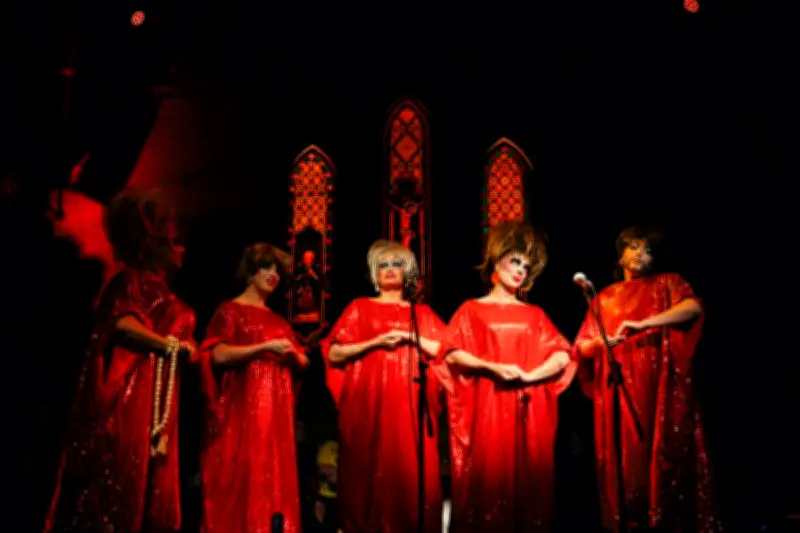
Divine Playhouse, a year-long queer-friendly arts pop-up in a deconsecrated Sydney church, is fighting eviction after Christian groups protested its launch party, which featured drag queens dressed as nuns. The venue, supported by the New South Wales government and the City of Sydney, was conceived as an affordable space for artists to create and experiment. But since images of performances were shared, campaigners have demanded the return of $100,000 in state arts funding, and an open letter calling for an apology to the Christian community has gathered more than 5,000 signatures. The venue's Instagram account has also been taken down due to complaints.
Lease Under Threat Over 'Offensive Trade'
The venue's lease is now under threat after it was issued a breach notice complaining that Christian beliefs have been “insulted and mocked,” and that Divine Playhouse must cease operating on the grounds of “offensive trade” and to prevent “public protests [that] are almost certain to occur and are likely to endanger members of the public.” The premier, Chris Minns, has said government officials are investigating whether Divine Playhouse’s offering is consistent with how it was described in the grant application.
Broader Debate on Free Speech
James Thorpe, vice-chair of the Night Time Industries Association and founder of Odd Culture Group, argues that beneath the debacle is a fundamental debate about who gets to speak and whose offence carries the power to silence another’s voice. “Liberal democracy rests on an uncomfortable bargain,” Thorpe writes. “We surrender the power to silence those who offend us in exchange for the freedom to speak when our own ideas offend others.”
Thorpe, who grew up in the church, notes that queer people have long fought for spaces to be themselves, often in a world that told them their lives were sinful. He points out that Christian iconography is part of queer culture too, and that queer artists have the right to confront, parody, and subvert it.
Hypocrisy in Outrage
Thorpe highlights the hypocrisy in the outrage, noting that while he finds views like those of Lyle Shelton—who compared children raised by same-sex couples to the Stolen Generations—profoundly offensive, he has never demanded church doors be closed or tried to control what is said from pulpits. “As a taxpayer, I help subsidise the income, payroll, fringe benefits tax and land tax concessions that buoy institutions teaching people that my relationships are sinful,” he writes. “Christians help fund art they may consider blasphemous. This is not a failure of pluralism. It is pluralism, simpliciter.”
Queer Erasure Online
The targeting of Instagram pages and brigading of Google reviews is not harmless theatre, Thorpe warns. When a venue or artist loses an Instagram account, it can lose its audience, ticket sales, and connection to community. Many artists who will lose bookings at Divine Playhouse are frightened to speak out, having seen how quickly visibility can make them the next target.
Thorpe also dispels the idea that Christianity holds a unique claim over Australian public life, noting that fewer than half of Australians identify as Christian, and that for tens of thousands of years before colonisation, the continent was home to the oldest continuing cultures on Earth. “If being ‘insulted and mocked’ becomes a mechanism for eviction, every artist who challenges power is vulnerable,” he writes.
A Call for Pluralism
Thorpe concludes by calling for queer culture not to be made smaller to accommodate the sensibilities of those who have argued for queer erasure. “Divine Playhouse should not have to become quieter, straighter or more respectable to earn its place in Sydney,” he writes. “To those who say they are offended, I say: I understand. Queer people understand offence very well. We bore your right to offend us. That was our part of the bargain. Now it’s time for you to honour yours.”