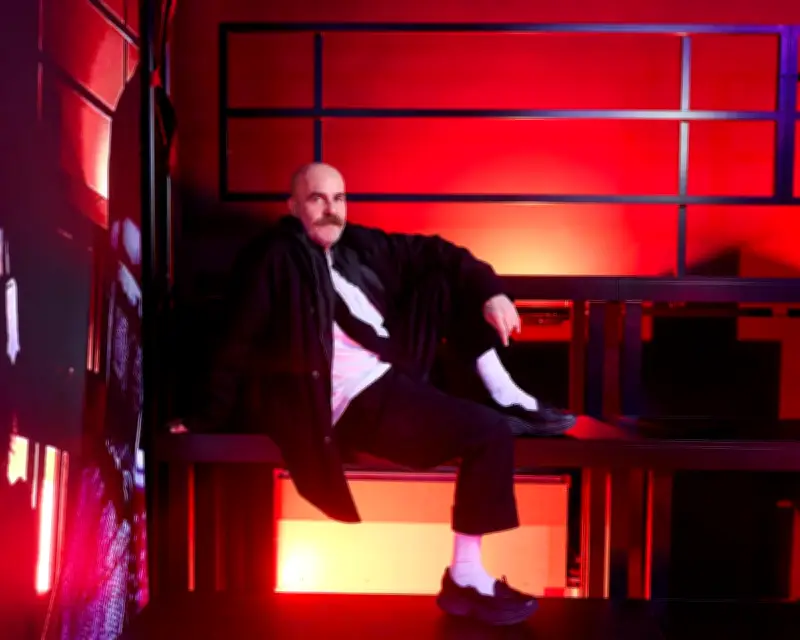
Greek artist and architect Andreas Angelidakis has transformed the Greek pavilion at the 2026 Venice Biennale into an immersive installation called 'Escape Room,' blending personal history, political commentary, and pop culture references. The pavilion, originally designed by M Papandreou and inaugurated in 1934, now features a light-up dancefloor, Frankie Goes to Hollywood's 'Relax' playing on the sound system, and wilted classical columns hanging from the ceiling or arranged as seating.
Personal Trauma and Artistic Expression
Angelidakis, 58, revealed that his work often stems from personal tragedy. 'I've made projects that appear funny to people, but they were about my mother's suicide,' he said, citing his 2013 video 'Troll,' which imagines an Athens housing block falling into ruin and ultimately leaving the city to become a mountain. 'Troll is a Norwegian object, and it's a building that goes and kills itself. So my work is, in fact, very dark.'
The artist experienced a series of devastating events in 2010: his father died of cancer, he was diagnosed with HIV, and the family faced bankruptcy. 'Death, bankruptcy and HIV all in three months was too much,' Angelidakis recalled. 'I really collapsed, and I think that's what forced me to become an artist and stop feeling obliged to call myself an architect.' Two years later, his mother died by suicide. He also went through a divorce from artist Angelo Plessas in 2021 after 22 years of marriage.
Political and Historical References
The 'Escape Room' installation is laden with political symbolism. The columns reference Picasso's 'Guernica,' the migration crisis, and the artist's sexuality, nodding to soft furnishings once known as pouffes. Riot shields protect two neon eggs representing 'the fascism that hatched in 1934,' the year the pavilion opened. Inflatables on the walls bear deconstructed versions of the MAGA slogan, including one that says 'Make Erika Eat Again,' a reference to Charlie Kirk's widow Erika. 'She's a wild phenomenon,' Angelidakis noted. 'They tell her to be sad and she comes on dressed like Janet Jackson doing Rhythm Nation, with a black cap, almost doing the Elon Musk salute.'
The pavilion's history is deliberately addressed: it opened when Greece and Austria sought to join the fascist axis with Italy and Germany, and its Byzantine-style facade reflects the Greek government's architectural preferences of the time. 'You know, let's make Istanbul Constantinople again,' Angelidakis said, referring to the long-standing Greek nationalist slogan. 'That has been the slogan for centuries – even though Byzantium was the Roman empire and we were made captive by it. I'm addressing some of those aspects of Greek delusion, in a way.'
Technology and Pop Culture Influences
Angelidakis's work heavily incorporates technology and internet culture. He began exploring digital realms in the 1990s after studying at Columbia University, where he was part of the first paperless studio. 'I got my first email in 94, and by the end of my degree I was doing computer animation and uploading things,' he said. The installation includes an LED screen broadcasting hall of mirrors-style images of visitors, a nod to Plato's cave, and a souvenir shop with giant books and T-shirts commemorating LGBTQ+ activist Zak Kostopoulos.
The artist also draws inspiration from RuPaul's Drag Race, which he calls 'like Malcolm X for gay kids.' He said, 'Because a child growing up today can see drag queens talking about their boyfriends and the problems of being masculine and feminine. That did not exist for my generation.'
A Critique of National Pavilions
Angelidakis is openly critical of national pavilions at the Biennale, which he sees as continuing the original purpose of foreign policy from the late 1800s. 'I'm against national pavilions. That's why I'm turning it into an escape room,' he said. He noted that protests against the participation of Russia and Israel at the Biennale often fail to address the system that generates the problems. 'So that's why I'm changing the function of the pavilion. It's no longer national, it's an escape room. But of course, it's a game, all of this. Science fiction and technology are my passions.'
The installation officially opened at 4:20 pm, a mischievous reference to cannabis culture, followed by an afternoon rave with Greek DJs from Power Dance Club. 'I like to see the world in a slightly altered state,' Angelidakis admitted, smoking a spliff during the interview.
The Venice Biennale runs until 22 November. In the UK and Ireland, Samaritans can be contacted on freephone 116 123. In the US, the 988 Suicide & Crisis Lifeline is available at 988 or 988lifeline.org. In Australia, Lifeline is 13 11 14.