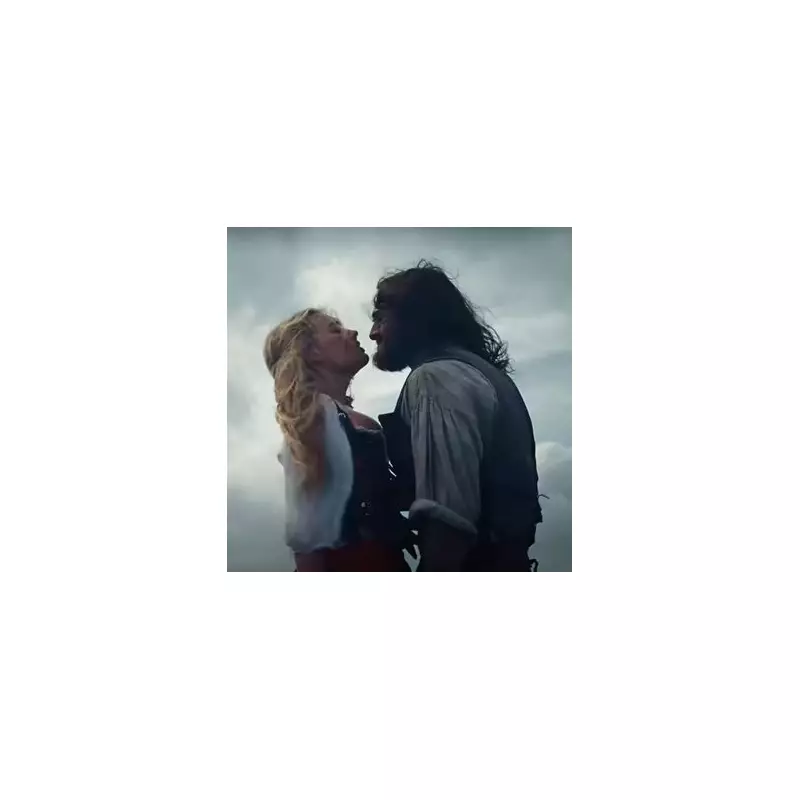
Emerald Fennell's steamy and provocative trailer for her upcoming Wuthering Heights adaptation has sent shockwaves through the literary internet, sparking intense debate about fidelity to Emily Brontë's original text. The two-minute-and-forty-second preview presents either a glorious cinematic disaster or an immaculately calculated practical joke aimed squarely at traditionalists.
A Calculated Provocation or Cinematic Misstep?
Fresh from the success of Saltburn, a film renowned for its expansive exploration of sexual appetite, Fennell appears to have surveyed the Brontë literary estate and deliberately crafted a trailer designed to make its most loyal custodians clutch their Waterstones totes in dismay. The resulting cinematic interpretation has already generated a substantial catalogue of perceived offences against the original text.
Casting Controversies and Bold Claims
The casting decisions alone have raised eyebrows among literary purists. Margot Robbie, aged thirty-five, has been cast as Catherine Earnshaw, who inconveniently dies at just nineteen in the novel. Meanwhile, Jacob Elordi, Gen-Z's favourite Australian internet-boyfriend, takes on the role of Heathcliff, a character originally described with terms like "dark-skinned", "gypsy" and "other".

Yet the most significant controversy emerges not from the casting choices, the gaudy interior designs, or even the notorious red latex costuming, but from nine bold words that flash across the screen: "Inspired by the greatest love story of all time." This declaration, almost certainly a tongue-in-cheek nod to the marketing of Samuel Goldwyn's 1939 adaptation, has become the focal point for mounting outrage.
Literary Backlash and Online Reactions
Backlash has accumulated in substantial heaps over the many suggestively erotic scenes featured in the trailer, scenes that book enthusiasts are quick to point out are entirely absent from Brontë's original text. One YouTube commentator observed: "I fear they're making it extremely sensual and provocative for shock value when the book had none of that at all." Another viewer quipped: "I didn't know Wuthering Heights was the fourth instalment in the 50 Shades of Grey franchise."
Writing in the Guardian, Samantha Ellis declares that labelling Wuthering Heights as a great love story surpasses all of Fennell's other transgressions, including the notorious latex costume, concluding definitively that "it's no romcom." This assessment holds truth in the same manner that a house fire differs fundamentally from a candlelit dinner.
Reconsidering the Nature of Literary Love
While the trailer offers minimal comedic elements, unless one finds fingers suggestively wandering into fish and eggs particularly humorous, to deny that Wuthering Heights constitutes a love story because its love turns viscous, narcissistic and ultimately ruinous represents a fundamental misunderstanding of how Emily Brontë interrogates romantic clichés about perfect love.
Wuthering Heights does not present a realistic account of relationship dynamics within the confines of Yorkshire village life. Instead, it functions as a gothic fever dream, crowded with obsession, cruelty, childhood innocence, revenge, and, unavoidably, love in its most extreme manifestation.
The Adaptation Challenge
Any director intending to tackle this formidable novel must contend with its many strange, obscure and incompatible elements. These range from its Russian-doll-like structure featuring unreliable narrators, time jumps and cast changes to its pervasive violence and inhospitable characters operating within a desolate landscape untouched by conventional morality.
The crucial question, therefore, does not concern whether Fennell remains faithful to the original text. No adaptation of Wuthering Heights can achieve complete fidelity, as the book proves too large, too strange and too unstable to submit fully to cinematic interpretation. The more compelling question involves what elements she has chosen to emphasise and remain faithful to in her adaptation.

Unearthing the Erotic Undercurrents
Unsurprisingly given Fennell's previous work, the answer appears to be sex. While no explicit sex scenes occur in Wuthering Heights, reading the novel immerses one in an atmosphere thick with erotic charge: bodies locked together in anger and longing, desire expressed through violence, proximity, obsession, and an almost pathological refusal of separation.
Cathy does not merely love Heathcliff but famously declares, "I am Heathcliff" – she insists that he constitutes her substance, her very being, the entity without which she cannot exist. Heathcliff responds not with tenderness but with overwhelming possession. This represents not romance in any modern sense but rather profound erotic fixation.
Heathcliff as Erotic Engine
Heathcliff functions as the primary engine of this erotic energy. Described by critic Richard Chase as "a sheer, dazzling sexual force," Heathcliff operates as an invader of households, constantly engaged in power play, the object of Cathy's unruly desire, and a lover demanding total union at any cost – even if that means disturbing the sanctity of a grave.
Much online resistance to Fennell's framing relies on a familiar sleight of hand – readers mistaking the absence of explicit sex acts for the absence of sexuality itself. Yet Wuthering Heights stands as perhaps the greatest example of a nineteenth-century literary tradition in which sex appears everywhere except where it is directly named.
Desire Displaced into Landscape and Action
Desire leaks persistently into weather descriptions, landscape imagery, themes of confinement, and acts of cruelty. The moors themselves seem to pulse with erotic energy. Obstacles are violently pushed through, rooms invaded, bodies struck, bitten and resisted. What remains unexpressed directly becomes displaced into extremity of action and environment.
This displacement explains why the novel often produces two distinct readings. On first encounter, it feels intoxicating – a story of total, tragic attachment that inspired Kate Bush, aged just eighteen, to write her iconic pop song. Upon second reading, however, the narrative curdles disturbingly. What once felt passionate now appears obsessive, coercive, even sadistic. The book does not mature, but the reader inevitably does.
Fennell's Personal Connection
In September, Fennell told the Brontë Women's Writing Festival that she felt a "profound connection" with the book upon first reading: "I wanted to make something that was the book when I experienced it at fourteen." The trailer, featuring shirtless, six-foot-five Elordi labouring the land, bread being kneaded into submission, and breathless exchanges between lovers ("Do you want me to stop?" "No"), possesses imaginative foundations within the original text.
Fennell's visual frames represent not so much erotic 'twists' as a deliberate excavation of that which was barely buried within Brontë's prose. If Wuthering Heights indeed constitutes the "greatest love story of all time," it certainly does not resemble anything one might seek on contemporary dating applications.
A Different Kind of Love Story
Cathy rejects Heathcliff for a proper, socially acceptable match; Heathcliff responds by dedicating his entire existence to the systematic ruin of everyone involved. Yet it may represent one of literature's greatest love stories in another sense entirely: few literary attachments demonstrate such monumental scale, relentless force or unembarrassed intensity. This is not love as comfort or compatibility, but love as obsession – naked, antisocial and all-consuming.
Historical Parallels in Reception
When the novel first appeared in 1847, it baffled and alarmed its original readers. Contemporary reviewers found it coarse, savage and fundamentally unseemly. Even Charlotte Brontë, Emily's own sister, apologised for the work in a posthumous preface, describing it as "terrible and goblin-like." The book was effectively accused of exhibiting bad taste.
That a century and a half later, identical charges are being levelled against a film trailer suggests less a butchering of the original text than an ingenious fidelity from a director who has fundamentally understood her assignment. Fennell's interpretation may prove controversial, but it engages deeply with the erotic undercurrents that have always pulsed beneath the surface of Brontë's masterpiece.