Viewers of the popular ITV quiz programme The 1% Club found themselves thoroughly perplexed following the latest episode, as a final picture question involving national flags generated widespread confusion and debate. The brain-teasing conundrum, shared on the show's official social media account, prompted a flurry of comments from fans who were left baffled by what many perceived to be a hidden catch in the question's phrasing.
A Question of Interpretation
The BAFTA-nominated show, hosted by comedian Lee Mack, challenges contestants with progressively difficult riddles rather than testing general knowledge. Each puzzle is rated based on the percentage of the public estimated to solve it, with players contributing £1,000 to a prize pot upon elimination. Those reaching the final round can win up to £100,000, culminating in the notoriously challenging 1% question designed to stump 99% of people.
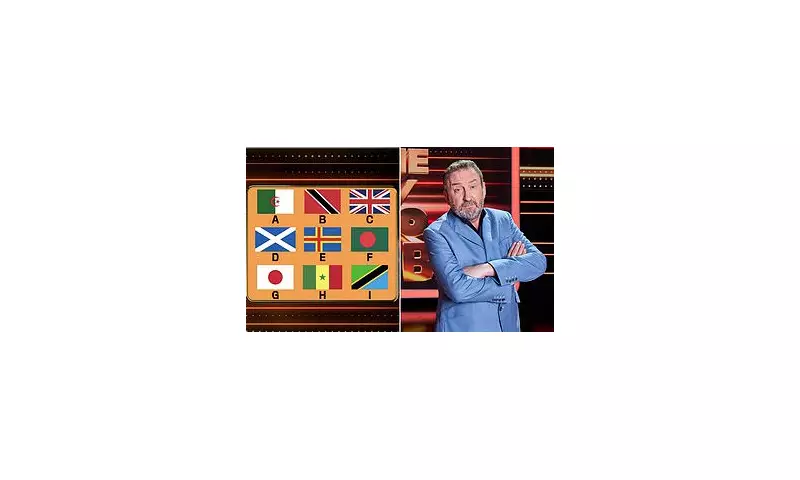
However, it was a recent flag-based puzzle that truly captured viewers' attention. The question posted to X read: 'If you take away all the flags that have stars, circles, red crosses, black stripes, and the colour green, which one is left?' Nine flags were displayed, labelled A through I: Algeria, Trinidad and Tobago, United Kingdom, Scotland, Aland in Finland, Bangladesh, Japan, Senegal, and Tanzania.

The Linguistic Conundrum
While the show's official account later revealed the correct answer as D, Scotland, many viewers argued that the question's wording created significant ambiguity. The crucial issue centred on the use of the word 'and' rather than 'or' in the list of excluded features.
As several astute fans pointed out, the phrasing 'stars, circles, red crosses, black stripes, and the colour green' using 'and' could be interpreted as requiring all those features to be present for a flag to be removed. Since none of the nine flags contain all those elements simultaneously, this interpretation would mean all flags remain, making every option technically correct.
One viewer commented: 'All of them because none of them have stars, circles, red crosses, black stripes and the colour green...' Another added: 'Being a pedant, isn't the answer for all of them, as the question lists all the options and the word AND, which suggests you need to remove all flags that have all those things.'
Grammatical Nuances Spark Debate
The discussion expanded to include grammatical technicalities, with some participants noting that the plural forms used in the question ('stars', 'crosses', 'stripes') could further complicate interpretation. One contributor observed: 'You've made a mess of the question. It should be star singular, cross singular, black stripe singular, etc. Nine of them have plural stars, crosses or black stripes.'
This linguistic scrutiny highlights how The 1% Club's distinctive format, which emphasises logical problem-solving over factual recall, can sometimes create unexpected complexities through seemingly simple wording choices. The 30-second time limit adds further pressure, forcing contestants to make rapid interpretations that might differ from more leisurely analysis.
Rollover Format Adds New Dimensions
The flag controversy emerged alongside the show's new spin-off format, The 1% Club Rollover, which has introduced additional strategic elements. In this version, unclaimed prize money carries over to subsequent episodes, creating potential jackpots of up to £500,000. Furthermore, players who reach the 1% question automatically qualify for the next programme, offering repeated opportunities to claim substantial winnings.
During recent episodes, only one contestant managed to reach the final question, opting to pocket £10,000 rather than attempt the 1% puzzle, thereby securing a return appearance. This strategic decision reflects the increased stakes and calculated risk-taking encouraged by the rollover format.

Viewer Reactions to Difficulty Levels
Interestingly, while the flag question proved challenging for many, some viewers have complained that other recent puzzles have been surprisingly straightforward. Following an episode where the 1% question involved identifying a repeated and missing number on a 5x5 grid (ultimately revealed as 18 repeated and 19 missing), several fans took to social media to express their views.
One viewer remarked: 'This is too easy! How are all these people going out?' while another stated: 'That 1% question was too easy! Got it straight away!' These contrasting reactions demonstrate the subjective nature of puzzle difficulty and the diverse problem-solving abilities among both contestants and home viewers.
The ongoing discussions surrounding The 1% Club's questions highlight the programme's unique position in British television entertainment. By focusing on logical reasoning rather than factual knowledge, it creates puzzles that can be interpreted in multiple ways, generating engagement and debate that extends far beyond the studio. As the rollover format continues and prize pots grow, viewers can anticipate further intriguing conundrums that test both linguistic precision and problem-solving agility.