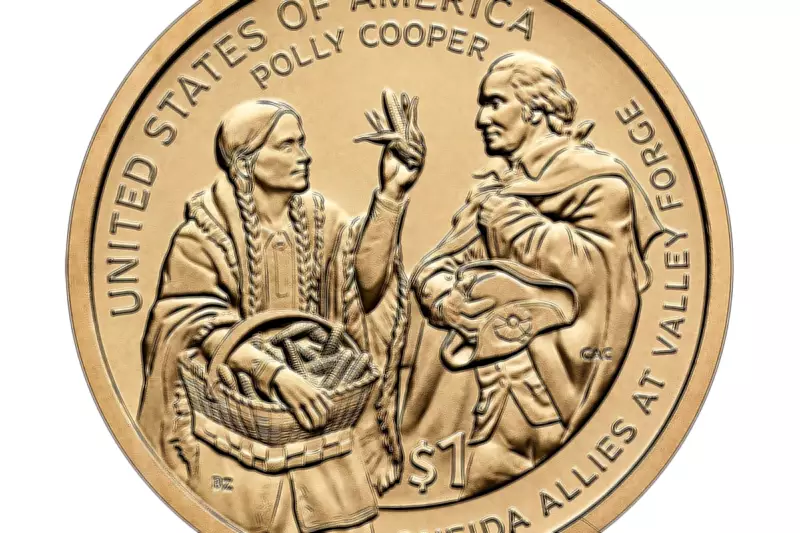
In a significant tribute to Native American history, a newly minted $1 coin will feature Polly Cooper, a woman from the Oneida tribe renowned for her crucial assistance to George Washington's Continental Army during the American Revolutionary War. The coin's release this week aligns with celebrations marking the 250th anniversary of the signing of the Declaration of Independence, bringing long-overdue recognition to Cooper's heroic actions.
A Journey of Compassion and Courage
The coin commemorates Cooper's pivotal role in a daring 1778 relief expedition from Oneida territory in what is now central New York to the rebel troops' winter encampment at Valley Forge, Pennsylvania. Washington's army faced a severe food and supply crisis, with soldiers starving and desperate during the harsh winter months.
Polly Cooper, alongside a delegation of 47 Oneida warriors, undertook a long and treacherous cold-weather trek carrying bushels of precious white corn to sustain the famished troops. According to cherished Oneida oral tradition, Cooper demonstrated remarkable foresight by intervening to prevent the hungry soldiers from consuming the corn raw, which would have caused severe illness. Instead, she patiently taught them how to properly prepare nutritious hulled corn soup, ensuring their survival.

Design and Symbolism
The coin's reverse side features an evocative design showing Polly Cooper offering a basket of corn to General George Washington. This artwork was developed through close collaboration between the Oneida community and the US Mint, ensuring cultural accuracy and respect. Ray Halbritter, a representative of the Oneida Indian Nation of New York, emphasised that "Polly Cooper symbolizes courage that is not just found on the battlefield but in compassion and willingness to help others, which is just a part of Oneida culture and hospitality."
The obverse side continues to depict Sacagawea, the young Native American woman who served as an indispensable guide for the Lewis and Clark expedition, maintaining continuity with the coin's established design.
Native American $1 Coin Program
This release forms part of the ongoing Native American $1 Coin Program, established by an act of Congress in 2007 to honour individual Native Americans and their tribes. Previous coins in this series have featured notable figures including:
- Osage prima ballerina Maria Tallchief
- Jim Thorpe of the Sac and Fox Nation, an Olympic champion and multi-sport professional athlete
- Landmark historical events such as the signing of the 1778 treaty with the Delaware tribe
Oklahoma Republican Senator Markwayne Mullin, a citizen of the Cherokee Nation, praised the program for highlighting those who "helped establish a country grounded in freedom and self-determination."
Controversial Context and Historical Complexity
The commemorative release occurs against a backdrop of controversy, as some coin designs previously authorised in anticipation of the 250th anniversary have been scrapped by President Donald Trump's administration. These included proposed coins featuring suffragettes who fought for women's voting rights and civil rights icon Ruby Bridges.
Furthermore, the celebration of Polly Cooper's story invites reflection on the complex and often tragic relationship between American settlers and Indigenous peoples. The Oneida Indian Nation of New York proudly identifies as "America's first ally," having broken with the Haudenosaunee Confederacy to support the Continental Army "at great sacrifice." This alliance made the Oneida targets for retaliation by the British and other Haudenosaunee nations, resulting in the loss of up to one-third of the tribe's population by the Revolution's end.
Dartmouth College professor Colin Calloway, an expert on Indigenous history during the revolutionary era, notes that "in the long run, the Oneida don't fare any better than tribes that sided with the British." He explains that millions of acres of Oneida territory were seized by New York state and private land speculators in subsequent decades, eventually displacing many Oneida to reservations in Wisconsin and Ontario, Canada.

Legacy and Interpretation
Professor Calloway cautions that stories like Polly Cooper's, similar to popular narratives about Sacagawea or early Wampanoag-pilgrim encounters, risk being co-opted to signify a "benign, reciprocal relationship" that never truly existed between settlers and Indigenous peoples. Nevertheless, the coin serves as a powerful testament to what Oneidas consider their pivotal role in the nation's struggle for independence.
Ray Halbritter reflects on this enduring legacy, stating "The whole country reaps the benefit of Polly Cooper's conduct because we won the conflict and the United States was born." This commemorative coin ensures that her story of courage, compassion, and sacrifice will be remembered and honoured for generations to come, while prompting important conversations about America's complex historical foundations.