This Week in History: Bowie's Death, Hudson Miracle & Saturn Landing
History This Week: Bowie, Hudson Miracle, Saturn

Each week in history carves indelible marks on our collective memory. Between the 12th and 18th of January, the world witnessed a remarkable convergence of events that spanned human tragedy and triumph, geopolitical upheaval, and breathtaking scientific achievement, all chronicled on the front pages of The Independent.

Cultural Icons and Scientific Triumphs

The week saw the world mourn a creative titan. On 12 January 2016, the iconic musician David Bowie died at the age of 69, just days after releasing his final album, Blackstar. Tributes flooded in for the artist who continually reshaped music and culture across five decades.

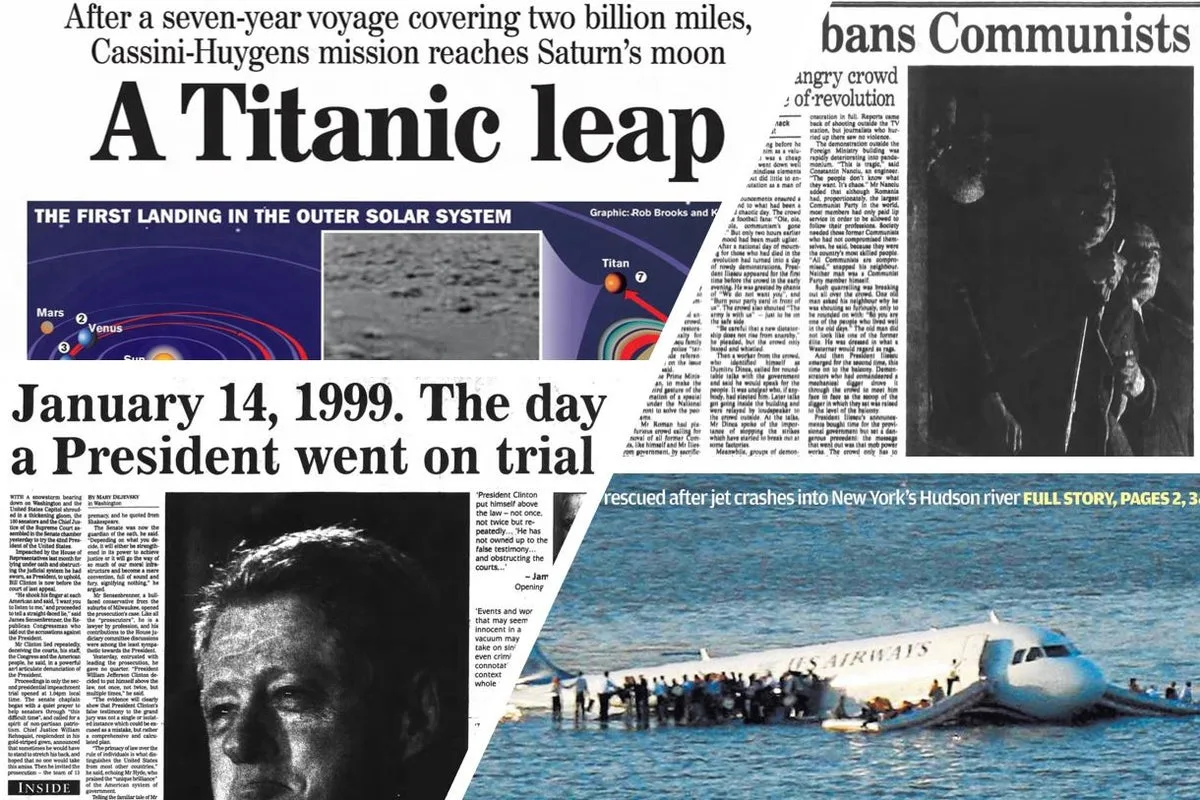
In stark contrast, a moment of jubilation unfolded in space exploration. On 15 January 2005, after a seven-year, two-billion-mile journey, NASA's Cassini–Huygens mission achieved a historic milestone. The Huygens probe successfully landed on Saturn's largest moon, Titan, marking the most distant soft landing ever accomplished.

Crises and Miracles: From the Skies to the Streets

Drama unfolded in the skies over New York on 16 January 2009. An Airbus A320, having struck a flock of birds, lost power in both engines shortly after take-off. In an extraordinary feat of airmanship, Captain Chesley Sullenberger guided the aircraft to a safe landing on the icy Hudson River. All 155 people on board survived, leading the event to be forever remembered as the "Miracle on the Hudson".

Earlier in the week, on 14 January 1988, a sobering health crisis came to light. Blood tests in New York revealed that one in every 61 babies born in the city was infected with HIV, highlighting the virus's spread beyond initial high-risk groups and raising alarms about transmission to newborns.

Political Upheavals and Legal Battles

The week was also a period of significant political change and controversy. On 13 January 1990, in the turbulent aftermath of Nicolae Ceausescu's execution, Romania's interim authorities banned the Communist Party, bowing to intense pressure from protesters.

In Britain, the long shadow of the Hillsborough disaster lingered. On 14 January 1992, the decision not to charge the sole police officer still under investigation was condemned by victims' families as a "whitewash", fuelling anger over the lack of accountability for the 97 deaths.

Across the Atlantic, Washington was gripped by a political storm. On 15 January 1999, President Bill Clinton faced impeachment proceedings in the US Senate, an event described as "The day a President went on trial." He was later acquitted in February.

The march towards war also accelerated. On 17 January 2003, UN inspectors reported finding a dozen empty chemical warheads in Iraq, a discovery that bolstered US claims and intensified the diplomatic standoff, leading to invasion weeks later.

These events, from the personal struggles of a young Prince Harry visiting rehab to the grand sweep of history, demonstrate how a single week can encapsulate the full spectrum of the human experience.