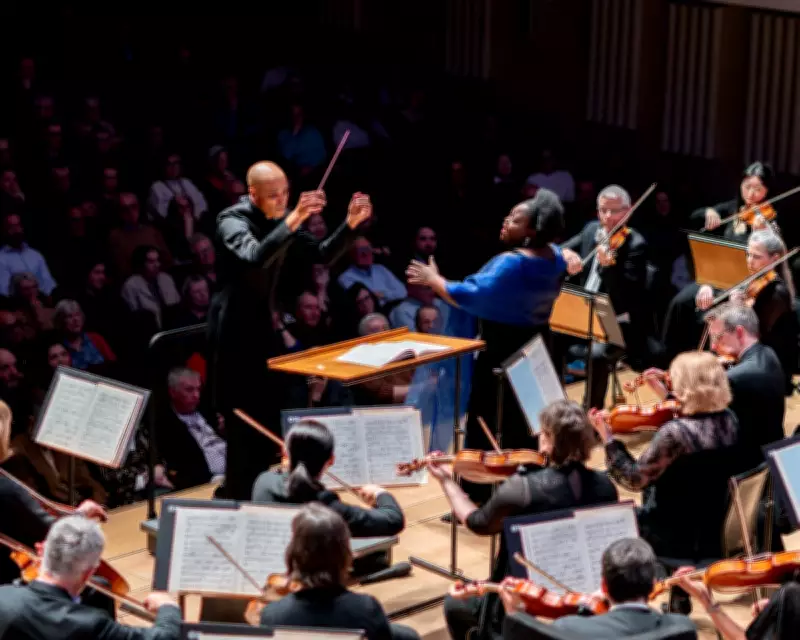
Masabane Cecilia Rangwanasha, the acclaimed South African soprano, joined conductor Kevin John Edusei and the Royal Philharmonic Orchestra for a performance of Richard Strauss's Four Last Songs at London's Cadogan Hall. The midweek concert drew a substantial audience, many eager to witness Rangwanasha's much-praised vocal talents firsthand.
A Soprano of Exceptional Promise
Rangwanasha, who won the song prize at the 2021 Cardiff Singer of the World competition and more recently the prestigious Herbert von Karajan prize at the Salzburg Festival, demonstrated why she is considered a rising star in the classical world. Her voice possesses a sumptuous, almost indecent beauty, coupled with a serious and thoughtful musicality that captivated listeners.
Her interpretation of Strauss's autumnal farewells to life, art, and love is still evolving, yet it showed clear signs of developing into a generational performance. In "Frühling," she conveyed a youthful, wide-eyed wonder with an airy delivery. The central songs were imbued with a backlit glow, which she allowed to suffuse and engulf the musical texture in the welcome release of "Im Abendrot."

Orchestral Shortcomings
Unfortunately, the Royal Philharmonic Orchestra's accompaniment proved inconsistent. The ensemble delivered an oddly pinched and poorly tuned account, often resisting the expressive invitations extended by conductor Kevin John Edusei. The composer's evanescent closing chords were landed with an unsubtle thump, detracting from the overall delicacy of the piece.
A lovely horn solo concluding "September" offered a brief glimpse of what might have been, suggesting a different, more harmonious possibility for the performance. However, this moment was an exception in an otherwise troubled orchestral backing.
Concert Opener and Beethoven's Revival
The concert began with Canadian composer Samy Moussa's 2024 work, "Adgilis Deda: Hymn for Orchestra." This piece was also plagued by intonation issues. Moreover, Moussa's filmic swells seemed constrained by the compact, 12-minute structure, struggling to earn their epic climaxes featuring gong and brass.
Following the interval, a transformed Royal Philharmonic Orchestra returned to the stage for Beethoven's Symphony No. 7. The ensemble was taut, energised, and precise, fizzing with kinetic charge. This account leaned into the work's wildness, discontinuities, and abrupt changes of direction.
Conductor Edusei exaggerated dynamics and speeds to create a dazzling, though often disconcerting, performance. The Rossinian scherzo verged on parody, while the finale exhibited a manic intensity, obsessively returning to fanfares that surged towards Beethoven's first-ever triple fortissimo. If the Strauss had the audience bidding farewell to life, this Beethoven provided the electric shock treatment that convulsively brought them back.
The evening at Cadogan Hall thus presented a stark contrast: a soprano of immense promise navigating the challenges of a classic song cycle with an orchestra not at its best, followed by a revitalised ensemble delivering a thrilling, if exaggerated, Beethoven symphony.